
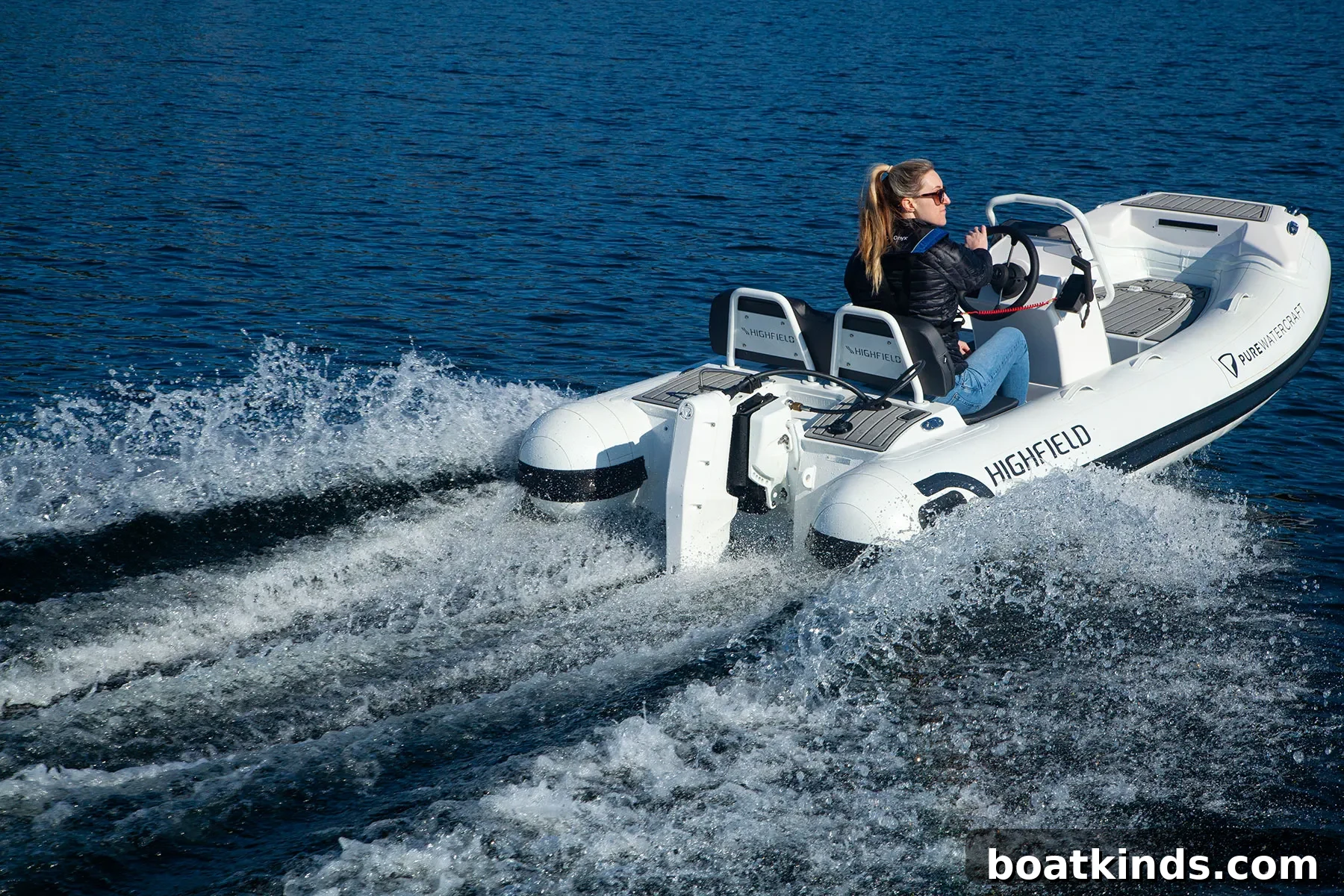
Once confined to chores like trolling and powering tenders, electric outboards are increasingly available with higher horsepower, bringing greater speed and capability to larger boats. But how far can electric outboards realistically take us? Advances in motor design are clear, yet battery capacity, cost and range—especially at high speed—remain the key hurdles.
Electric outboards offer many advantages: they run much quieter than internal-combustion engines, have fewer moving parts, require less maintenance, produce strong torque, are lighter in some configurations and emit no exhaust. These benefits make them appealing for leisure boaters, commercial operators and for use on environmentally sensitive waterways. Still, converting larger boats and long-range applications from gasoline to electric hinges on improvements in battery energy density, cost and charging infrastructure.
To understand the direction of electric outboard development, seven manufacturers shared their perspectives on current capabilities and what the future may hold.
TORQEEDO
Founded in 2005, Torqeedo is one of the most established names in marine electrification. The German company has delivered well over 100,000 electric inboard and outboard systems and offers a broad range of products, from ultralight motors for kayaks and canoes to Travel outboards for dinghies, Cruise motors in the 6–25 hp segment and higher-power 40- and 80-hp units for larger boats.
Torqeedo demonstrated twin 80-hp (50 kW) electric outboards during the 2013 Miami International Boat Show; those motors remain the company’s most powerful production offering. Torqeedo executives emphasize that building bigger motors is relatively straightforward—the central constraint is storing enough energy on board without excessive weight and cost. “The hard part was always to get enough capacity and low weight inside a boat to have sufficient range,” Torqeedo’s product management director said.
Battery technology has steadily improved: initially paired with a 12-kWh pack, Torqeedo’s systems have since been upgraded to batteries with much greater capacity. The company now offers a 40-kWh option that substantially extends range and enables more boats to consider electric propulsion. Torqeedo is also developing modular systems—branded Deep Blue—to support multiple battery, charging and motor configurations and is exploring range extenders using hydrogen or methanol to address long-range, high-speed use cases.
Meanwhile, Torqeedo sees immediate market opportunities where electric propulsion already makes practical sense: lakes and waterways with fuel restrictions, high-displacement low-speed vessels, efficient hulls such as pontoons, and locations where fuel availability is declining. In many of these situations, boaters can recharge with shore power or top up with solar, simplifying logistics compared with hauling gasoline.
EVOY
Evoy, founded in Norway in 2018, quickly gained attention when its inboard-powered 28-foot Evoy1 reached speeds above 55 knots, breaking the unofficial production electric boat speed mark. The company has focused on high-performance electric powertrains and currently sells powerful inboard systems while preparing to launch electric outboards.
Evoy’s upcoming Gale Force 120-hp outboard is expected to debut in the spring, with a 300-hp model slated for 2023 and a 400-hp outboard planned for 2024. Evoy’s CEO acknowledges the familiar constraint: battery storage limits range, and incremental improvements in cell chemistry, rather than a single disruptive breakthrough, are the most likely path forward. Using automotive-grade cells, Evoy expects steady gains similar to other electric sectors.
Evoy believes there is a significant market for higher-powered electric propulsion, particularly for efficient hulls or defined-use cases—rivers, lakes and many commercial applications—where long high-speed distances are not required. The company sees commercial users as an early growth segment, with broader leisure adoption following as battery costs decline.
PURE WATERCRAFT
Pure Watercraft has positioned itself as a performance-minded electric propulsion company and drew industry attention after a strategic investment from General Motors that provided access to EV technology. Pure demonstrated a pontoon prototype driven by two 50-hp electric outboards shortly after that announcement.
Pure’s founder and CEO argues that electric propulsion’s broader shift mirrors the automotive industry: as carmakers phase out internal combustion models, traditional fuel infrastructure changes, increasing the appeal of electric propulsion for boats that are typically filled at gas stations. He frames the transition around practical applications rather than simply horsepower—asking what owners want their boats to do and matching propulsion systems accordingly.
Pure expects incremental battery improvements—on the order of a few percent per year—rather than a near-term revolution in energy density. For many use cases, such as pontoons, well-designed electric drivetrains paired with appropriate batteries can provide all-day performance with lower energy consumption than an equivalent gasoline setup.
VISION MARINE TECHNOLOGIES
Canadian firm Vision Marine Technologies has evolved from building low-powered electric launches to developing high-performance electric outboards. The company introduced the E-Motion 180E, a 180-hp production electric outboard designed around a high-voltage architecture.
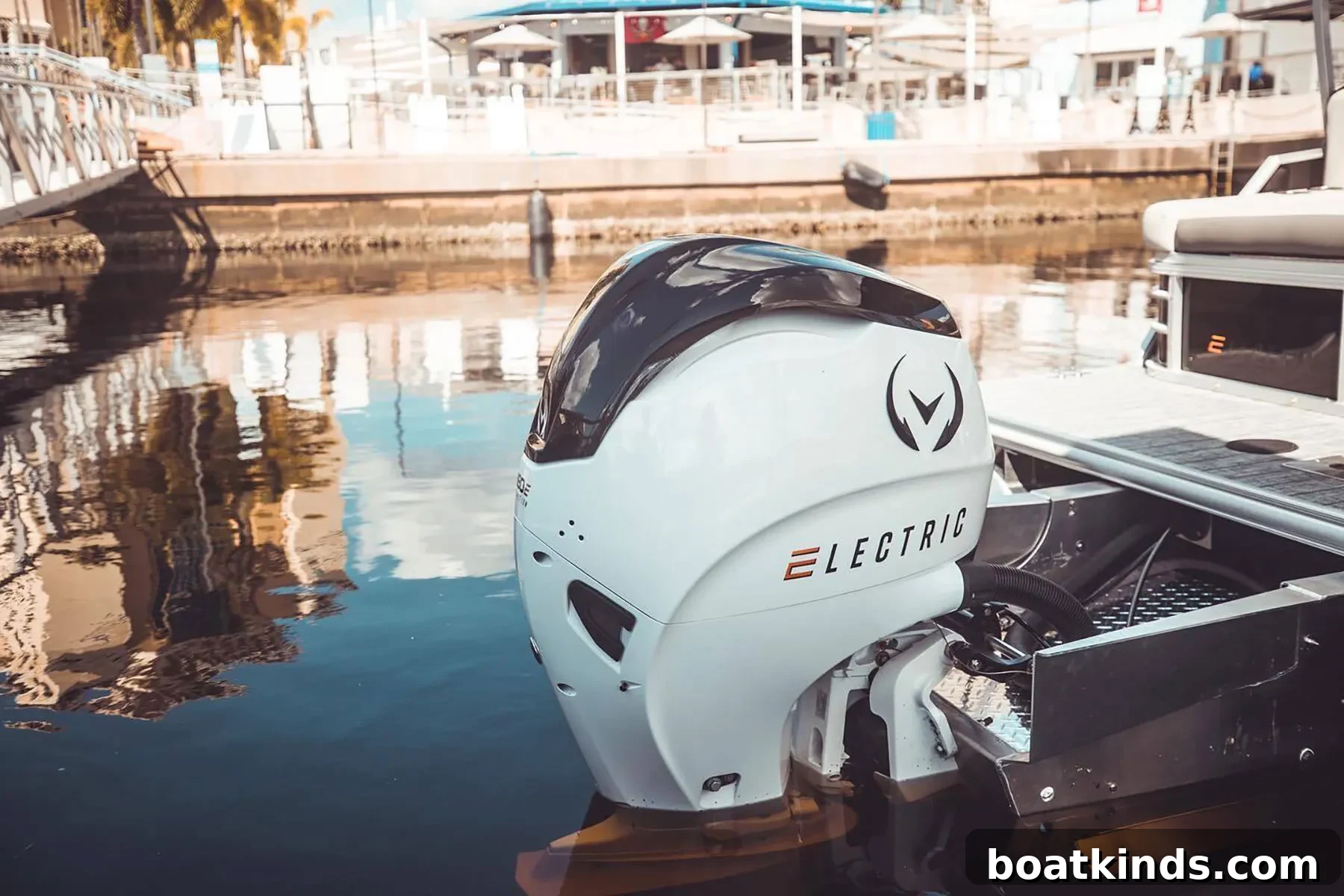
Initial specifications called for a 60-kWh battery capable of an estimated 70 nautical miles—or about 3.5 hours—at a cruising speed of 17 knots. Vision Marine later partnered with a battery supplier to create a 35-kWh marinized high-density power pack, and the company believes that future battery improvements and dual-battery configurations will continue to extend range. Demonstrations have shown promising performance, including sea trials exceeding 30 knots with passengers on board, though real-world range depends heavily on battery selection and operating profile.
FLUX
Flux Marine, based in Rhode Island, is targeting the 15–70 hp segment where it sees a practical opportunity today. The company has produced demo motors across that range and has been testing several battery suppliers to integrate proven packs rather than developing its own cells.
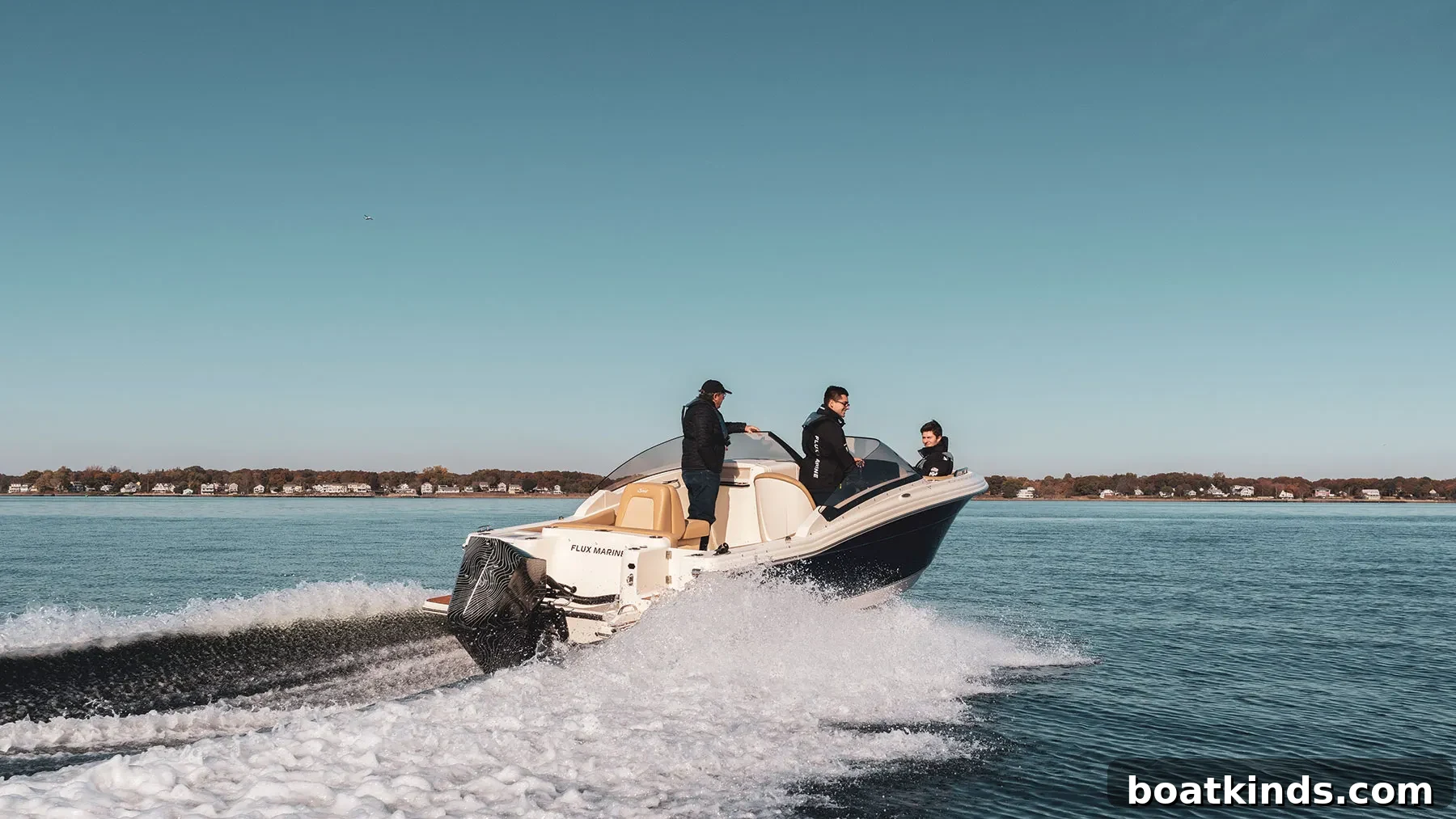
Flux’s leadership expects battery improvements to make larger systems practical over time but cautions against expecting multiplicative leaps overnight. They foresee electric outboards in the 100–300 hp range becoming increasingly viable as energy density improves, but remain realistic about limits when comparing marine demands to automotive or aviation applications: boats operate in a medium far denser than air, and offshore use cases require prolonged energy reserves.
YAMAHA
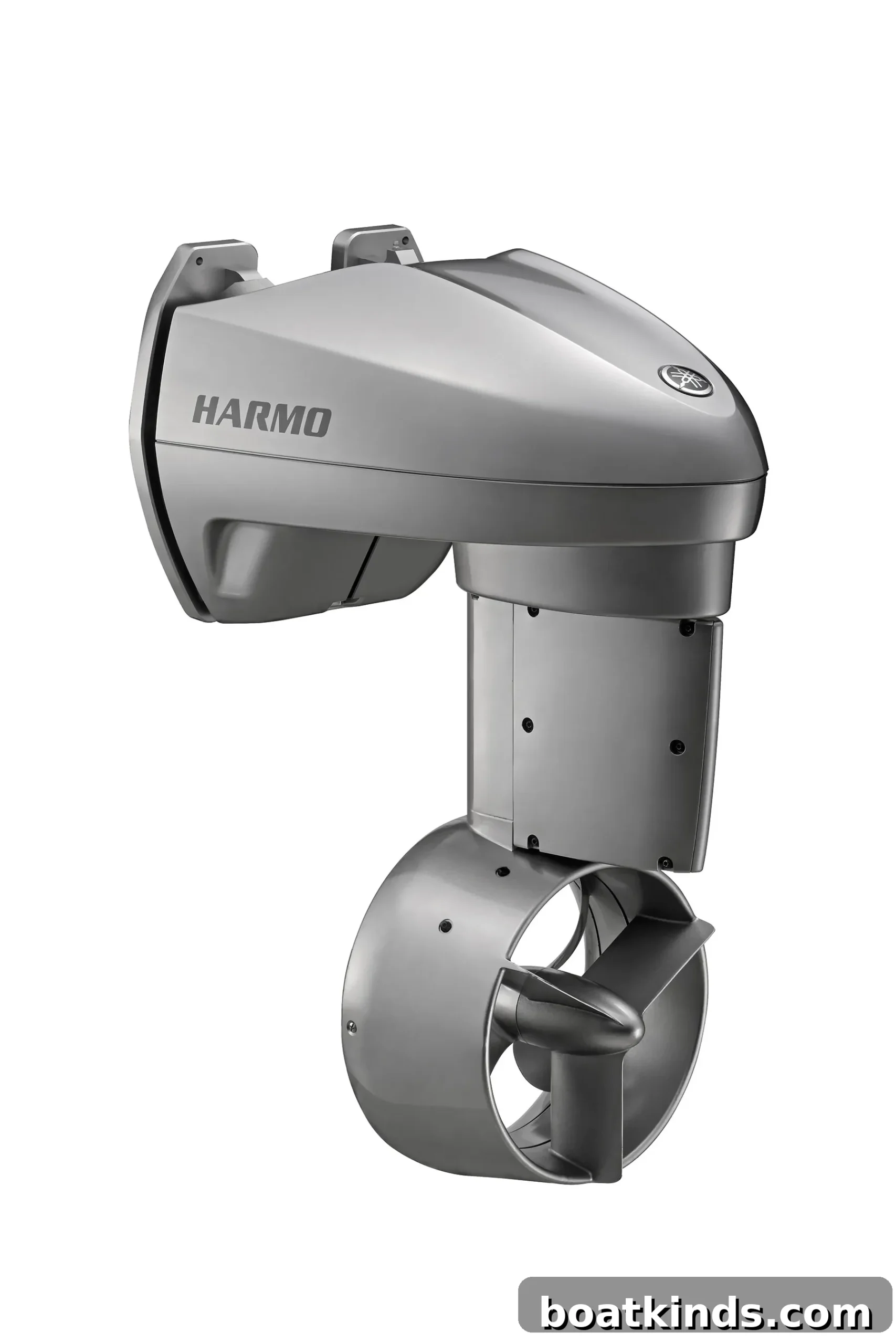
Yamaha Marine introduced its Harmo electric outboard system to the U.S. market after launching it in Europe. The Harmo employs a rim-drive motor and a compact 3.7-kWh power unit paired to a 48-volt supply, delivering thrust comparable to a conventional 9.9-hp engine. Yamaha positions the Harmo for regulated waterways and areas where internal-combustion engines are restricted.
Yamaha’s leadership has been candid about the limits of current batteries: building large electric motors is straightforward, but powering them with practical on-board energy for high-speed, long-distance use remains a major technical challenge that will take time to solve.
MERCURY MARINE
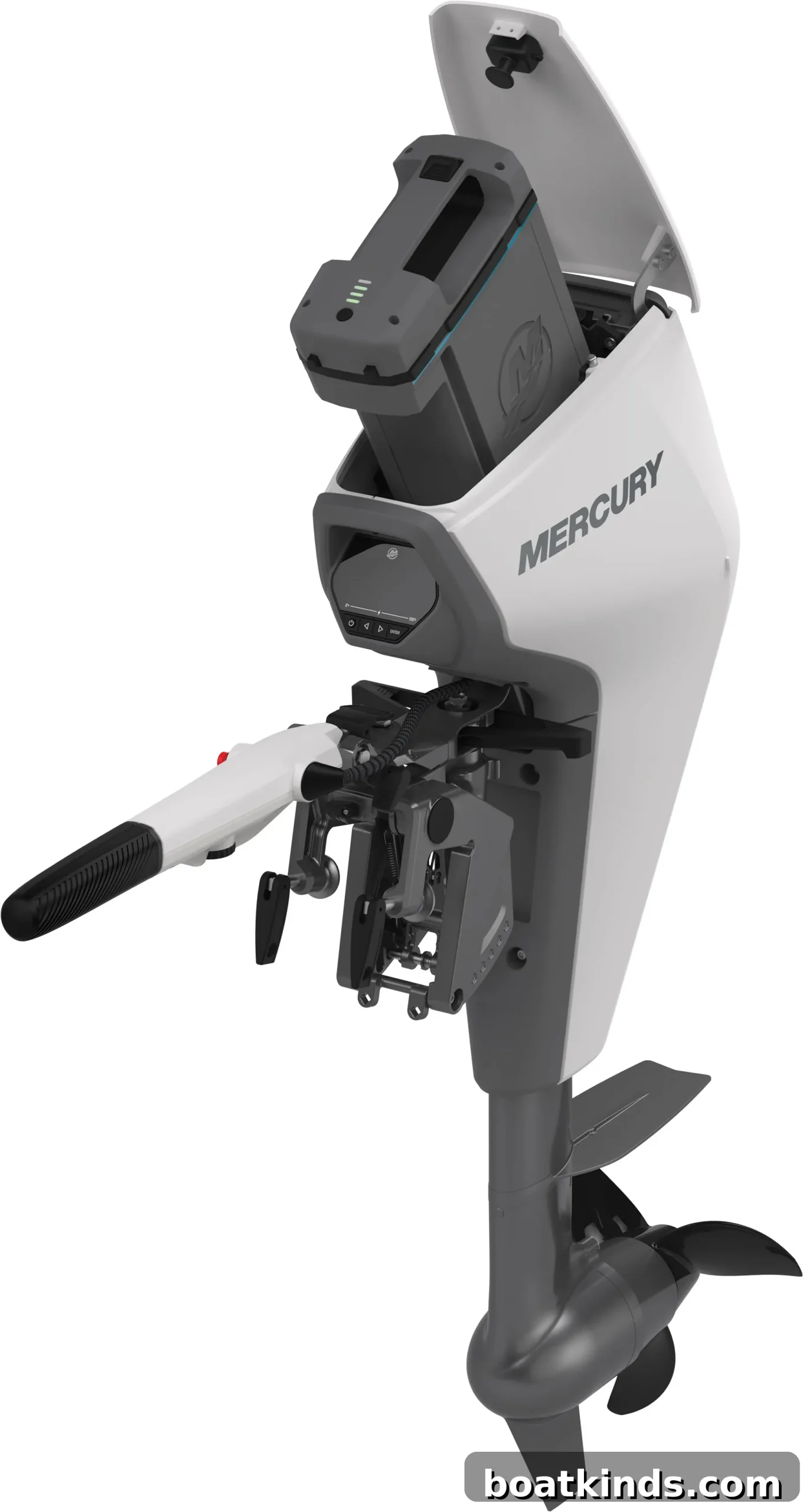
Mercury Marine has announced plans to enter electric propulsion and previewed the Avator electric outboard concept. The company emphasized ease of use, removable quick-charging lithium-ion battery packs and integrated displays that highlight battery state. Mercury’s initial product focus appears to target the lower horsepower segments to demonstrate commitment to electrification before moving into higher-power solutions.
Overall, manufacturers agree on several points: electric outboard motors are already practical and advantageous in many applications; higher-horsepower units are technically feasible; and the major limiting factor is energy storage—battery capacity, cost, weight and charging logistics. As battery technology advances and infrastructure improves, expect electric outboards to expand into more segments, but long-range high-speed electric propulsion for large offshore boats remains a longer-term challenge.
This article was originally published in the May 2022 issue.