
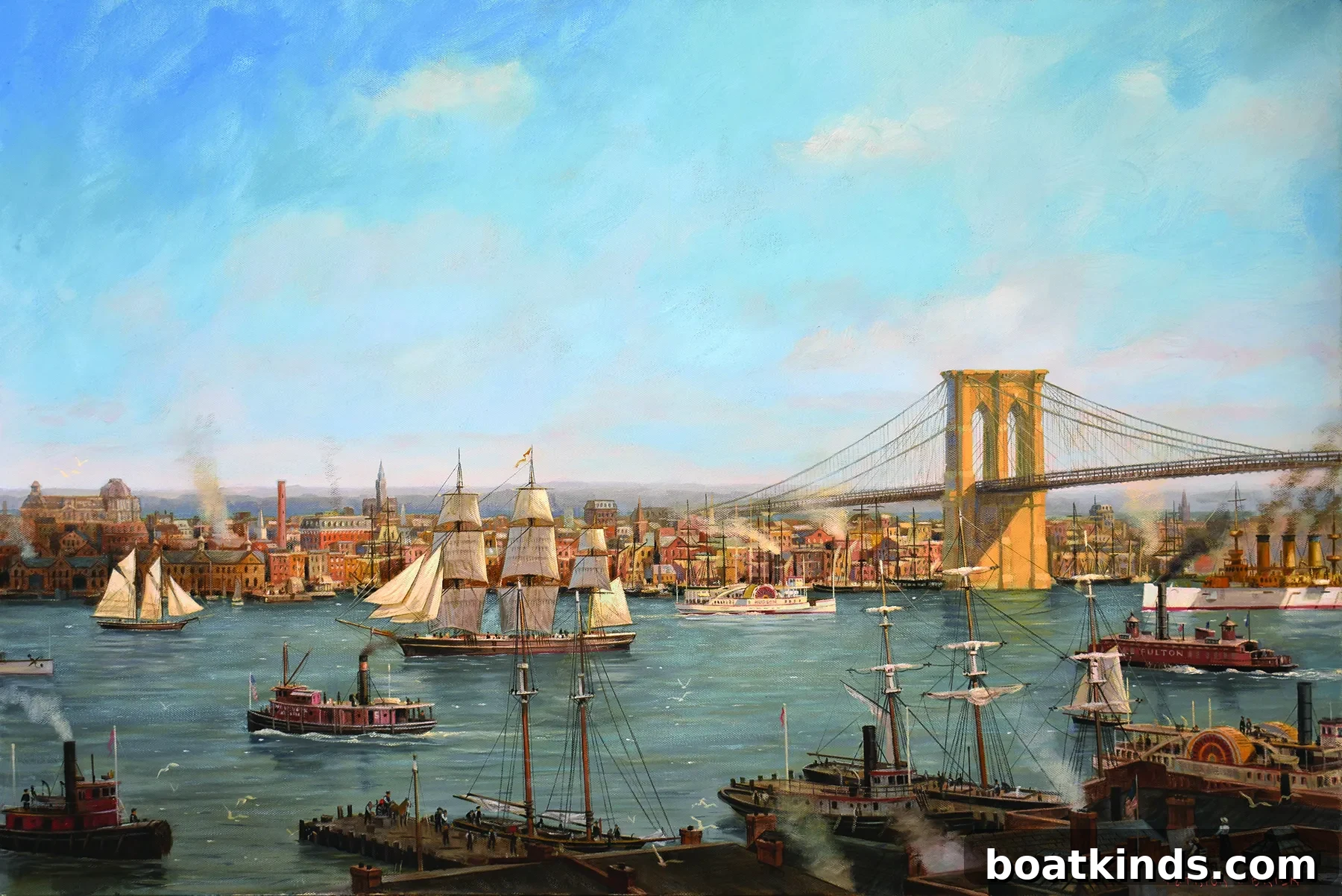
Patrick O’Brien’s “Empire City”: A Maritime Portrait of New York’s East River, 1899
In the painting “Empire City,” artist Patrick O’Brien presents a lively morning on New York’s East River in 1899. The composition captures a moment of transition: a battleship moves beneath the Brooklyn Bridge—whose twin towers were then the tallest structures in America—while the Fulton Ferry crosses toward Manhattan, its services beginning to fade in importance after the bridge’s completion. O’Brien’s work emphasizes the layered history of the waterfront, where sail and steam shared the same waterline.
A Moment in New York History
“Empire City” offers more than a scenic view; it freezes a unique moment in New York history when the harbor still hosted both traditional sailing vessels and newer steam-powered ships. That coexistence of technologies and types of craft is central to the painting’s appeal. The scene conveys the industrial energy and maritime traffic of the period—the mix of military, commercial and passenger craft that defined the working river. The Brooklyn Bridge stands as a dominant architectural symbol, a marker of change in the city skyline and of shifting transportation patterns.
The Artist’s Relationship with New York and Maritime Subjects
Patrick O’Brien has long been drawn to New York’s past. His fascination with the city’s maritime history is grounded in meticulous research and a visual memory for period detail. He studies old maps, photographs and prints to reconstruct accurate urban and nautical settings. For O’Brien, the era depicted in “Empire City” is especially compelling because it brought together sailing ships and steamships, creating visual contrasts and storytelling possibilities that he finds irresistible.
Raised in a family with naval ties—his father served in the Navy—O’Brien developed an early interest in ships and seafaring subjects. That background helped shape his artistic focus and informed his understanding of vessels, rigging and ship behavior on the water. His apprenticeship in related fields included work as a draftsman at a naval architect’s office, which reinforced his technical appreciation for ship design before he turned fully to illustration and fine art.
From Illustration to Maritime Painting
O’Brien’s professional path moved from scientific and illustrative work into the realm of maritime painting. After studying biology in college, he briefly worked in technical drafting and later enrolled in art school, where he decided to leave after two years when the program did not match his practical needs. He has described his career since then as entirely self-directed, building a freelance practice around historical and natural subjects.
As an illustrator, O’Brien produced historic and prehistoric scenes, wildlife art and children’s book illustrations for notable clients such as National Geographic, the Discovery Channel and the Smithsonian. One of his books, The Great Ships, allowed him to explore maritime topics in depth. Displaying some of his ship paintings at the Annapolis Marine Art Gallery marked a turning point: his work began attracting attention within the marine art community, and he increasingly focused on seafaring themes.
Research, Accuracy and the Creative Imagination
Though the scene in “Empire City” springs from O’Brien’s imagination, the elements within it are rooted in careful research. He checks historical records and visual references for each vessel he depicts, ensuring that hull shapes, rigging, superstructures and types of workboats reflect period-appropriate styles. The battleship, the ferry, the tugboats and smaller work craft in the painting are composed from genuine sources; nothing about the styles of boats or buildings is invented out of whole cloth.
At the same time, O’Brien exercises creative license in how he assembles these elements. The arrangement of ships, the specific interactions on the water, and the pictorial balance are artistic choices meant to convey atmosphere, motion and the rhythm of harbor life. The result is a convincing historical tableau that still reads as an evocative, painterly scene rather than a strictly documentary print.
A Baltimore-Based Maritime Artist
Now based in Baltimore, Maryland, Patrick O’Brien continues to bridge imaginative composition with historical accuracy. His maritime paintings attract viewers who appreciate both the romance of classic seafaring imagery and the authenticity of well-researched detail. O’Brien’s approach—combining personal interest, family ties to naval life, technical drafting experience and years of illustration work—gives his paintings a distinctive voice in contemporary marine art.
“Empire City” stands as an example of how maritime painting can preserve and interpret urban and nautical history, offering viewers a richly textured glimpse of New York’s waterfront at the turn of the 20th century.
—Carly Sisson
This article was originally published in the September 2022 issue.