
Hal Roth, who died at 81, left behind a rich legacy of books and films chronicling the early days of Pacific cruising and a lifetime of sailing adventures. Together with his wife Margaret, he turned voyages into stories, beginning in 1966 when they slipped the lines in their first yacht named Whisper and set off from San Francisco for a bold cruise that Hal already envisioned as a book.

“His idea was for us to circumnavigate the Pacific,” Margaret Roth remembers. “It makes a good story, better than just wandering around.” That voyage became the basis for Two on the Big Ocean and launched a series of books that documented their cruises around Cape Horn, across the Mediterranean and ultimately around the world. They filmed many of their journeys as well.
For his final work, while battling terminal lung cancer, Hal chose a subject that required no passage at sea. Handling Storms at Sea, published by McGraw-Hill less than a month after his death at home in Easton, Md., in late October, distilled decades of seamanship into practical guidance for sailors facing extreme weather.
When the Roths first met in San Francisco in 1959, neither of them was a sailor. Margaret had come from England on a visit; Hal, originally from Cleveland, had left school to join the Army Air Corps during World War II, later graduated from the University of California, Berkeley with a degree in journalism, studied photography with Ansel Adams, and worked as a freelance writer for national magazines. They married in 1960 and, living among friends who owned sailboats, decided to learn to sail themselves.
The couple built their skills through charters and lessons—testing the water in the West Indies, scrutinizing an experienced captain with questions, sailing in Greece and taking lessons in Scotland. In 1962 they bought a 35-foot steel sloop in Holland and shipped it to the United States, only to find it cramped for extended cruising. Later, while living in Sausalito and searching for a more suitable yacht, they fell in love with a fiberglass Spencer 35 in Seattle, purchased a stock hull in Vancouver, completed the finishing work themselves, and sailed her home to California.
Roth had published his first book, Pathway In The Sky, about the John Muir Trail in 1965, and was already planning the Pacific circumnavigation that would define their next years. That trip became a template for many of the Roths’ future expeditions and is vividly remembered by Margaret. Their first long passage, from Sausalito to the Marquesas, took 23 days and came before electronic navigation—so sextant sights and dead reckoning guided them. “Every day you would take a sight and mark a little X on the chart,” she says. The uncertainty and the eventual reward—approaching an island and finding it exactly where your navigation predicted—remain unforgettable in an age of GPS and chartplotters.
As early cruisers in the South Pacific, the Roths often found themselves the only yacht in a harbor. Their first landfall in the Marquesas was on an uninhabited island, where towering volcanic cliffs, lush greenery and waterfalls created dramatic scenery. Nearby huts housed friendly islanders, and a skilled carver sold them a ceremonial sword and later brought fresh fruit and vegetables. When he revealed a toothache, Hal used a dentist’s kit kindly given to them before the voyage to perform emergency dental work.
They met fellow cruisers in Tahiti, arriving for Bastille Day to find celebrations that carried on for a full week with dancing, rowing, javelin throwing and basket weaving. In the Cook Islands their boat, Whisper, doubled as a mail carrier, laden with packages bound for the next island. In Samoa they learned local customs and social rhythms—in one island group women were comfortable baring their breasts yet kept their knees covered—and in the Wallis Islands they joined in dances to celebrate a new church, tacking on their own lively version of the boogie-woogie to the traditional performances.
Their route took them north to Guam and on toward Japan. In Kagoshima Bay they watched a volcano erupt, scattering pumice across the sea. As they sailed up the Japanese archipelago they were welcomed into private homes, shared meals aboard Whisper, and traded stories that appeared in local newspapers. From Japan they continued to Alaska’s Aleutian Islands, crossed the Gulf of Alaska, followed the coast of Canada and finally passed under the Golden Gate Bridge to return home—completing 18,538 miles in 19 months.
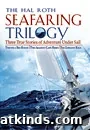
Hal and Margaret Roth went on to sail many thousands more miles. Hal completed two single-handed circumnavigations in competitive races and recorded those voyages in additional books. In total, Roth published a dozen works that enrich the literature of cruising and single-handed sailing, including a compilation volume containing three of his titles.
This story originally appeared in the February 2009 issue.