
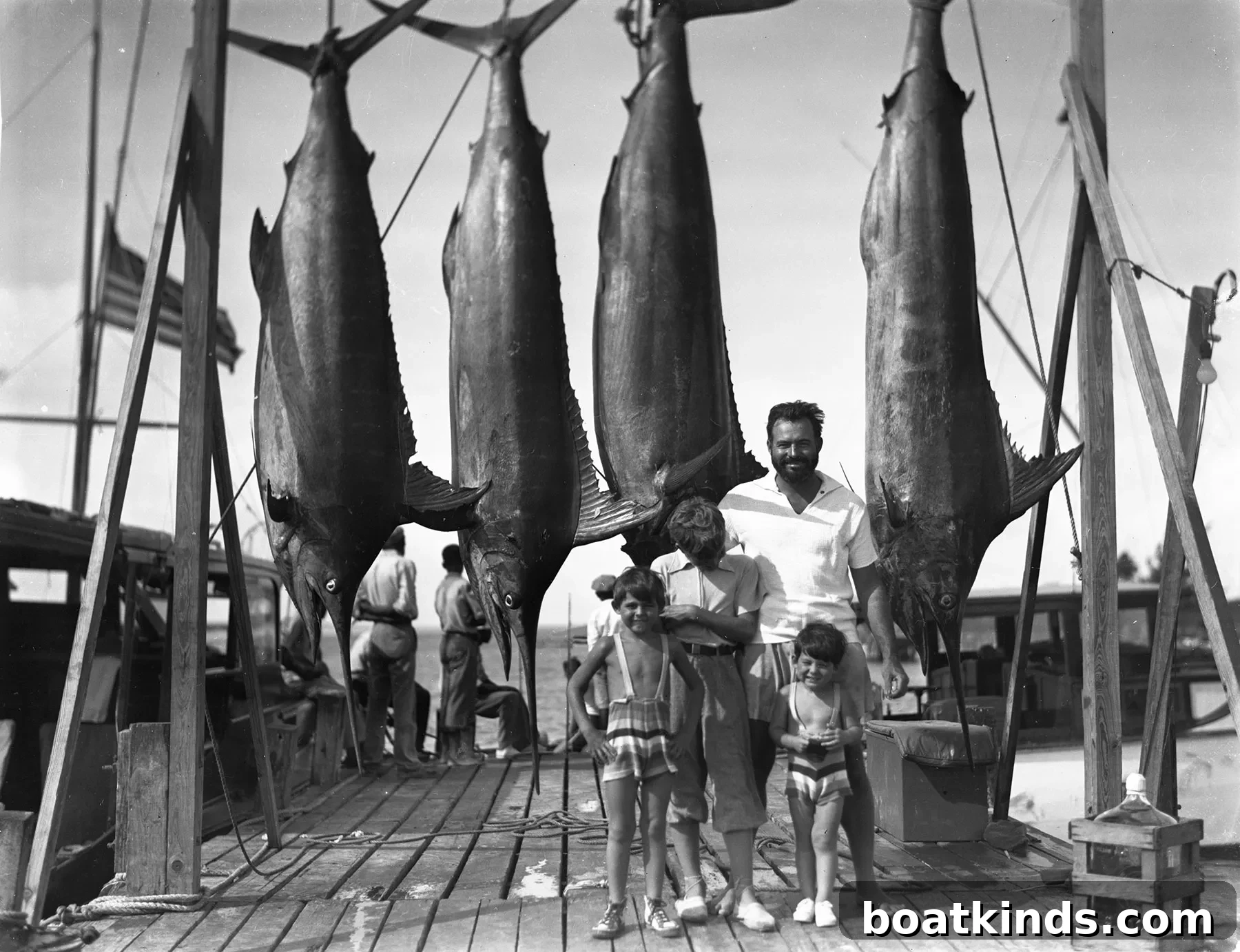
Ernest Hemingway and the Pilar: A 1935 Marlin Catch in Bimini
Ernest Hemingway—affectionately known as “Papa,” a nickname he acquired in Paris during the 1920s—is a central figure in 20th-century American literature. The Nobel Prize in Literature–winning author created enduring works such as The Sun Also Rises, A Farewell to Arms, For Whom the Bell Tolls and The Old Man and the Sea. A lifelong fascination with the sea and big-game fishing threads through much of his fiction, and the photograph above is a vivid testament to that passion.
Taken in 1935 after a memorable day aboard Hemingway’s boat Pilar, this image captures the author and his three sons—Jack, Patrick and Gregory—possession of a remarkable marlin off Bimini in the Bahamas. The Pilar served as both a practical vessel for deep-sea fishing and a creative retreat, where Hemingway combined relentless pursuit of sport fish with careful observation of the ocean’s drama.
Marlin, Sharks, and the Reality of Deep-Sea Fishing
Marlin catches like this were impressive on their own, but they also reveal the harsh realities of open-ocean sportfishing. Once a fish was hauled in and the commotion began, sharks often converged within minutes. If an angler could not play and land the catch quickly, sharks would rapidly strip the fish down to the backbone. Many anglers of that era returned to the dock with only halves of fish or skeletons with a few scraps of meat still attached—a common and frustrating outcome in those waters.
This danger and unpredictability of the sea informed both Hemingway’s real-life adventures and his fiction. The physical struggle against a powerful marlin, and the subsequent scramble to protect a prized catch from sharks, formed an elemental conflict that the author repeatedly explored. The photo from Bimini offers a snapshot of that struggle resolved in favor of success—at least for the moment.
The Old Man and the Sea: Life Imitating Art
The events depicted here have a direct echo in The Old Man and the Sea. In that novella, Santiago—a weathered Cuban fisherman—sets out alone in a small skiff into the Straits of Florida and hooks an enormous blue marlin. Santiago battles the fish with a handline for three days, demonstrating endurance, respect for the fish, and a deep, almost spiritual connection to the sea. When he finally brings the marlin alongside his skiff and begins the journey home, the fish’s blood draws sharks that strip the marlin down to its skeleton, leaving Santiago to return with little to show for his epic struggle.
Hemingway drew on his extensive experience in the Caribbean and along the Florida Straits when creating Santiago and his ordeal. The novel captures the physical demands of big-game fishing, the ever-present threat of predators, and the emotional consequences of losing what one has fought so hard to attain. Readers can clearly see how moments like the 1935 Bimini catch inspired the themes and realism of the book.
Legacy of the Pilar and Hemingway’s Sea Life
Hemingway’s relationship with the sea extended well beyond sport. He spent many years living and writing in Cuba, where fishing formed an essential part of daily life and literary inspiration. The Pilar—his familiar fishing craft—served as both a setting for adventure and a symbol of a lifestyle that blended solitude, skill, and risk. Photographs such as this one preserve a public record of those pursuits and help explain why maritime imagery appears so strongly in his work.
Whether viewed as a family moment, a sporting achievement or a piece of literary history, the 1935 photograph from Bimini offers a clear window into Hemingway’s world. It shows the author at ease on the water, surrounded by his sons, celebrating a hard-won catch against the ever-present threats of the deep. That combination of triumph and peril is precisely what fuels the drama in many of his best-known stories.
This article was originally published in the November 2021 issue.