New England Coast Guard Rescue Report — May 2010
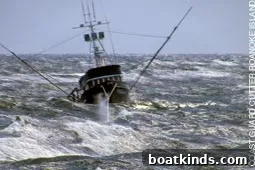
HEAVY-WEATHER TOW — The 55-foot fishing vessel Wahoo, home-ported in Kodiak, Alaska, nearly disappeared beneath a large swell on May 3 while being towed by the Coast Guard cutter Roanoke Island. The tow took place about 14 miles south of Pearl Island in 20-foot seas with 35-mph winds, a reminder of how quickly ocean conditions can overwhelm even seasoned mariners.
South Portland: 26-foot Bayliner Taking on Water (May 16)
A Coast Guard rescue crew assisted three people after their 26-foot Bayliner began taking on water near Cape Porpoise, Maine. Sector Northern New England received a distress call by cellphone at about 1:30 p.m. and immediately advised the boaters to don life jackets while rescue units mobilized.
Responders from Coast Guard Station South Portland launched a 25-foot response boat and arrived at the scene at 2:05 p.m. They found the Bayliner was flooding at roughly three gallons per minute. To control the inlet, the rescue team used a dewatering pump in addition to the vessel’s bilge pumps. Once flooding was stabilized, the Coast Guard towed the boat to safety at Caco Marina.
This incident underscores the value of prompt reporting, life jacket use, and basic dewatering equipment aboard recreational vessels. Quick actions by both the boaters and the Coast Guard prevented a more serious outcome.
Boston Area: Two Rescued from a Sinking Boat (May 12)
Several Coast Guard units and the Plymouth harbormaster responded after a mayday call from a small recreational vessel taking on water about two miles east of Plymouth Harbor, Massachusetts. The event unfolded in the early morning hours, when crews from multiple stations coordinated to save two men from Kingston, Mass.
At 2 a.m., a 47-foot rescue boat from Coast Guard Station Point Allerton recovered one man clinging to Buoy 5 near the harbor. A short time later, around 2:30 a.m., an HH-60 Jayhawk helicopter aircrew from Air Station Cape Cod located a second man. The second man was recovered unconscious; rescue personnel aboard the Point Allerton boat administered CPR and transferred him to awaiting paramedics.
Both men were wearing life jackets when rescued. The recreational 15-foot boat ultimately sank. Weather conditions at the time included an air temperature of 46°F, water temperature around 57°F, and winds near five miles per hour. Multiple Coast Guard stations — Cape Cod Canal, Provincetown, Point Allerton — along with Air Station Cape Cod and the Plymouth harbormaster, coordinated the response, illustrating how rapid multi-unit cooperation can be critical during night rescues.
Nantucket: Overboard from Fishing Vessel (April 27)
An Air Station Cape Cod HH-60 Jayhawk helicopter crew hoisted two fishermen from the water approximately two miles east of Sankaty Head Light off Nantucket. The rescue unfolded in the early morning hours when crew aboard the 60-foot clam dredge Silver Fox reported that a deckhand had fallen overboard shortly before 5 a.m. That crewman was not wearing a life jacket or a survival suit. A second crewman donned a survival suit and jumped in to assist, and both were later found in the water as the disabled Silver Fox drifted because a hose had fouled the propellers.
Coast Guard Sector Southeastern New England at Woods Hole received the distress call at 5:04 a.m. The Jayhawk launched at 5:22 a.m., and Station Brant Point dispatched a 47-foot motor lifeboat at 5:28 a.m. The helicopter arrived on scene at 5:40 a.m., deployed a rescue swimmer, and hoisted both men. They were transported to Nantucket Cottage Hospital. One of the recovered fishermen was reported to be in recovery; the other later died.
The 47-foot motor lifeboat reached the scene at 6:10 a.m. and provided assistance to the Silver Fox. A nearby fishing vessel, the Mandy Lynn from New Bedford, towed the disabled Silver Fox back to port for repairs. At the time of the incident, winds were 5 to 10 knots, seas were under 1 foot, and the water temperature was about 55°F.
Key Takeaways
These incidents from the New England coast highlight several recurring themes: the importance of wearing life jackets, the benefits of quick distress reporting, and the effectiveness of coordinated multi-unit Coast Guard responses. Whether facing heavy-weather towing, a slowly flooding recreational boat, or an overboard emergency from a commercial fishing vessel, preparedness and rapid action are essential to saving lives on the water.
This article originally appeared in the New England Home Waters section of the July 2010 issue.