
Harold Burnham’s passion for wooden boats keeps a tradition alive
For master shipwright and charter captain Harold Burnham, building and sailing traditional wooden boats is more than a craft — it’s a way of life and a mission to preserve Essex, Massachusetts’s maritime heritage. Burnham, an 11th-generation boatbuilder and a 2012 National Heritage Fellowship recipient, has devoted his career to keeping Essex’s boatbuilding traditions alive in a town where that culture is rapidly fading.
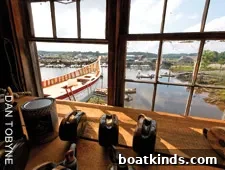
“The culture here is maritime-based — based on trade and fishing,” Burnham explains. “Today that maritime culture is disappearing quickly. Any way we can hold on to it is important.” His approach has been practical and communal: teach as many people as possible how these boats were made, involve the community in their construction, and use the boats on the water so people can experience them firsthand.
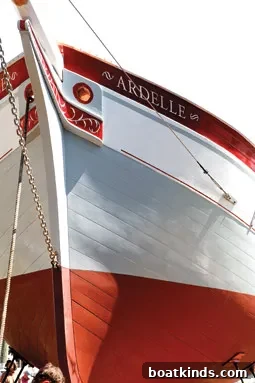
One vivid example of that approach was the launch of the schooner Ardelle on July 9, 2011. When the two-masted Pinky slid down the ways at the H.A. Burnham yard, some 2,000 people cheered — many of them volunteers who had given their time rather than pay, drawn by a desire to learn, contribute and celebrate a living piece of maritime history.
Volunteers like Zachary Teal, who at 15 became the youngest worker on Ardelle, remember Burnham as a patient teacher and a passionate builder. Teal, now a freshman at Maine Maritime Academy, credits the experience with shaping his work ethic and his interest in boats. “If you really want to do something, you’ve got to work hard,” he says. The teamwork that built Ardelle also created a strong sense of ownership and pride among the volunteers — many of whom now crew the schooner on day sails out of Gloucester, Massachusetts.
Burnham’s commitment to sharing knowledge has helped revive awareness of Essex’s traditional “heavy-construction” schooner techniques. Two decades ago, only a handful of people knew how to build an Essex schooner; Burnham opened his yard and his methods to others, ensuring that hundreds of people have since seen and learned the craft.
Over 23 years Burnham has built six wooden vessels that reflect regional fishing and workboat designs:
• Kim — a 22-foot sloop launched in 1990, used for lobster charters.
• Thomas E. Lannon — a 65-foot twin-masted Fredonia-style fishing schooner launched in 1997 for charter service from Gloucester.
• Lewis H. Story — a 30-foot two-masted Chebacco fishing schooner launched in 1998 as the Essex Historical Society and Shipbuilding Museum flagship.
• Fame of Salem — a 50-foot Chebacco fishing schooner launched in 2003 as a replica of a War of 1812 privateer-style boat, now chartering from Salem.
• Isabella — a 38-foot mid-1800s-style two-masted fishing schooner launched in 2006 for private cruising.
• Ardelle — a 58-foot, 49-passenger Pinky fishing schooner launched in 2011 that runs day cruises and helps support the shipyard’s operations.
Building six traditional wooden boats over two decades is a labor of love that on its own is difficult to sustain financially. Ardelle, however, was intended to change that balance by combining shipbuilding with a charter business: the boats themselves showcase the yard’s work while generating income through sails and public engagement. “By running the shipbuilding and charter businesses together, one hand feeds the other,” Burnham says.

The shipwright’s life began long before Ardelle. A Massachusetts Maritime Academy graduate, Burnham spent six years at sea in the merchant marine and continued building boats in his spare time. When family life made a full-time seafaring career impractical, he returned to shipbuilding and to skippering charter vessels to make ends meet. Ardelle emerged after a string of canceled orders left him with timber and materials on hand — he decided to build a boat that would both pay the bills and rekindle public interest in wooden schooners.
Essex’s boatbuilding legacy runs deep. Burnham’s family traces its boatbuilding roots back to the mid-1600s, and in the 19th century Essex yards produced an astonishing number of wooden vessels. The town’s access to quality timber and its close ties with Gloucester’s harbor made it a regional hub for building schooners that supplied the fishing industry. As steel and fiberglass replaced wood and the fishing industry contracted after World War II, traditional wooden boatbuilding declined — a gap Burnham has worked to narrow.
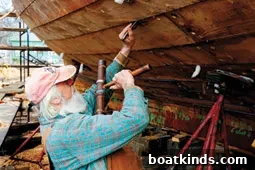
Burnham learned from the remaining master builders in town, studied historical photos and drawings, and absorbed the craft through hands-on practice. He mills white oak and locust in his own sawmill, carves half-models, lofts and frames hulls, makes trunnels (wooden pegs used for fastening), builds masts and rigs, and installs engines when needed. His focus is on the robust “Pinky” and similar heavy-construction schooners, built with double-sawn frames and wooden fastenings that, when maintained, can outlast many modern materials.
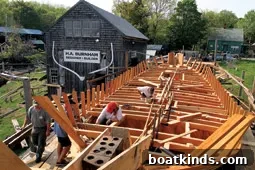
“Wooden fastenings will last indefinitely,” he says. Teaching techniques like driving trunnels is central to keeping the craft alive; many people who have visited the yard have tried the work themselves. Burnham’s two children, Alden and Perry, grew up in the boatyard, helping on projects and learning the history and skills that shape their family’s life. Both contributed to Ardelle’s construction and continue to play roles in the business.
Community remains central to Burnham’s success. Volunteers were fed generously and treated as part of the crew; their labor and camaraderie were essential to launching Ardelle and to sustaining the yard through lean periods. The result is a living classroom where maritime history is both preserved and put into practice through sails, apprenticeships and public engagement.
Dan Tobyne photos
More information: www.schoonerardelle.com
More on the H.A. Burnham yard and its services: www.burnhamboatbuilding.com
See related article: A magical boatyard
April 2014 issue