
Hinckley 35 Review: A Modern Outboard Dayboat Blending Tradition and Performance
On a bright late-summer afternoon in Newport, Rhode Island, the harbor hums with activity: tourists stroll the waterfront, shipyard crews detail and varnish yachts, and weekday boaters steal a few hours to enjoy the water. The air is humid and the breeze light after Hurricane Henri, but the harbor still offers enough motion to keep dinghy sailors entertained. It’s an idyllic August scene as we head from the harbor into Mackerel Cove to test Hinckley’s newest model, the Hinckley 35.
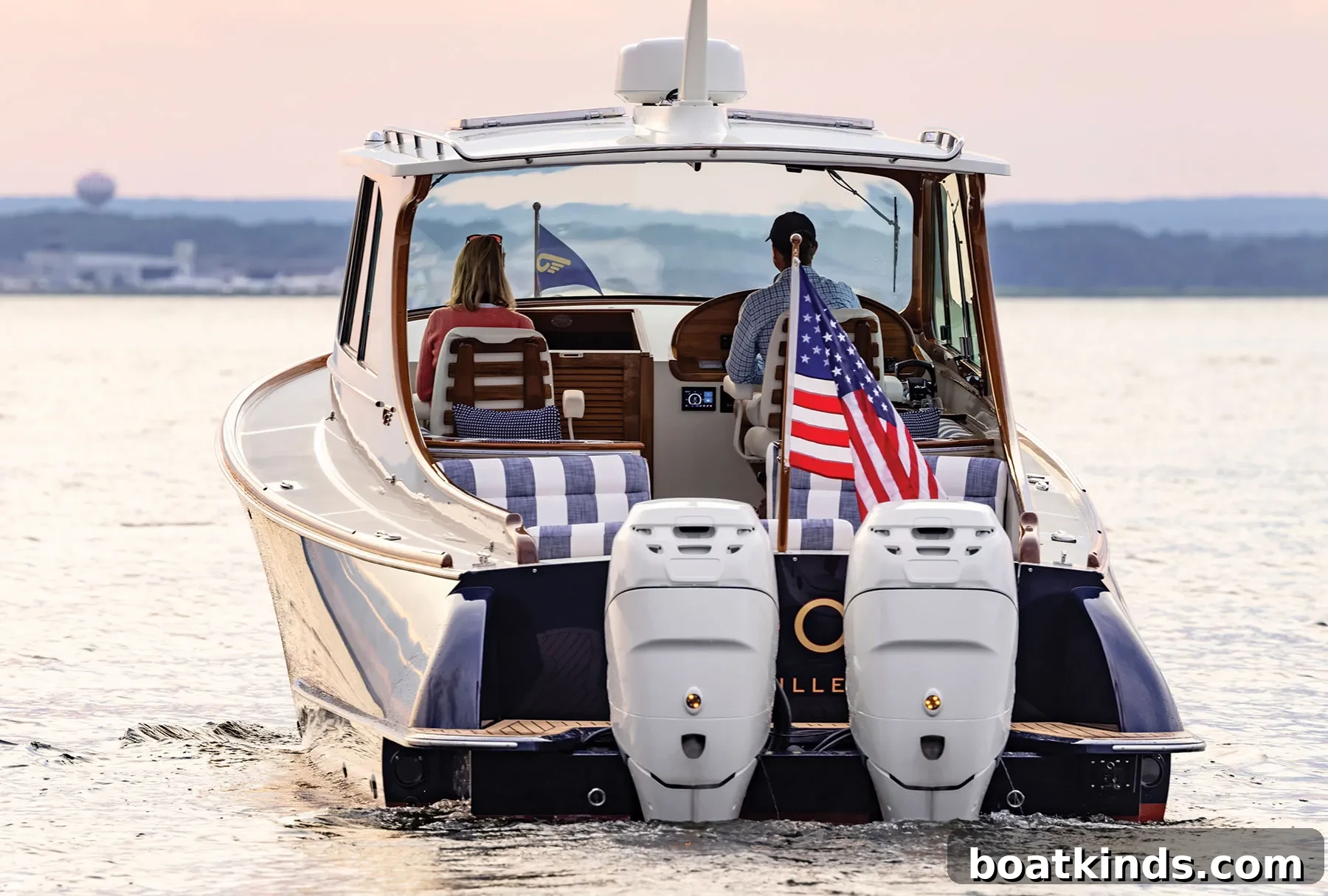
Basking in the sun, the Hinckley 35 displays the builder’s polished brightwork and classic lines that echo the brand’s heritage. The 35 is clearly related to Hinckley’s iconic Picnic Boat introduced in 1995, but it embraces a different kind of propulsion: twin outboard engines. The test boat wears twin 350-hp Mercury Verado outboards; the standard package lists twin 300-hp Yamaha or Mercury Verado outboards. For some long-time Hinckley enthusiasts—particularly those familiar with the company’s jet-driven Picnic Boats—outboards represent a notable shift. For Hinckley, however, the choice reflects the company’s broader history with powerboats.
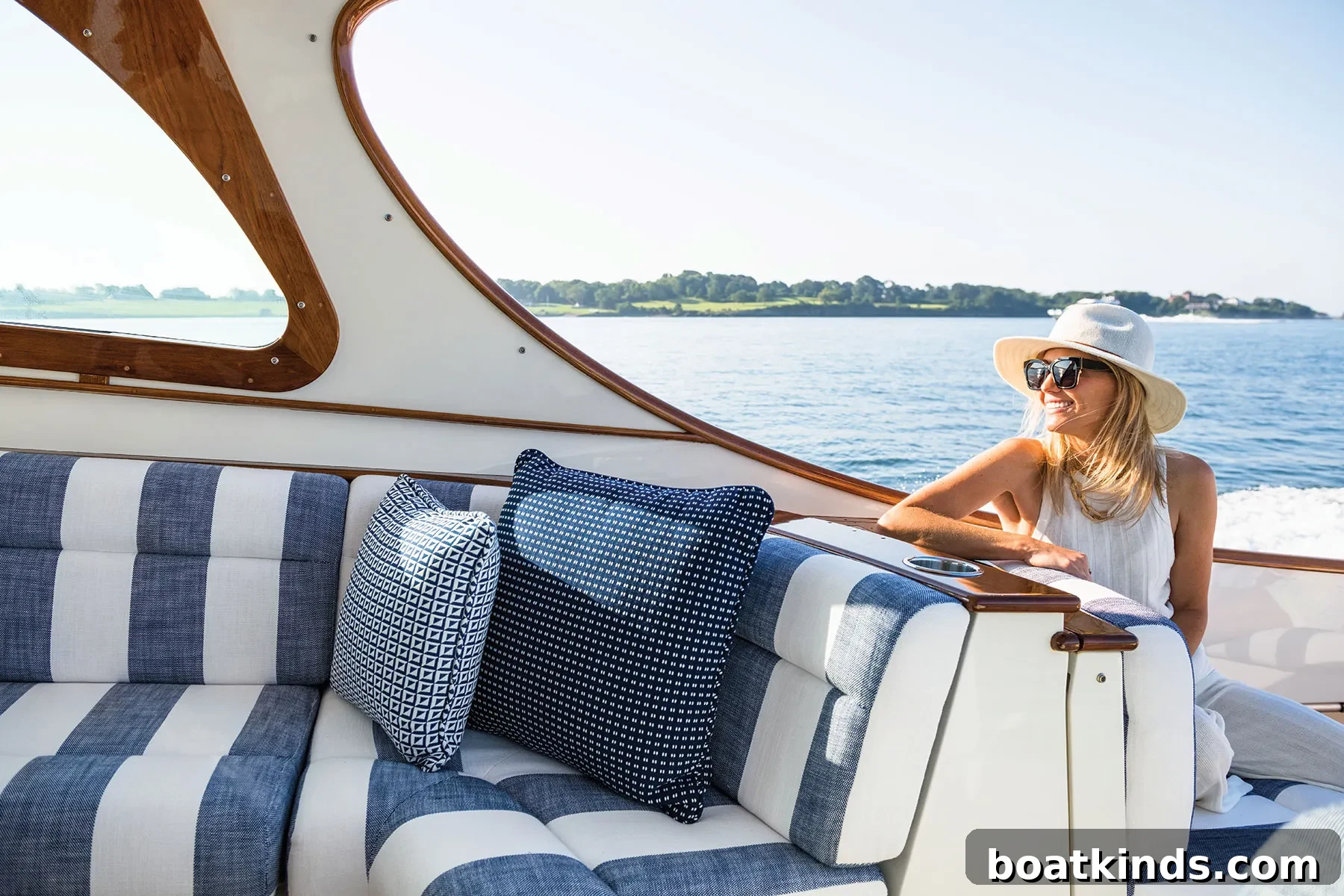
Scott Bryant, Hinckley’s vice president of sales and marketing, points out that Hinckley’s reputation includes both sail and power boats. Before the Picnic Boat and the brand’s well-known jet drives, the shipyard built a range of powered craft—including military workboats and midcentury runabouts like the 15-foot Kingfisher, which could be fitted with outboards. That lineage informed the design choices that led to the outboard-powered Sport Boats introduced in 2018 and now the new 35.
“The Hinckley 35 is an intersection of outboard power and the best possible Hinckley experience,” Bryant says. “It’s the evolution.” The company stresses that the 35 is not a Picnic Boat; jet propulsion remains core to that model family. Instead, the 35 is engineered from the keel up to maximize the advantages of outboard power.
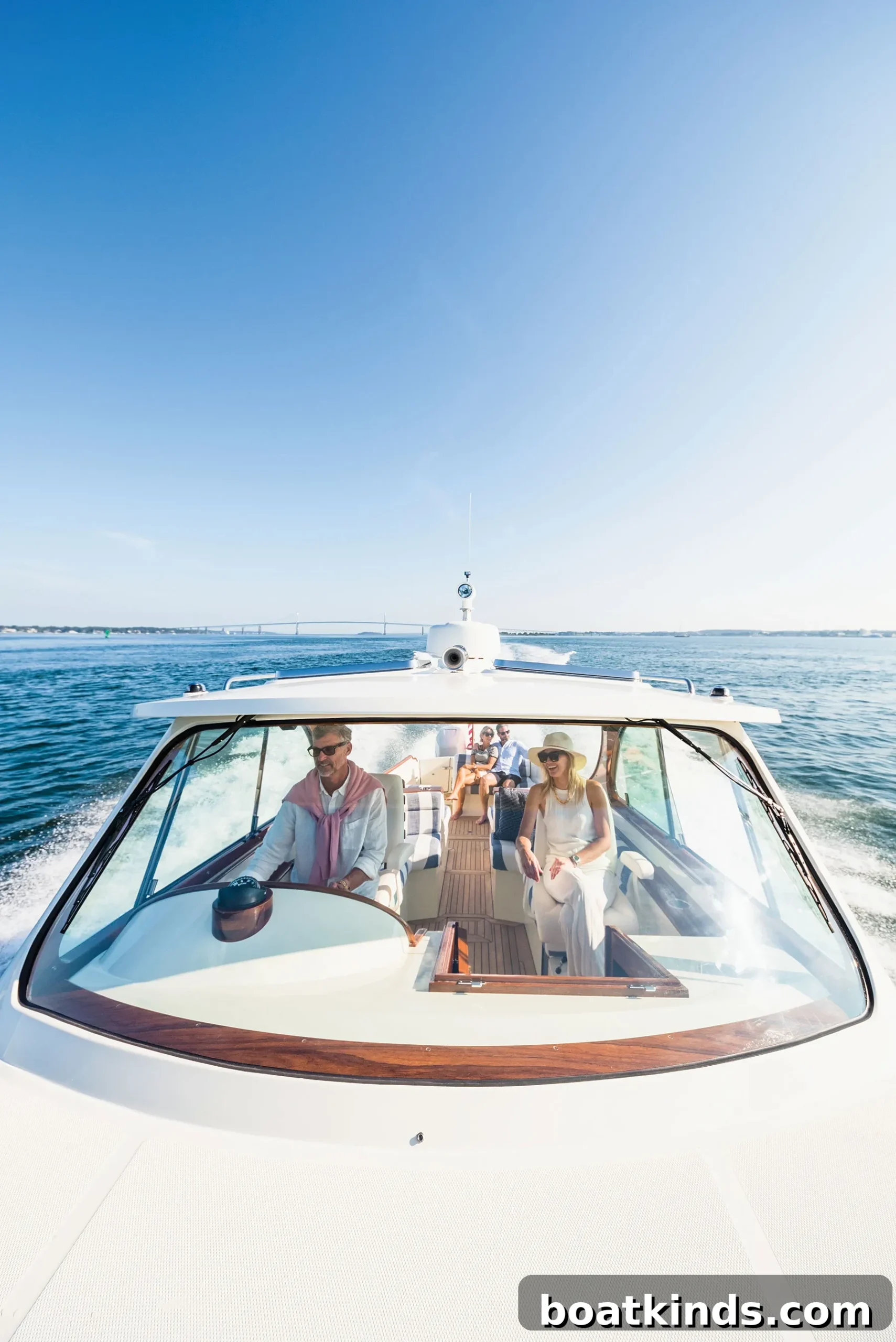
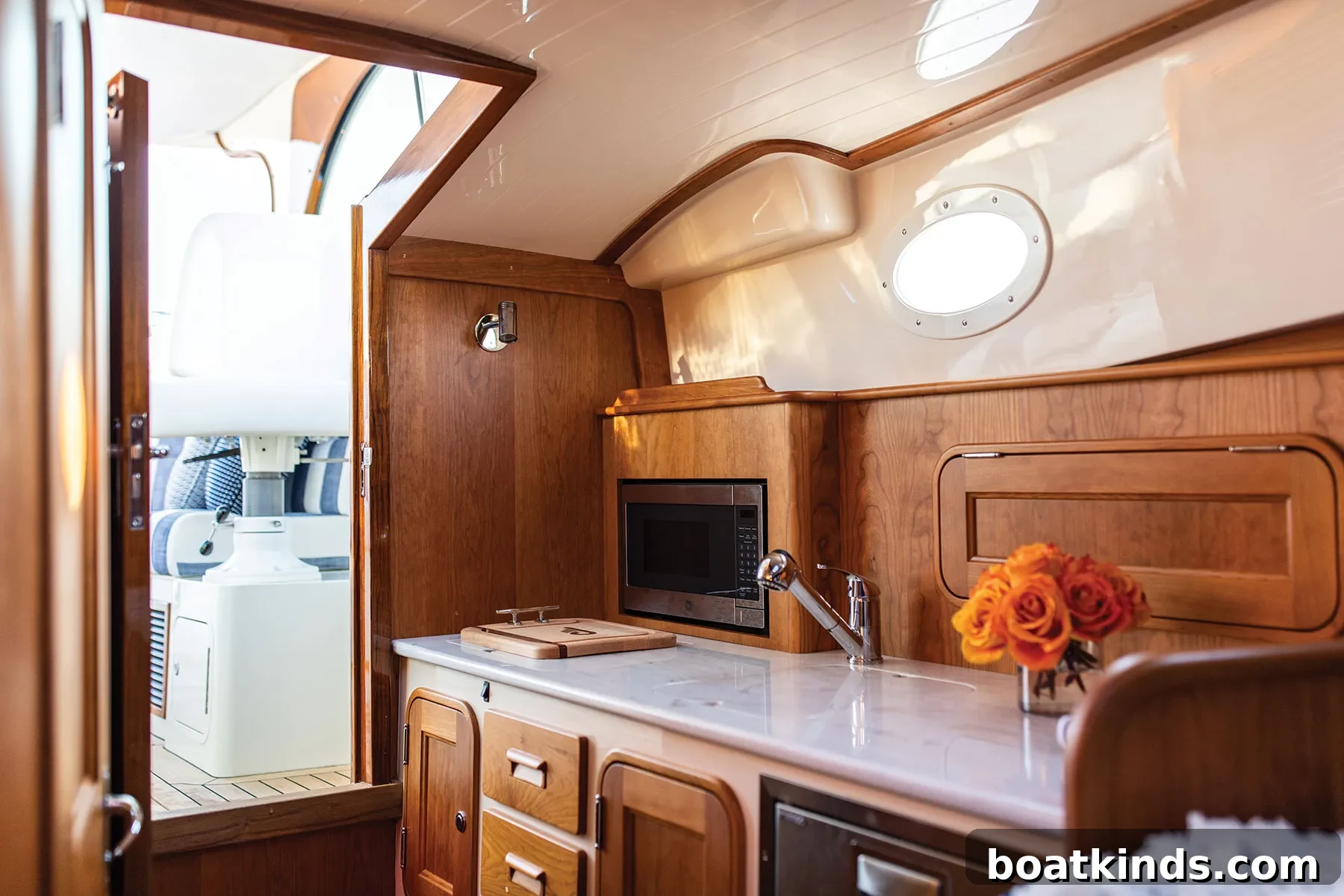
Naval architect Michael Peters, who has shaped every Hinckley hull since 2008, designed the 35’s hull with wide chines and pronounced strakes to provide lift, stability and predictable handling. The hull uses infused carbon epoxy construction for strength and durability. Underway, the 35 feels solid in 2- to 3-foot head seas; sharper chop delivers sudden impacts, but overall the hull dampens motion well. A small, telling detail: after completing our performance run and reducing to neutral, a vase of roses left on the galley counter in the forward cabin remained upright, an unambiguous sign of the boat’s steadiness.
Belowdecks, the cabin is compact yet comfortable for a couple spending a night aboard or for shelter from the sun. A scissor berth sits forward, the head is on the starboard side, and a small galley with a stovetop, refrigerator, sink and microwave is to port. Storage is integrated throughout the cabin to keep gear organized. Headroom requires a modest duck on entry, but the interior layout makes efficient use of available space.
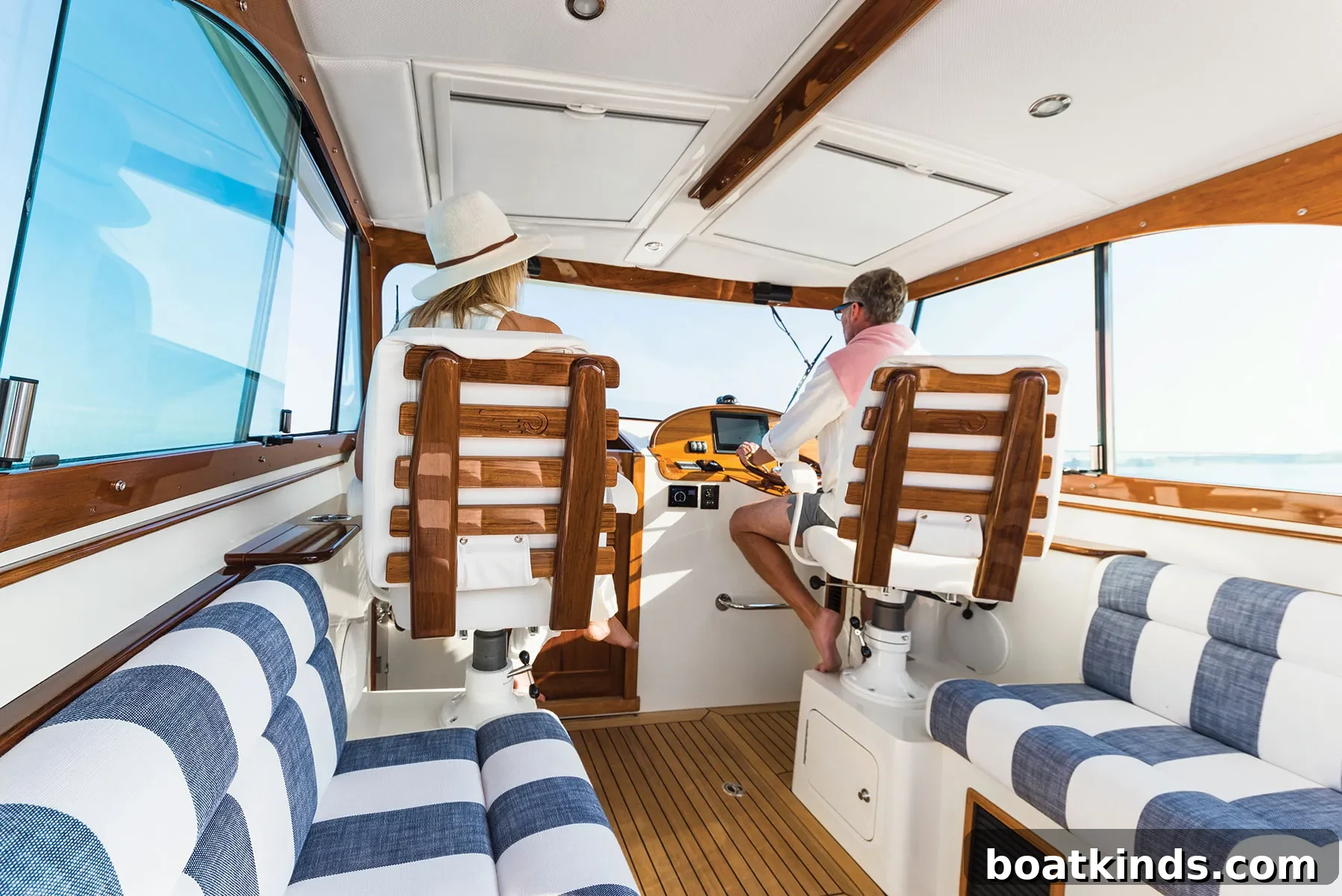
One of the most notable aspects of the Hinckley 35 is its noise mitigation. The chemically bonded hull, together with a large cockpit that separates the helm from the engines, lowers vibration and reduces airborne noise. Conversations at the wheel remain comfortable even at speed, and the outboard configuration is surprisingly quiet compared with many other outboard-driven dayboats.
Outboard propulsion also gives the 35 a performance edge over comparable jet drives. During testing we recorded a top speed of 40.1 knots, a touch under Hinckley’s published figure of 41.7 knots. Beyond top speed, the outboards free up valuable midships volume. Where a jet drive and its supporting systems would normally sit, the 35 offers a spacious stowage locker that lifts with the press of a button. That space is large enough for electric scooters, foldable furniture, inflatable paddleboards and other dayboat toys, and it provides easy access to the optional Seakeeper stabilizer—an important convenience for families who want to bring gear and play on the water.
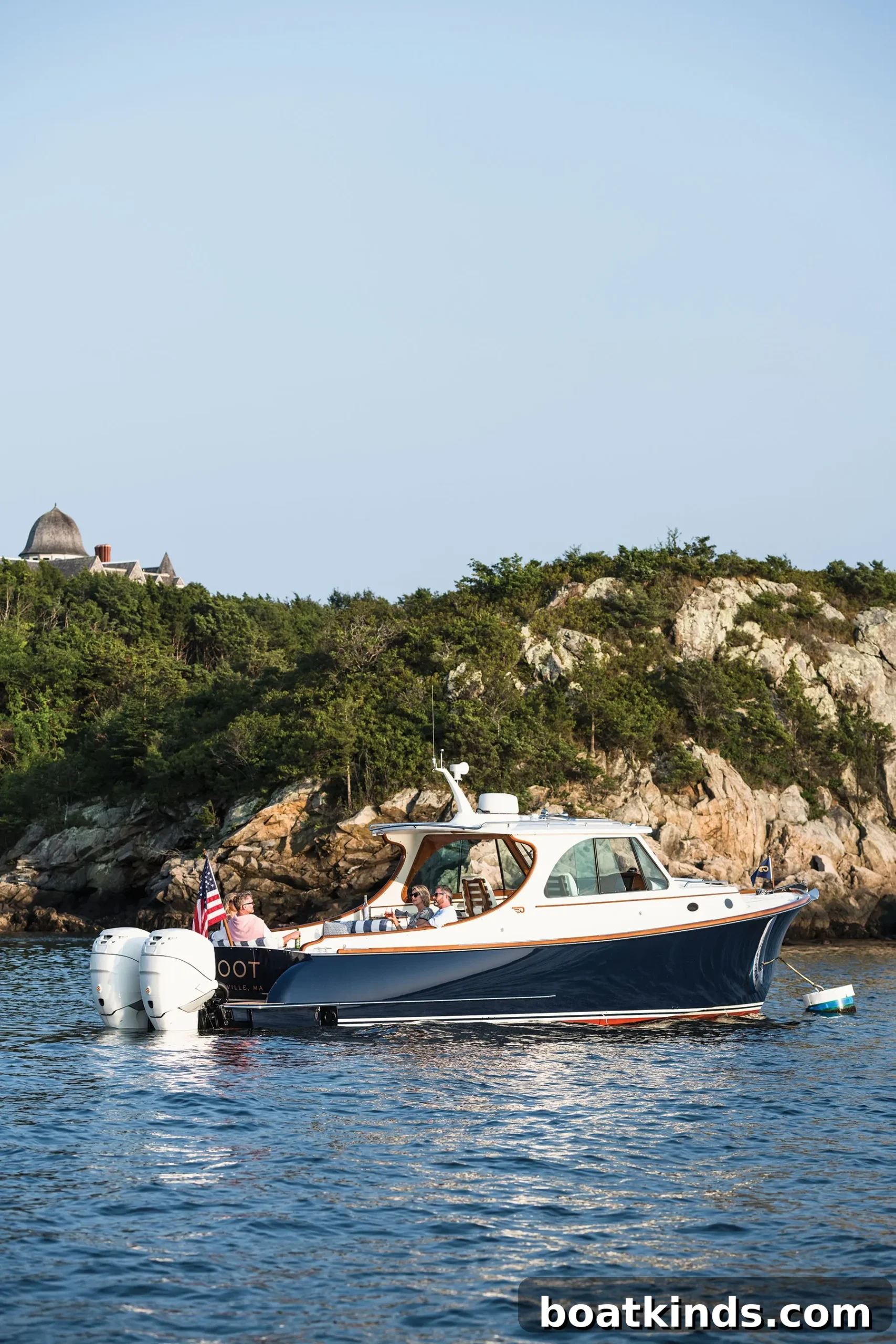
Perhaps the most significant outcome of adopting outboards is the broadened appeal. The 35 has drawn interest from a younger and more diverse group of buyers; of the first 13 hulls sold sight unseen, most orders came from new-to-Hinckley customers. Deliveries are slated for locations across the country, including Florida, California, New England and the mid-Atlantic. “There’s an acceptance and knowledge about outboards, and that’s comfortable for some owners,” Bryant says. “These are people who have always wanted a Hinckley, and now we don’t have to train them in jets.”
As we ease back into the marina, navigating heavy harbor traffic, the Hinckley 35’s ClearView single-pane windshield enhances sight lines and makes close-quarters maneuvering straightforward. I asked Bryant whether traditional Hinckley owners had pushed back on the idea of outboards on a design that visually recalls a classic. His response was simple: the market has embraced the change.
Some loyal owners may resist change, Bryant notes, but many Hinckley owners view their boats as cared-for assets to be passed on to the next keeper. From that perspective, outboard propulsion has practical advantages: simpler repowering and potentially longer useful life for the hull, making it easier for future generations to enjoy time on the water.
Specifications:
LOA: 38’8”
Beam: 11’
Draft: 2’10”
Displ.: 13,174 lbs.
Fuel: 300 gals.
Water: 35 gals.
Standard Power: (2) 300-hp Yamaha or Mercury Verado Outboards
This article was originally published in the November 2021 issue.