
Upgrading Your Boat Alternator: How to Size and Choose the Right Unit
When you increase the size of a boat’s battery bank or switch to a different battery chemistry, the engine alternator often needs an upgrade to match the batteries’ charging requirements. Selecting the correct alternator is not simply a matter of choosing the highest-amp unit available; it requires calculating the battery bank’s acceptance rate and matching the alternator’s output so the batteries can be recharged efficiently and safely.
On sailboats this calculation can be especially important. Many sailors deliberately limit engine run time to reduce fuel use and noise, which typically leads to deeper discharges of the house battery bank. Deeper discharges increase the amount of charging current required to restore the bank in a reasonable time, so upgrades need to be matched to real-world usage rather than theoretical capacity alone.
As a general guideline, aim for an alternator that can deliver an output equal to the maximum acceptance rate of the house battery bank. Typical recommended sizing is roughly 25% of total amp-hour capacity for conventional flooded batteries, about 30% for gel batteries, and around 45% for AGM or thin-plate pure lead types. For example, a 400 Ah AGM house bank would suggest an alternator capable of supplying close to 180 amps under peak recharge conditions. These figures are starting points; actual needs should be calculated from the battery bank’s cumulative amp-hour rating, the battery manufacturer’s stated charge acceptance characteristics, and the amount of engine run time you plan to allow.
Different battery chemistries and constructions accept charge at different rates. Flooded lead-acid batteries, gel cells, absorbed glass mat (AGM) and thin-plate pure lead batteries all have distinct bulk-charge behaviors when deeply discharged. Some chemistries ask for higher currents during the bulk phase, while others require gentler, more controlled charging profiles. Choosing an alternator without accounting for these differences can result in undercharging, excessive engine run time, overheating the alternator, or prematurely aging the batteries.
Factory or stock alternators supplied with marine engines are often based on automotive designs: they include an internal regulator and provide a linear output that rises with engine speed. That means more current is available the faster the unit spins. A modern upgrade option is a custom alternator fitted with a “smart” regulator. Smart regulators can maximize charging efficiency at lower engine speeds, and can be programmed or selected to follow specific voltage and charging curves suited to your battery chemistry. This improves charge efficiency and can reduce the need to run the engine at wide-open throttle simply to push current into the bank.
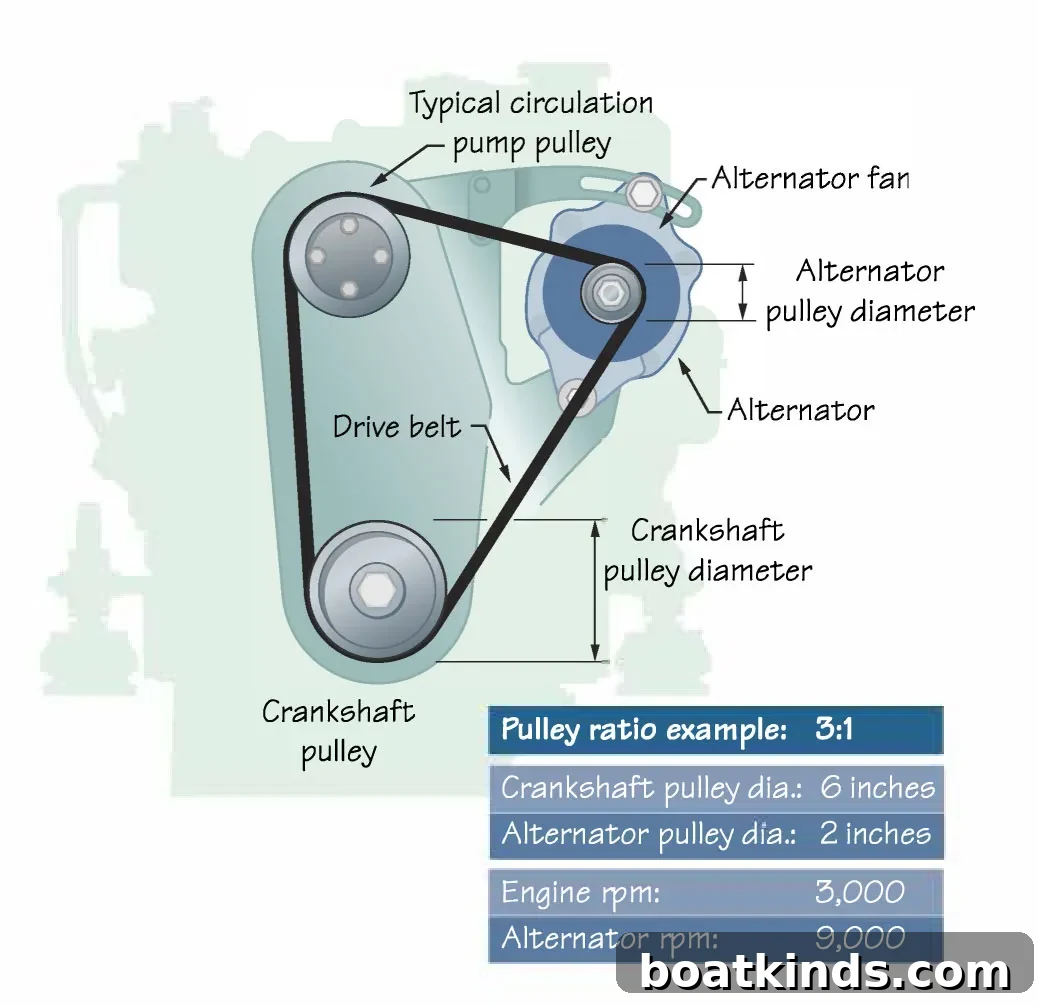
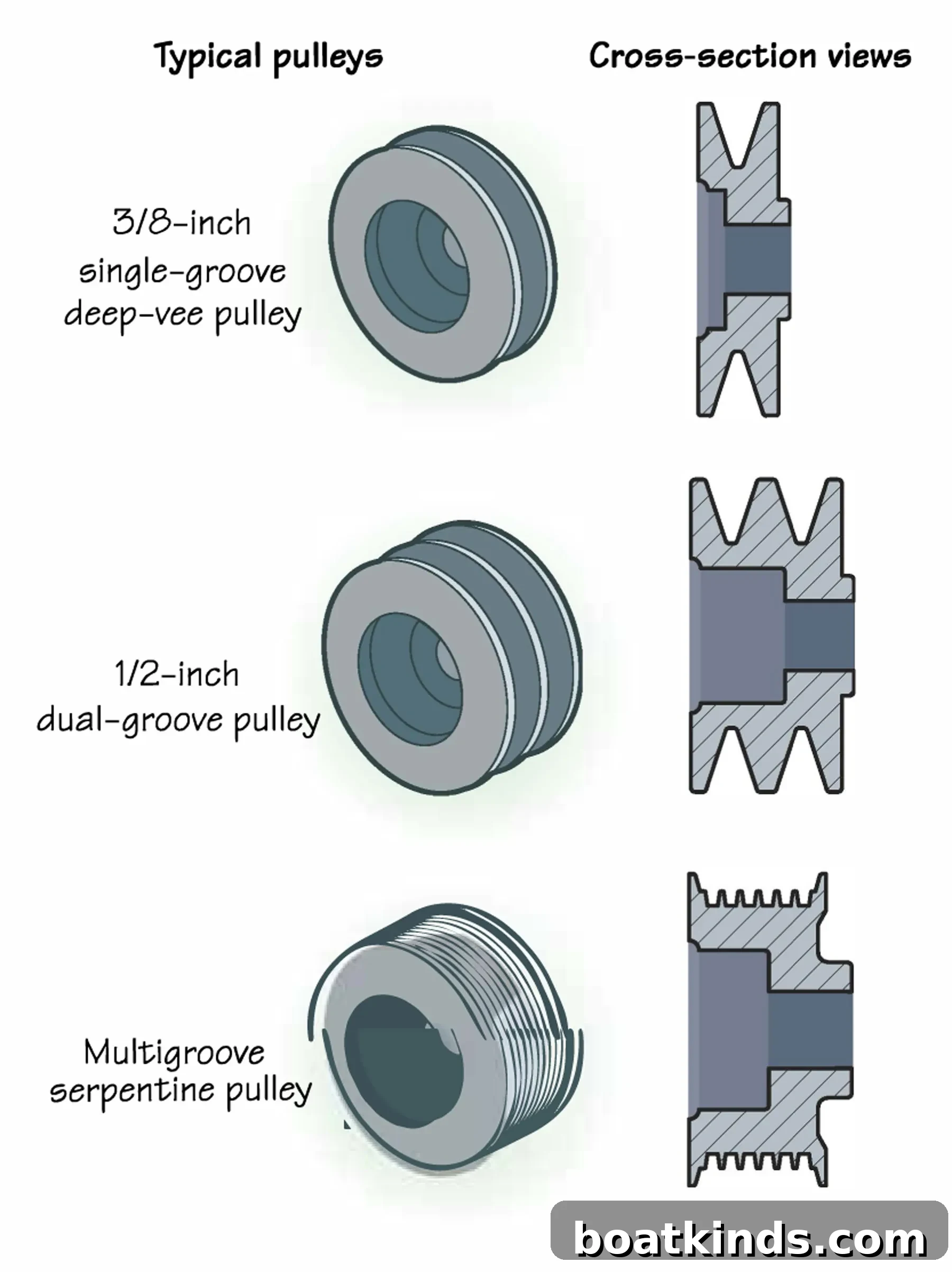
Mechanical considerations are equally important. As electrical load increases, mechanical demand on the alternator grows, which may require a stronger or wider belt and appropriately sized pulleys. Calculate pulley ratios so the alternator reaches the manufacturer’s recommended maximum speed at your engine’s rated full-throttle rpm. If the pulley is too large, the alternator will be under-spun at operating rpm and cannot deliver its rated current—negating the benefit of the upgrade. Conversely, an excessively small pulley can over-speed the alternator at high rpm, so match pulley size to both engine rpm and alternator limits.
Alternator performance also changes with temperature. Most alternators are rated at a cold temperature and will reduce output as internal temperature rises. Allow for this reduction when sizing your unit, and check whether the alternator’s cooling fan is directional or optimized for a particular airflow direction. Good ventilation around the alternator and correct fan orientation help maintain output and longevity. When planning an installation, consult the supplier or manufacturer about cooling requirements and confirm that the fan orientation will move air effectively in your engine compartment.
Before purchasing a replacement alternator, follow these practical steps: determine the total amp-hour capacity of your house bank; consult battery specifications for recommended maximum bulk-charge acceptance; calculate required charging amps based on the battery chemistry percentages above; factor in the real-world engine run time you intend to allow; and verify pulley and belt compatibility plus cooling and mounting constraints. If in doubt, consult a marine systems professional to confirm calculations and ensure electrical and mechanical integration is safe and reliable.
About the author: Roger Hellyar-Brook runs a marine consulting business, repairing and upgrading boats of all types. He has spent more than 40 years in the marine industry and is the former manager of the systems program at The Landing School in Arundel, Maine.
About the illustrator: Paul Mirto is a digital illustrator, longtime boater and former Coast Guardsman. mirtoart.com
Interested in engines? Take an online course with expert Steve Zimmerman at boatuniversity.com
This article originally appeared in the October 2017 issue.