
Annapolis Sailing School Celebrates 50 Years of Teaching Sailing with Fun and Safety
When founder Jerry Wood opened the Annapolis Sailing School five decades ago, he built it around a single guiding principle: learning to sail should be fun. That simple philosophy helped the school grow into a longtime local institution on the Chesapeake Bay.
“Jerry realized a long time ago that it has to be fun,” says Tim Dowling, the school’s president. “Sailing is really a lifestyle. Anyone can read a book on it, but if you don’t enjoy it while you’re out there doing it, you’re not going to continue to do it.”

As the school marks its golden anniversary, Wood’s approach has proven successful. Since its founding in 1959, roughly 250,000 people have learned to sail through the school’s programs, according to Dowling, who considers the school a defining part of his own life.
“I have been involved with the school for 29 years,” Dowling says. “They hired me at 15 to start teaching and all through college and high school I kept coming back here. I’m truly blessed to do what I love for a living.”
After Jerry Wood’s death in February 2003, his wife Kathy continued to run the school until she passed away in 2005. With no children or heirs to take over, Dowling purchased the business and became the official owner in July 2006, continuing the school’s mission of accessible, enjoyable sailing instruction.
From a Plywood Catamaran to a Purpose-Built Training Sloop
The school’s origins were modest. In 1959 people began asking Wood if they could rent his father’s 10-foot plywood Tornado catamaran and a small plywood Raven dinghy. At that time formal sailing instruction was rare—most sailors learned as children, through clubs, or from friends.
“This was before fiberglass became common,” recalls Rick Franke, general manager emeritus. “Jerry quickly realized that the catamaran was too fast for people and the Raven was too small, so he commissioned Olin Stephens of Sparkman & Stephens to build a fiberglass training sailboat for him.”
Wood gave Stephens clear parameters: the boat needed to be smaller than 26 feet so it would not require numbering under Maryland law, have a shallow draft, be easy to handle, and be forgiving enough to safely carry four adults. The result was the 24-foot Rainbow sloop, introduced in 1961 and still used today as the school’s primary beginner vessel.
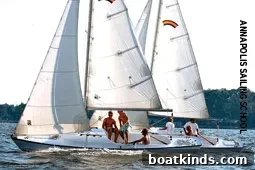
The Rainbow blends comfort and safety: a spacious cockpit that easily fits four adults with room to move, and a simple rig that reduces clutter and confusion for students. “It is in my mind the best high-tech beginner’s boat out there,” Dowling says. “And they are indestructible. These boats can take abuse.”
Growth, Facilities, and Fleet
Within six years of opening, Wood had acquired two acres of waterfront property along the Chesapeake Bay, the site where Annapolis Sailing School still operates at 7001 Bembe Beach Road. Franke, who started there part-time in 1968 and became general manager in 1980, credits Wood with helping make small-boat sailing more accessible to the public.
“He was part of the fiberglass revolution that made small-boating much easier for people,” Franke says. “Jerry was partially responsible for making sailing the everyman sport to the extent that it is today.”
Today the school’s fleet includes 15 Rainbows and five 26-foot Hunter cruisers used for more advanced instruction. The variety of boats allows the school to teach beginners the basics as well as to provide advanced, hands-on training for people moving into cruising and keelboat handling.
Customized Instruction and Rebuilding Confidence
Beyond scheduled courses, a significant portion of the school’s business involves on-the-water instruction on privately owned boats. Instructors have worked on vessels ranging from compact 14-foot dayboats to larger cruising yachts up to 60 feet, helping new owners and nervous boaters feel confident and competent.
“We have had students who had bought a boat from the dealership, were given the keys and not given any training on how to use it,” Dowling explains. Part of the school’s role is restoring confidence after frustrating experiences—difficult docking, for example, can leave owners embarrassed and leave boats unused. Annapolis Sailing School focuses on practical, calm instruction to get people back on the water.
Fifty-Year Celebrations and Community
To mark its 50th anniversary, the school plans events throughout the year, including reunions and gatherings for past and present instructors and students. “We’re hoping to have a reunion of all the teachers from past years in the summer—maybe over the Fourth of July,” Dowling says. Plans for summer programming are still being finalized, with an emphasis on bringing the community together to celebrate a half-century of sailing education.
For details on courses, schedules, and anniversary events, visit www.annapolissailing.com.
This article originally appeared in the April 2009 issue.