
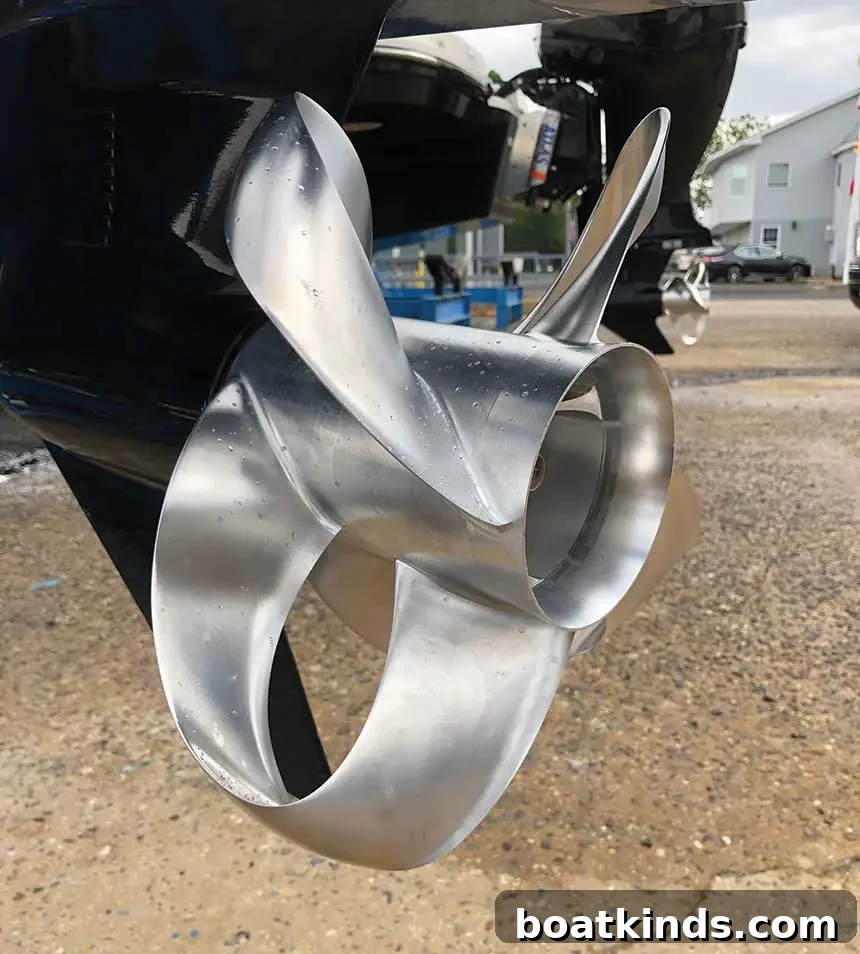
Late spring is my favorite season for getting afloat and testing the newest marine gear that caught my eye at the winter shows. This year’s highlights include an innovative propeller, a new family of multifunction displays and networking tools, a fuel filter head with an NMEA 2000 water-in-fuel alarm, and a compact stabilizer designed for smaller boats. Each product targets practical onboard problems—efficiency, situational awareness, fuel contamination and comfort—and represents meaningful progress in marine technology.
Sharrow MX-1
The Sharrow MX-1 is a radical rethinking of the conventional propeller. Its unique tip-less design aims to reduce tip vortices—those circular water disturbances at the blade tips that sap thrust and introduce vibration. By eliminating tips, Sharrow reports up to a 15% increase in propulsion efficiency, along with gains in top speed, reduced vibration, improved handling and earlier planing at lower speeds. That combination addresses fuel economy and ride quality for recreational boaters and commercial operators alike.
Founder Greg Sharrow points out that removing tip vortices is the key to the performance gains. The MX-1’s geometry minimizes those losses and can be adapted to replace many traditional propellers across a wide range of craft. The MX-1 won the National Marine Manufacturers Association Innovation Award for propulsion equipment and parts at the Miami International Boat Show, underlining the industry attention being paid to this different approach to a centuries-old design.
Furuno TimeZero Touch 3
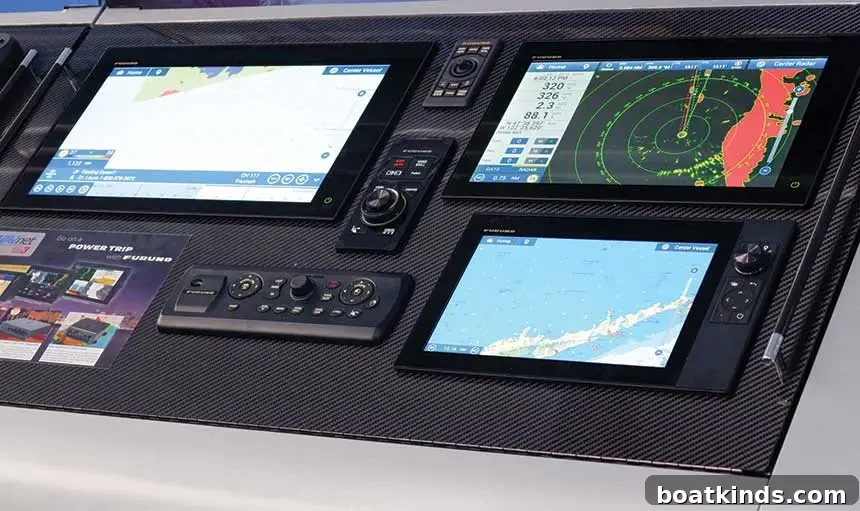
Furuno’s TimeZero Touch 3 (TZT3) series expands its line of multifunction displays (MFDs) with 12-, 16- and 19-inch models. The 12-inch unit combines a responsive touchscreen with physical knobs and buttons for hybrid control, while the larger 16- and 19-inch screens are full touch with optional remote controls. These sizes cover a broad range of helm layouts from center consoles to larger sportfish and cruising stations.
The TZT3 lineup is integrated into Furuno’s TZ Cloud ecosystem. This system synchronizes waypoints, routes, photos and user-defined zones across TimeZero products, the TZ iBoat mobile app and TimeZero desktop software. For users who work across multiple devices—tablet, chartplotter and PC—fast, reliable sync removes a common friction point and helps maintain consistent navigation data across the fleet.
Furuno also introduced two solid-state open-array radars that complement the TZT2 and TZT3 displays: the DRS12A-NXT and the DRS25A-NXT. The DRS12A-NXT is a 100-watt model that delivers performance comparable to a 12 kW magnetron radar, while the DRS25A-NXT is a 200-watt unit with roughly 25 kW-equivalent performance. Solid-state radars offer lower maintenance and improved reliability compared with magnetron-based systems, and these models are positioned to provide high-resolution target detection for collision avoidance and situational awareness.
Signal Filters Fuel Head
Signal Filters unveiled a fuel filter head that warns boaters of water contamination by broadcasting an alert on the NMEA 2000 network. Unlike common designs that use a sensor mounted to a bowl beneath the filter, this system employs a metal probe that reaches the bottom of the filter element to measure electrical resistance. The probe contacts a sensor in the filter head; the head itself houses the alarm electronics and the NMEA 2000 interface.
The unit fits standard filter sizes, making retrofit installation straightforward. For emergency situations, a filter without the probe remains available. The filter head is priced at about $400 and has been tested to pass 180 gallons per hour without flow restriction—suitable for many diesel engine installations. By integrating the alarm into the NMEA 2000 network, fuel contamination warnings can appear on MFDs and onboard displays where they’re most likely to be noticed.
Seakeeper 1
Seakeeper’s smallest unit, the Seakeeper 1, brings gyro stabilization to a wider segment of boaters. Targeted for boats roughly 23 to 29 feet overall, the Seakeeper 1 lists at about $15,000 and is designed to fit where space and budget previously prevented installation of active stabilization.
To simplify installation, Seakeeper reshaped the flywheel enclosure so it does not protrude below the unit’s frame. That change allows the unit to mount on the deck without cutting into the deck cavity, enabling placement under leaning posts, inside seating lockers or in many cockpit compartments. The footprint is similar to a large cooler—compact enough for tighter installations on smaller boats.
The Seakeeper 1 includes a top-mounted control panel for local operation, though most installations will integrate the unit with MFDs for remote monitoring and control. It runs on DC power and can utilize alternator output from the boat’s engines. The unit accelerates to its stabilizing speed in about 21 minutes and reaches full 9,750 rpm in 31 minutes, with a simplified, single-cylinder, hose-free braking assembly designed for easier field replacement. Those refinements reduce installation complexity and ongoing maintenance compared with earlier units.
For a broader view of new marine innovations, consult the Miami International Boat Show innovation awards and related industry coverage to see other products recognized for technical advancement and practical benefits to boaters.
This article originally appeared in the June 2020 issue.