
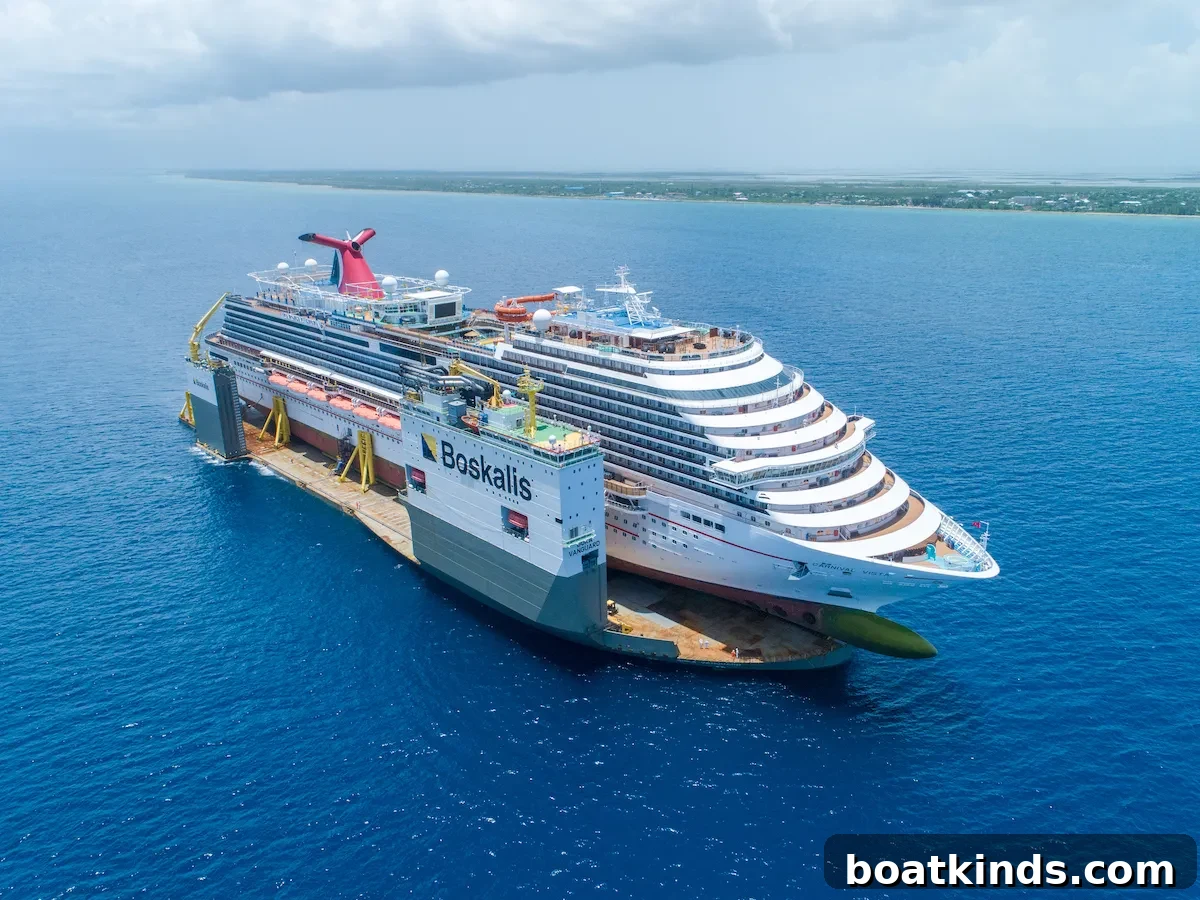
BOKA Vanguard Loads Carnival Vista for Azimuth Pod Maintenance
Occasionally even the largest passenger ships require maintenance that can’t be performed while they are afloat. When a cruise ship needs access to underwater equipment or propulsion components, the options include traditional dry docking or a specialized lift operation. Recently, Carnival Cruise Line’s Carnival Vista was transported aboard the 902-foot by 230-foot semi-submersible heavy lift vessel BOKA Vanguard for repairs to her azimuth pod drives.
The transfer was completed during a carefully planned, roughly 12-hour float-on/float-off operation that placed the cruise ship onto the dry deck of the BOKA Vanguard. After securing the Carnival Vista aboard the heavy lift ship, the two vessels made a short transit to Freeport, Bahamas, where technicians performed the necessary maintenance work. Videos and reports of the operation highlight how specialized marine engineering and precise coordination make these complex moves possible.
What Is a Semi-Submersible Heavy Lift Ship?
Semi-submersible heavy lift ships like the BOKA Vanguard are purpose-built vessels that can partially submerge their cargo deck to allow another vessel to float directly over it. Once the transported ship is correctly positioned, the heavy lift vessel de-ballasts to raise the deck, lifting the cargo ship clear of the water for transport or for short-term repairs. Because the cargo deck can be flooded and then cleared of water, these ships are ideal for carrying large vessels, offshore platforms, and other oversized loads that cannot be moved by standard towing or crane operations.
Why Use a Heavy Lift Ship for Azimuth Pod Repairs?
Azimuth pod drives—rotatable propulsion units mounted beneath the hull—are critical components for maneuvering and propulsion on modern cruise ships. Repairs or inspections of these pods require dry access to their housings and electrical or hydraulic connections. Instead of sending a large cruise ship into a conventional dry dock, owners may choose a heavy lift operation for time efficiency, availability, or logistical reasons. Loading the ship onto a semi-submersible can reduce downtime, simplify access for specialized teams, and avoid scheduling challenges at busy shipyards.
How the Load Procedure Works
While specific operational details vary with each job, a typical semi-submersible load involves several coordinated steps:
- Positioning: The heavy lift vessel ballast tanks are flooded so the cargo deck submerges to a preplanned depth. The transported ship is carefully maneuvered into place over the submerged deck.
- Alignment and Clearance: Tugboats and harbor pilots assist with fine alignment to ensure the ship rests evenly on the support blocks or cradles on the deck. Clearances around hull appendages are monitored to prevent contact damage.
- Deballasting: The lift ship pumps out ballast water in a controlled sequence, gradually raising the cargo deck and lifting the transported vessel clear of the water.
- Securing: Once lifted, the ship is secured with sea-fastening systems and other restraints to withstand transit motions. Final checks ensure stability and safety for the voyage to the repair site.
Safety, Planning, and Expertise
These operations demand meticulous planning, experienced crews, and robust safety protocols. Naval architects and marine engineers calculate loads, stability, and block placement. Communication between ship captains, harbor authorities, and the heavy lift crew is essential to coordinate tides, weather windows, and harbor traffic. Properly executed, a float-on/float-off transfer is a reliable method to move large tonnage while minimizing risk to both the transported vessel and the heavy lift ship.
Benefits for Shipowners and Operators
Using a semi-submersible heavy lift offers several advantages: reduced time in busy shipyards, access to specialized repair facilities without lengthy dry-dock waits, and the ability to move large vessels over longer distances without the wear and fuel costs of independent transit. For operators of large cruise ships and offshore units, these capabilities can translate into cost savings and faster return-to-service.
The recent operation involving the Carnival Vista and the BOKA Vanguard showcases how modern maritime logistics and heavy lift technology combine to solve challenging maintenance needs. By leveraging the unique capabilities of semi-submersible carriers, shipowners can maintain critical systems like azimuth pod drives with minimal disruption to schedules and passenger operations.