
Mercury Marine recently combined a product reveal and a retirement celebration for its Verado outboard family. The new V10 Verado 350 and 400 replace the outgoing L6 Verado 350/400—the last derivatives of the 2.6-liter supercharged platform that launched the Verado nameplate 19 years ago. Over nearly two decades, advances in design tools, casting methods and digital controls have transformed outboard engineering. Mercury has applied those advances and extensive engineering experience to fill the final gap in its next-generation Verado lineup with these all-new V10 models.
Boating trends have evolved alongside outboard technology. Center-console yachts over 50 feet commonly run four or five large outboards, and many wide-beam day cruisers above 40 feet now use multiple outboards instead of inboards. While the new V10 Verado engines will suit freshwater fishing boats and some pontoons, their primary purpose is to power the heavier, multi-engine boats becoming more common in today’s market.
The V10 Verado features a 5.7-liter (349 CID) V10 powerhead built on the proven architecture of Mercury’s V8 4.6-liter Verado 250/300 introduced in 2019. Both engines share a 92mm bore, 86mm stroke and a 64-degree cylinder angle. This commonality simplifies manufacturing and supply-chain logistics. The V10 layout achieves a 5.7-liter displacement while preserving a narrow profile and the 26-inch center-to-center transom spacing used by the V8 and the previous L6 Verado models. That compatibility eases installation for boatbuilders and simplifies repower projects because existing mounting patterns remain unchanged.
All-New Gearcase and Props
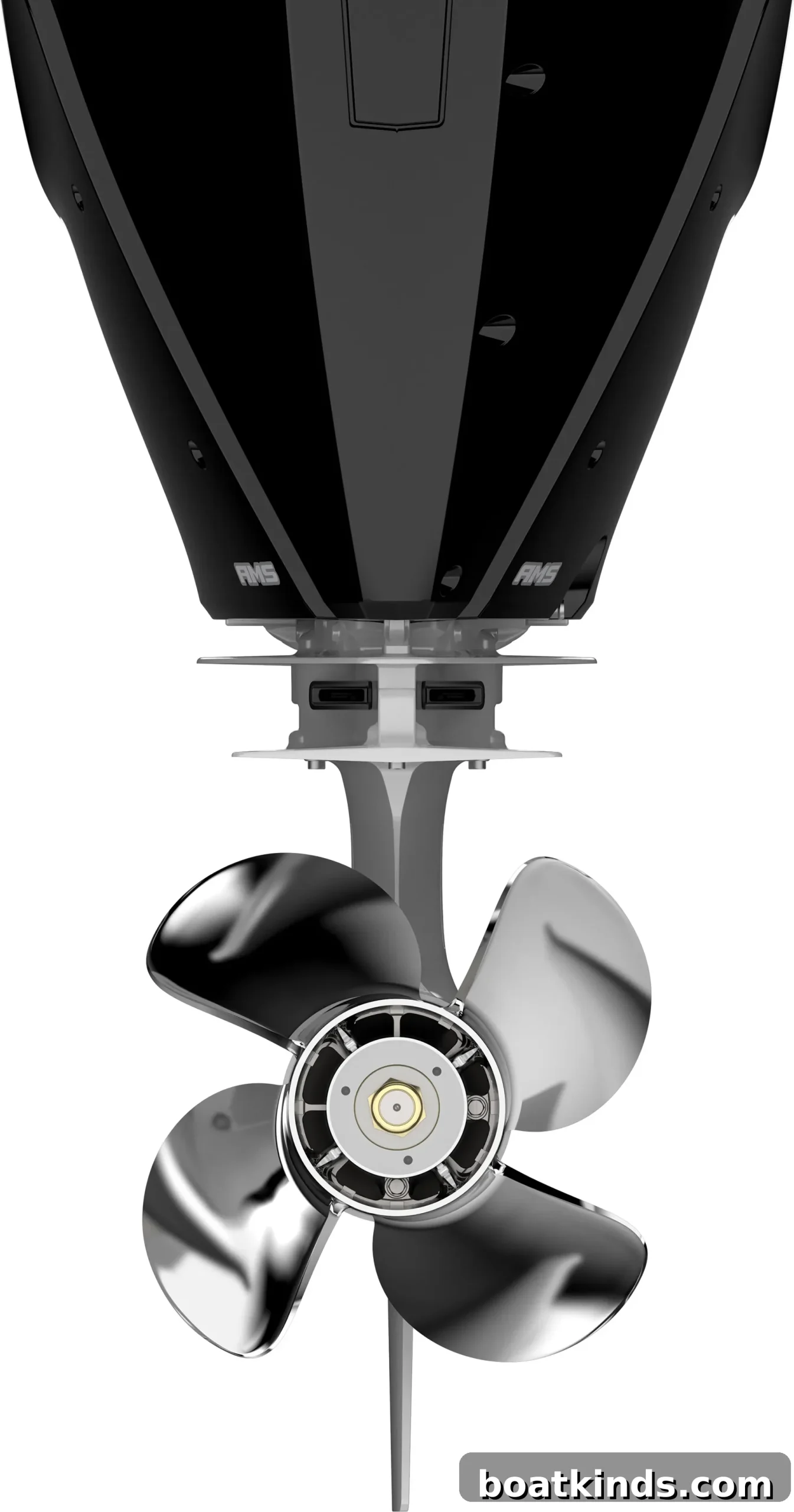
Beyond the powerhead, Mercury redesigned the gearcase and propeller system using computational fluid dynamics (CFD). The new gearcase measures 6.4 inches in diameter and supports a lower 2.08:1 gear ratio along with propellers up to roughly 18 inches in diameter—an inch larger than the V8 gearcase that uses a 1.85:1 ratio. The larger gearcase is optimized to handle greater blade area and improved hydrodynamics.
Matched to the gearcase is Mercury’s new Revolution X line of four-blade propellers. With blades up to about 17 inches in diameter and significantly wider blade area—35 to 50 percent more than props designed for the smaller 5.44-inch gearcase—the Revolution X propellers extend available pitch from 18 to 33 inches. They are sized specifically for the V10’s 1.5-inch tapered prop shaft, and only Revolution X props fit this shaft.
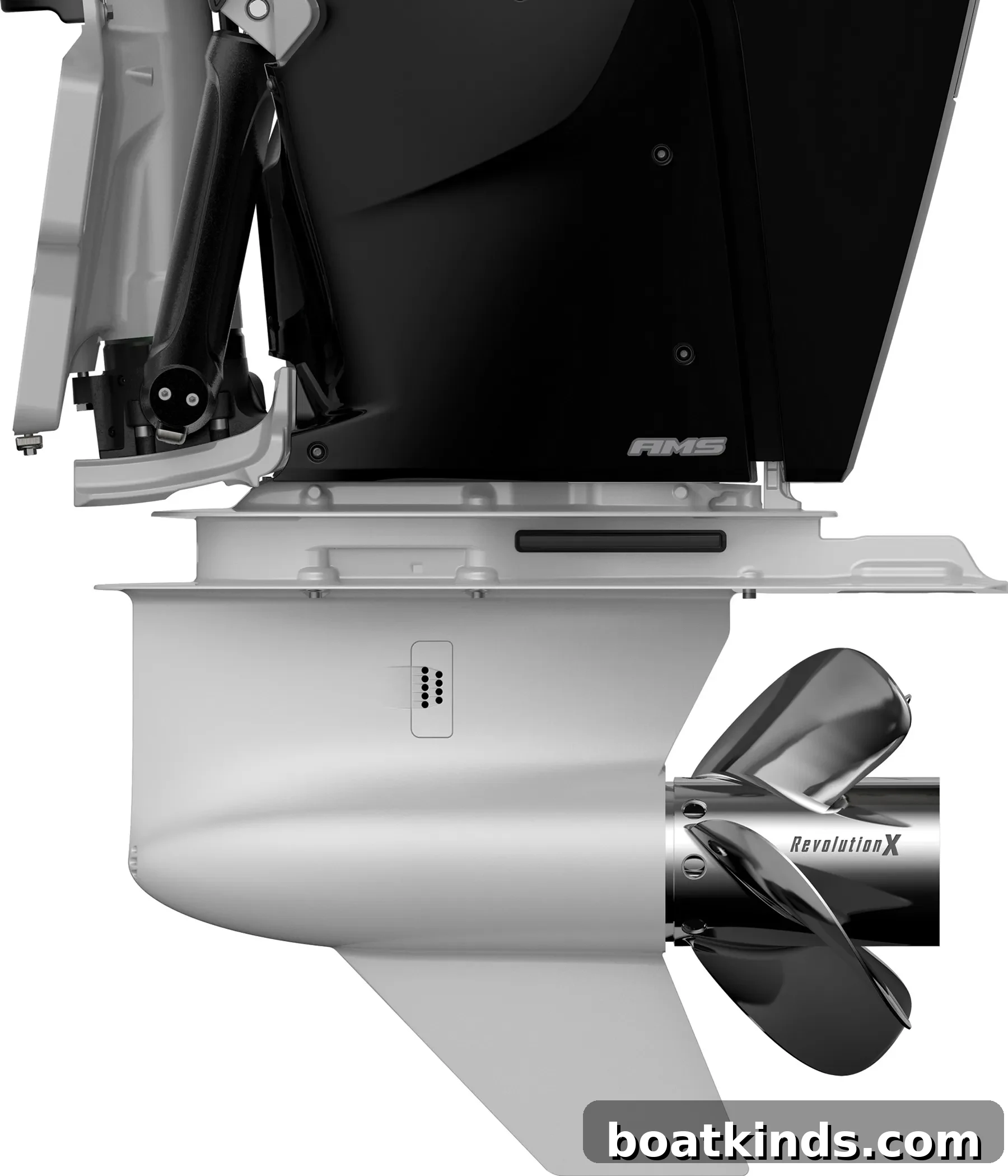
Mercury engineers emphasize that the lower gear ratio amplifies torque delivered to the propeller shaft and reduces propeller RPM relative to engine speed, which improves efficiency while maintaining performance. CFD work also shaped the gearcase to generate lift, allowing heavier boats to plane more quickly and, at speed, ride higher to reduce hull drag. In some tests Mercury reports the gearcase performs well even at semi-surface speeds.
Because the deeper gearcase can be mounted slightly higher on the transom—many builders moved the V10 motors up about 0.75 inches—concerns about added drag from a larger gearcase are mitigated in many installations.
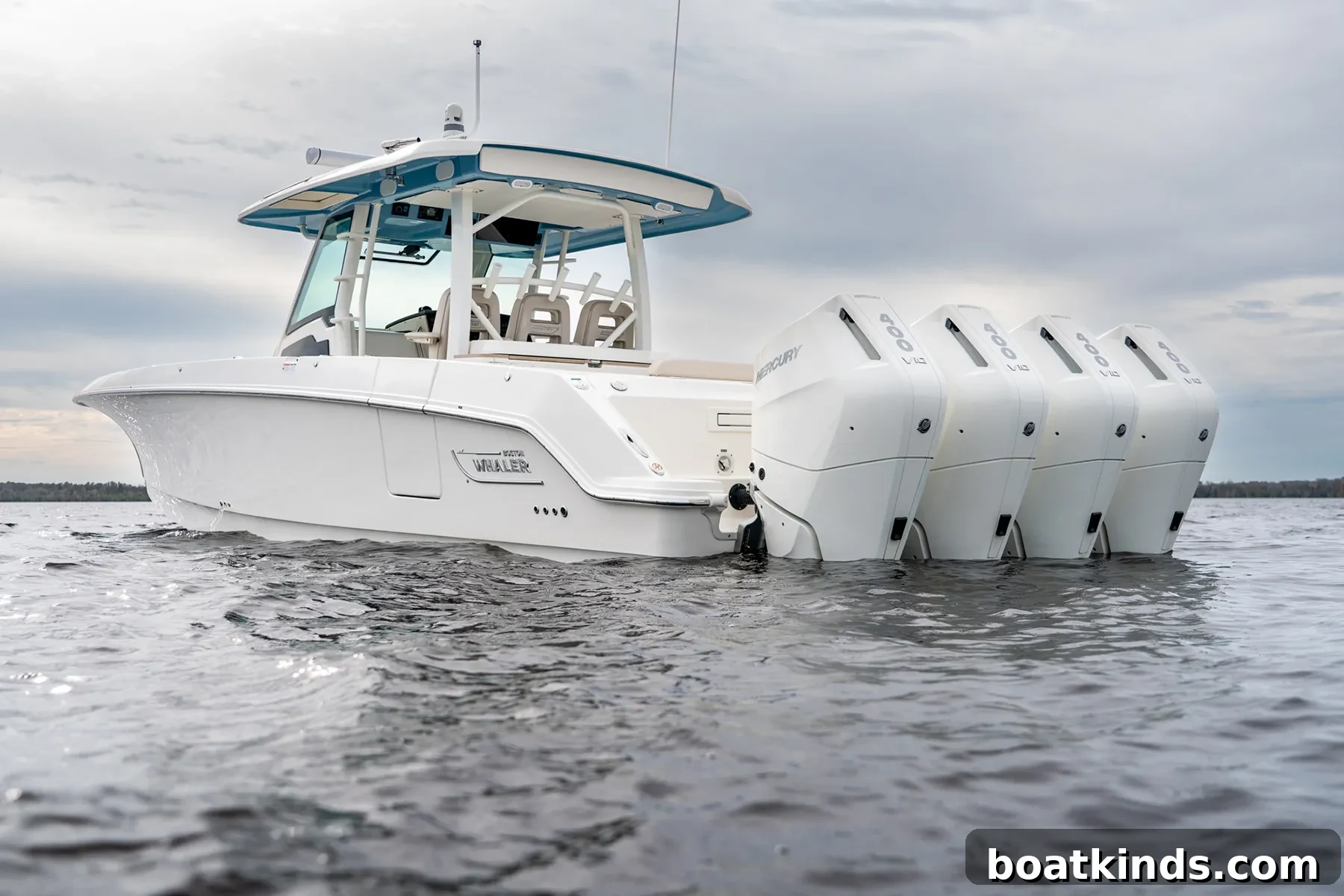
The performance improvements depend on the hull. During press sea trials at Mercury’s Lake X, a Boston Whaler 380 Outrage fitted with four V10 400 outboards reached 68.5 mph at 6,350 rpm on 25-pitch props, with 0–30 mph in just under eight seconds. By comparison, the same model with the previous quad 2.6-liter Verado 400 setup had lower top speed and comparable acceleration. Other hulls showed more modest gains: a Valhalla V-33 running twin V10 400s posted a top speed only slightly higher than the 2.6-liter-powered version, illustrating that efficiency gains vary with hull design. Mercury’s integration testing across more than 40 hulls found average top-speed improvements of roughly 3–5 mph, with the largest gains on heavier, traditional V-bottoms.
Feels Fast
On the water, the V10 Verado delivers a refined but athletic driving experience. The engines are carefully counterbalanced to minimize vibration and are notably quiet until the electronically selectable hot-rod exhaust tone is engaged. Throttle response is crisp and the powerband is broad, delivering strong acceleration across the rev range. Mercury reduced engine mass where possible—drilling through the center of the crankshaft and camshafts, for example—so that the V10 Verado dry weight on a 25-inch shaft is 709 pounds. That is 27 pounds more than the 2.6-liter Verado but lighter than several competing large outboards, including the V8 Yamaha XTO 425 by a substantial margin.
The V10 shares many of Mercury’s proven features: the Advanced Midsection to isolate powerhead vibrations from the hull, Gen 2 DTS digital throttle-and-shift controls with auto-trim buttons, and Adaptive Speed Control to maintain engine RPM as load changes. The motors are compatible with Mercury SmartCraft electronics, VesselView displays and the Mercury mobile app. Service points such as the dipstick and oil fill are accessed under the top cowling, and the engine produces full rated power on commonly available 87-octane fuel.
Electro-hydraulic power steering is standard, and Mercury is introducing an optional electric steering system for boatbuilders, which will become standard on joystick-equipped craft by midsummer. Electric steering promises improved response and precision, particularly for low-speed joystick maneuvers.
Fathom Ready
Recognizing the growing electrical demands of modern boats—powerful audio systems, multiple displays, appliances, chillers and stabilizers—the V10 Verado includes a new 150-amp alternator that delivers full output at just 1,500 rpm. That is more than double the charging capacity of the 2.6-liter Verado models and significantly higher than some competitors.
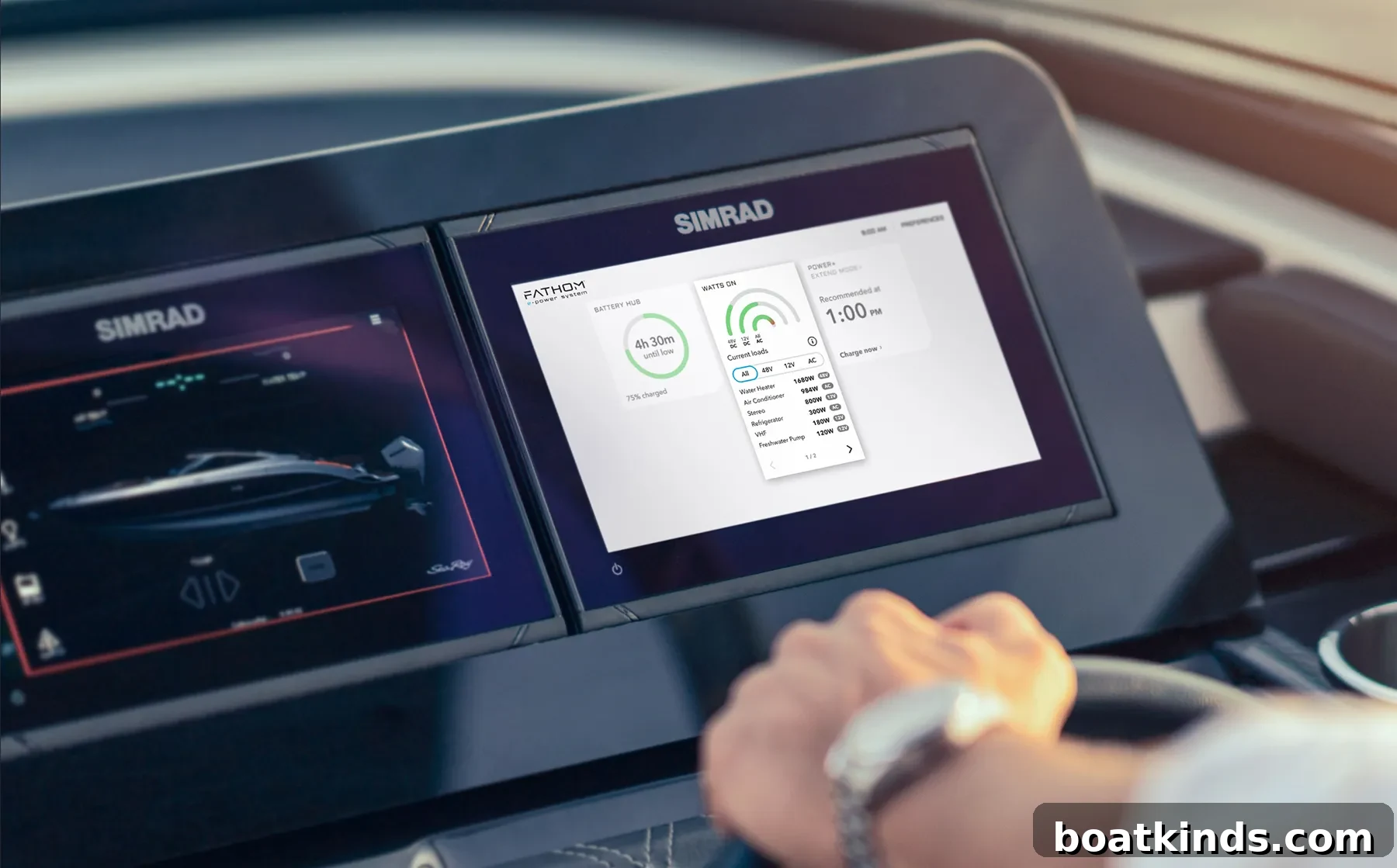
Mercury also offers a 48-volt alternator option designed to integrate with the Navico Fathom e-power system, a lithium-ion auxiliary power-management platform intended to replace small on-board generators. The Fathom system, already installed on select boat models, allows robust charging of house battery banks from the outboard alternator. The 48-volt alternator charges house batteries at a rate nearly four times faster than a standard 12-volt unit, and it can directly power accessories through a converter when running at speed while maintaining the house bank and charging start batteries as needed.
Power + Mode lets captains use the engine as a dedicated charging source when the boat is at rest. If house batteries reach a low threshold, the captain can enable Power + Mode on the multifunction display or through the Fathom app. The outboard runs at up to 2,500 rpm to charge the house batteries while safety protocols lock shifting and steering, require the cowl to be in place, and monitor exhaust temperature and water pressure to ensure the boat remains in the water. The engine logs Power + Mode hours separately so low-rpm charging time doesn’t count against the motor’s primary service hours. While effective, the 48-volt system requires at least about 1,300 rpm to generate full 48-volt output, so long-duration trolling at very low rpm will charge at 12 volts instead.
The Fathom e-power solution integrates components from Mercury and partner brands within the Brunswick ecosystem to scale to each boat’s electrical load based on builder-specified gear and appliances. Builders can choose how many engines are equipped with 48-volt alternators to meet expected charging requirements.
Color Options
The V10 Verado 350 and 400 are offered in four shaft lengths—20, 25, 30 and 35 inches—to suit single and multi-engine installations. Finish options include classic Phantom Black and three tones of white (Pearl Fusion, Warm Fusion and Cool Fusion). Accent panels are available in five colors, and a paint-ready option enables bespoke customization.
V10 Verado motors are available to boatbuilders now and will reach retail dealers later in 2023. While final retail pricing is pending, Mercury indicates an expected price near $40,000 per engine at each horsepower rating. With the introduction of the V10 Verado, Mercury fills out a complete lineup of large outboards engineered to meet the needs of modern, high-performance multi-engine boats.
This article was originally published in the February 2023 issue.