
SS American Star: A Salvage Tug, a Broken Towline, and an Artist’s Memory
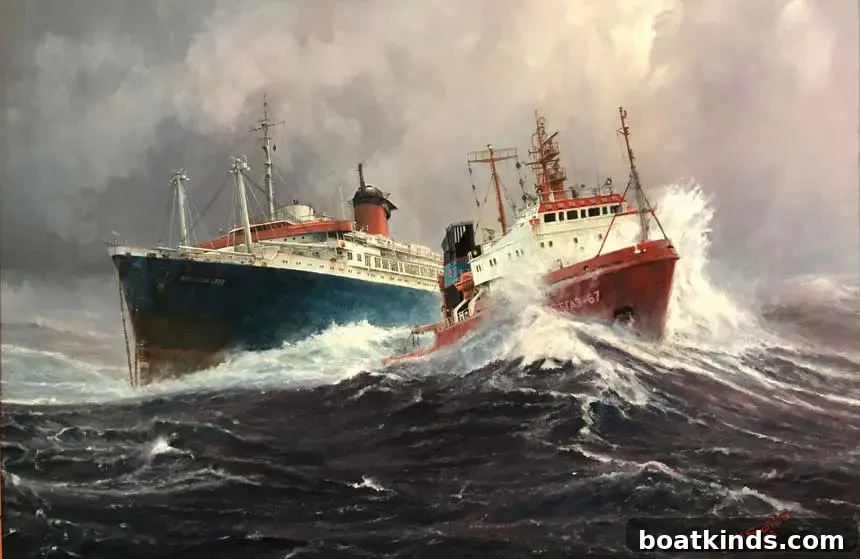
A broken towline dangled from the bow of the SS American Star as the ocean liner pitched and rolled in a savage Atlantic storm. The Ukrainian oceangoing tug Neftegaz 67 took a wave over her bow while maneuvering to reattach the tow. It was early 1994, and both vessels were in dire danger after steaming into a thunderstorm near the Canary Islands.
What the photograph cannot fully convey are the precise dangers felt by the tugboat crew at that instant: the spray, the slipping deck, the unrelenting motion of ship and sea. Marine artist Marek Sarba knows those hazards firsthand. He spent many years at sea aboard salvage tugs and merchant ships, traveling widely while cultivating the skills that would later inform his maritime artwork. Having worked on towing decks, he understands that a single mistake in those conditions can be fatal.
“When something goes wrong on open waters, the waves and the constant heave and roll make it almost impossible to work while staying balanced,” Sarba says. “Everything on deck becomes a humid, foamy struggle—you feel the engines, you smell the oil, and every movement is calculated against the next wave.” That practical knowledge is evident in the intensity and authenticity of his painting of the SS American Star incident.
The liner involved in this dramatic scene began life as the SS America, launched in 1939. She enjoyed a long career in U.S. and European passenger service and was widely admired for her balanced design—large enough to offer comfort and style, but not so grand as to intimidate. Her interiors were described as warm and sophisticated rather than ostentatious, a quality that made her a candidate for preservation and reuse late in her life.
In the early 1990s a preservation effort by the SS America Preservation Society aimed to transform the vessel into a floating hotel. While being towed to a new purpose, the ship and her tugs encountered the violent Atlantic storm that ultimately proved decisive. After three days of relentless weather and failed attempts to secure a reliable tow, the liner drifted ashore and was wrecked at Playa de Garcey in the Canary Islands. “Everything ended sadly,” Sarba admits, but the episode nonetheless captured his imagination as an experienced seaman.
Sarba approached the subject the way he always approaches maritime scenes: with careful research, with respect for the human element, and with a deep recollection of the sensations of life at sea. He reconstructed the action mentally before beginning the painting—envisioning the crew’s frantic movements, the groaning of lines under strain, and the tug’s fight to regain control. Then, with a cup of coffee and music on the stereo, he set to work with brush and palette.
“I don’t just paint a picture; I paint the voices and the effort. I remember the feel of the deck under my feet, the spray in my face, the snap of a towline,” he explains. His art aims to transport viewers into the immediacy of the moment: the physical labor, the unpredictability of weather, and the narrow margin between success and disaster in salvage operations.
Ship salvage is an unforgiving profession. Tug crews must coordinate under pressure, manage heavy gear, and read the sea and wind to avoid catastrophe. Towlines, tow bridles, winches, and the deck crew’s experience all become decisive factors when a tow breaks in a storm. Sarba’s background allows him to portray these technical details with credibility while focusing on the human drama.
The wreck of the SS American Star remains a poignant example of the risks that attend maritime preservation and salvage efforts. While the attempt to convert the liner into a hotel ultimately failed, the episode provided material for artists, historians, and seafarers alike to reflect on the sea’s power and the courage of those who work upon it.
For Marek Sarba, the painting is not merely a visual record; it is a memory of sounds, smells, and sensations that only someone who has spent time on towing decks can fully understand. His work stands as both homage and testimony: an artist’s way of preserving, in pigment and composition, a perilous episode from the life of a once-beloved ocean liner.
This article originally appeared in the February 2019 issue.