
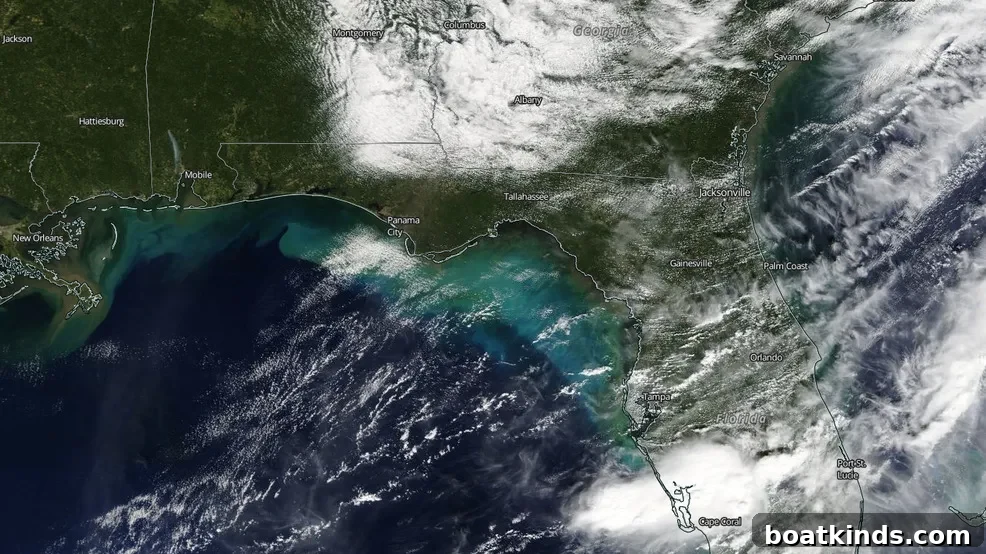
Hurricane Michael Stirred Up the Gulf: Satellite Images Reveal a “Blender Effect”
Hurricane Michael made a devastating landfall as a Category 4 storm, leaving widespread destruction along the coast. Beyond the damage on land, satellite images clearly show the hurricane’s powerful influence over the Gulf of Mexico, where strong winds and churned waters created a visible “blender effect.” These images reveal how the storm stirred up sediment in shallow coastal waters, altering the appearance of the sea over a broad area.
Before-and-after satellite photos captured from orbit offer a striking view of the changes Michael forced on the surface of the Gulf. In the areas near the Florida coast, previously clear blue water turned murky and discolored as sand and sediments lifted from the seafloor were suspended in the turbulent waters. The effect is visible from space: swirls, plumes, and diffuse clouds of sediment extend outward from the storm’s path, a direct consequence of the hurricane’s intense winds and wave action.
This so-called “blender effect” is a useful way to describe how hurricanes impact shallow marine environments. When a powerful storm moves over shallow continental shelf waters, the combination of strong surface winds, large waves, and storm surge stirs up bottom sediments. Those sediments become entrained in the water column and are transported by currents and the rotating flow around the storm. From above, satellites pick up contrasts in color and clarity, making the sediment plumes visible as distinct bands or patches against the clearer surrounding waters.
Satellite observations play a key role in documenting the environmental impacts of major storms like Hurricane Michael. Space-based sensors can capture broad, high-resolution views that reveal how far-reaching the effects of a hurricane can be on coastal and marine systems. For coastal communities and scientists alike, these images provide a vantage point that complements on-the-ground damage assessments, offering a clearer picture of how storms affect both land and sea.
Beyond the immediate visual impact, the sediment stirred into the water can have ecological implications. Increased turbidity reduces light penetration, which can stress or damage seagrass beds and shallow-water ecosystems that rely on sunlight. Suspended sediments can also transport nutrients and pollutants, temporarily altering water chemistry and habitat conditions. While natural processes will eventually redistribute and settle these sediments, the short-term consequences can be significant for fisheries, habitats, and water quality.
For emergency managers and coastal planners, satellite imagery documenting events like the Blender Effect provides additional context for post-storm recovery and environmental monitoring. The images can help identify areas where sediment transport was most intense, where coastal erosion may have been aggravated, or where sediment deposition might alter shorelines and nearshore habitats. These insights contribute to longer-term planning aimed at restoring and protecting vulnerable coastal zones.
Hurricane Michael’s powerful winds and storm surge were responsible for the severe damage on land, but the satellite view of the Gulf underscores that the storm’s reach extended well beyond shorelines. The visible sediment plumes and churned waters are a reminder that the impacts of a major hurricane are both terrestrial and marine, affecting infrastructure, ecosystems, and coastal processes alike.
As satellite technology and remote sensing techniques continue to improve, our ability to observe and understand these storm-driven changes will increase. These observations not only document the dramatic visual effects of storms like Hurricane Michael but also inform research and recovery efforts that aim to mitigate future harm to coastal communities and ecosystems.