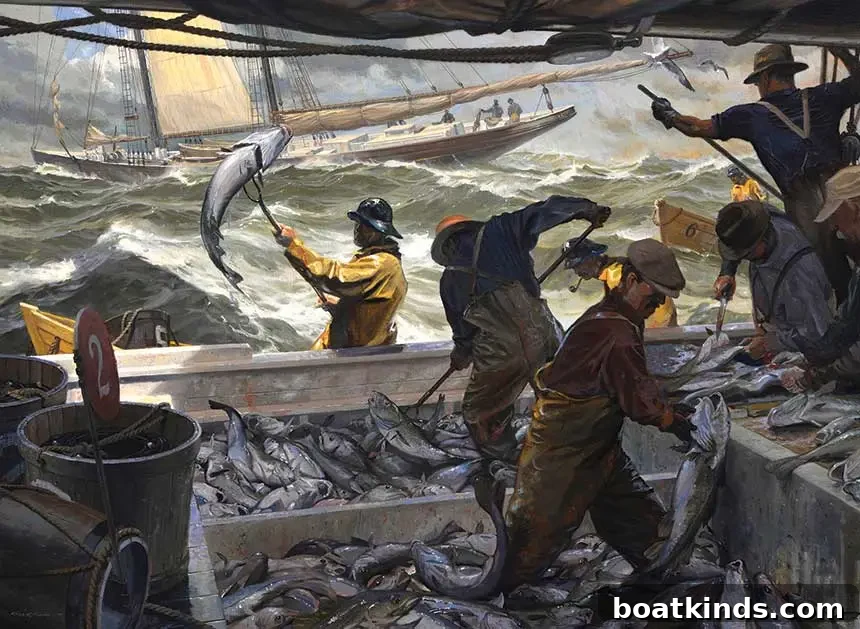
For a marine artist, painting what lies before the eye is one task; composing a convincing scene drawn from history and imagination is another. Translating the atmosphere, labor and authenticity of a bygone maritime life into a single canvas is a demanding assignment. That was the brief Russ Kramer accepted when he agreed to create this painting for a commercial fisherman and his family, who wanted an evocative tribute to the era when the Grand Banks were alive with activity.
Kramer set out to make a work that was both visually compelling and historically credible. To do that he immersed himself in a variety of source materials before touching brush to canvas. He rewatched the 1937 film Captains Courageous for mood and costume references, studied archival newsreels to understand the behavior and bearing of skippers, and reviewed documentaries that documented the schooners that plied the waters out of Gloucester, Massachusetts. He also examined a detailed model of the schooner Arethusa, the work of model maker Erik Ronnberg, now held in the Mystic Seaport Museum collection, to capture rigging, hull shape and the vessel’s overall silhouette.
Research extended beyond books and film. Kramer involved his client directly in the creative process. The fisherman provided photographs he had taken of holds piled with cod and haddock, and several crew members came to model in their foul-weather gear. Those images and live references helped Kramer render the textures of wet oilskins, the heft of fish being hauled aboard, and the practical gestures of men at work—details that lend the painting a lived-in realism.
The finished piece, titled When Cod Was King, places the Arethusa in the distance as a working backdrop. In the foreground, dorymen transfer fresh cod and haddock into the schooner’s pens amid choppy seas and an overcast sky, a snapshot of a productive day on the Banks. Other hands on deck sort, dress and stow the catch. The composition captures a moment of controlled chaos—muscular effort, weather-worn faces, and the routine intensity of commercial fishing—while the jogging schooner in the background suggests a return to port with full holds.
Beyond its documentary intent, the painting aims to evoke the emotional rhythm of that maritime life: the camaraderie of crew, the physicality of work, and the sea’s constant presence as both provider and adversary. Kramer balances dynamic movement and careful detail so the scene feels immediate without becoming cluttered. Light and color are used to emphasize wet surfaces, the pallor of fish, and weather patterns that would have been familiar to fishermen of the era. Clothing and gear are depicted with practicality rather than romanticizing, reinforcing the painting’s sense of authenticity.
This piece also functions as a family portrait of a profession. The client’s involvement ensured that the representation reflected lived experience rather than an idealized stereotype. Including real crew members as models helped capture individual postures and working rhythms, while the supplied photographs guided accurate depiction of holds and catches. Those choices ground the painting in specific, believable detail.
For viewers today, When Cod Was King offers more than aesthetic pleasure: it acts as a visual document of maritime heritage, reminding us of a chapter in fisheries history when the Grand Banks were among the world’s richest fishing grounds and when schooners and dorymen were central to coastal communities. The painting invites reflection on labor, tradition and the changing relationship between people and the sea.
This article originally appeared in the December 2019 issue.