
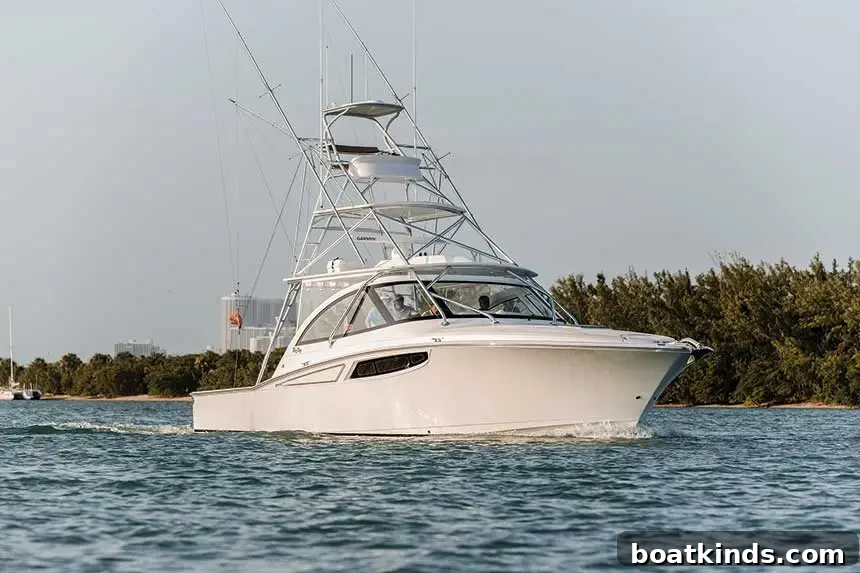
As we prepare to cast off from the Miami International Boat Show aboard the Mag Bay 42 Express Sportfish, I ask Mag Bay President Mike Howarth if he’ll take the helm. “Ain’t no way I’m driving this boat,” he replies. “I haven’t driven a boat in years.”
Howarth has been in boatbuilding for more than five decades, best known for co-founding Cabo Yachts in 1991. Today he runs Mag Bay with his son, Barrett Howarth, the company’s 31-year-old vice president, and he leaves the piloting to Barrett.
“Barrett drove a Cabo in a tournament when he was 15 years of age,” Mike says. “I’m really proud of him.”
“I was younger than 15,” Barrett corrects. “My dad taught me to drive a 35 [Cabo] when I was 9, and by 13 I was running one on my own.” He remembers a moment 60 miles offshore during a tournament, backing down on a fish, when his father passed by on a 110-footer. “That was pretty cool,” Barrett says. “I was hooked on fishing.”
When Cabo Yachts was sold to Brunswick in 2006, Barrett felt the loss keenly. He had literally grown up in the Cabo factory; “my crib was literally a boat,” he says. Boatbuilding is in the family — his mother worked as a carpenter at Jensen Marine, and Barrett remembers helping her haul bow rails in a pickup and then grabbing burritos for the crew.
In 2014 Mike saw how determined Barrett was to build boats and agreed to start a new firm. They consulted naval architect Michael Peters, known for his Cabo designs, and after deliberation chose a twin-outboard, stepped-hull approach for their first model. The Mag Bay 33 Center Console arrived in 2015; the Mag Bay 42 Express Sportfish followed as the company’s second model. Also penned by Peters, the 42 features a conventional modified V-bottom and inboard diesel power.
As Barrett maneuvers the 42 off the dock I notice the twin 24-inch Garmin displays that dominate the helm. “We called Garmin and asked, ‘Are you coming out with something bigger?’” Barrett says, noting 24 inches was the largest Garmin screen at the time. “The whole idea with this boat is bigger and more.”
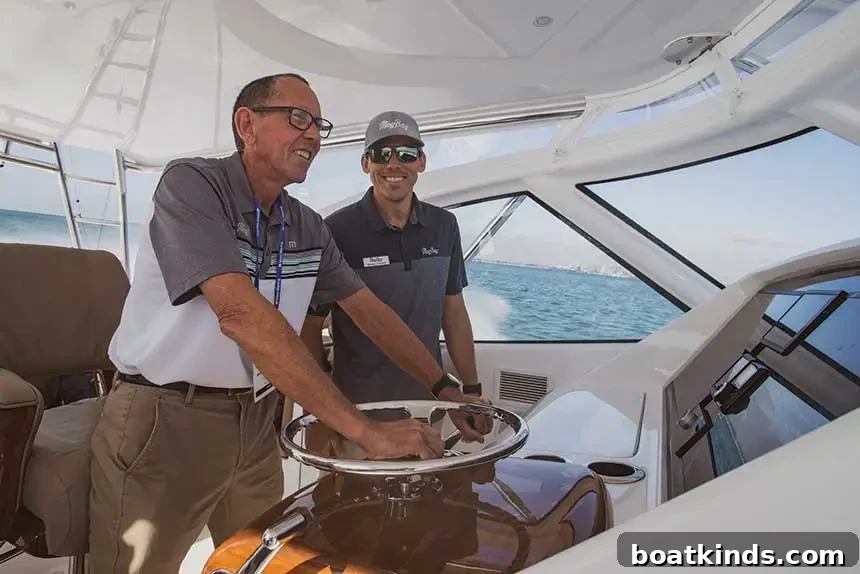
That larger-is-better philosophy shows throughout the Mag Bay 42. Sea strainers, bilge pumps, deck fishboxes, the transom livewell, hawsepipes and cockpit drains are all oversized. The boat has more deadrise, larger motors, deeper pockets, 29½-inch propellers on 2¾-inch shafts, and nearly twice the power of a comparable Cabo 40. “There’s a lot of Cabo influence on the Mag Bay,” Barrett says. “All our guys at the factory are Cabo guys.”
After passing under the William M. Powell Bridge into Biscayne Bay, Barrett opens the throttles to 26 knots. Boat show traffic keeps the water busy, but the 42 simply levels wakes as it slices through them. Pushed to 38 knots — just shy of its 40-knot-plus WOT — the ride is exhilarating. The twin 1,000-hp Volvo Penta D13 diesels hum loudly beneath the deck, but not so loud they interfere with conversation.
This hull is the first off the line and the team is still fine-tuning details. Barrett climbs aft to check the trim tabs and, hanging over the stern with his father while the boat runs, they decide the tabs should be raised a quarter-inch. Back at the helm he demonstrates the 42’s nimble handling: one engine in forward, the other in reverse sends the boat spinning on its axis with minimal water coming into the cockpit. It’s clear the 42 can outmaneuver even the craftiest gamefish.
Visually the boat is pleasing and cohesive. From bow to tuna tower the lines slope aft in a continuous flow that reads clean and purposeful — Michael Peters drew a handsome profile. The helm is minimalist and refined, with a faux-teak pod and three Release Marine helm seats. We’re seven aboard and there’s still seating space between the helm and the L-shaped settee.
Belowdecks the cabin feels roomy, offering 6 feet, 8 inches of headroom, long hull-side windows and two skylights. A practical galley includes two under-counter stainless refrigerators, a stove and a microwave. The L-shaped settee doubles as additional sleeping space facing a 42-inch television. Forward, the stateroom features an island double berth, two hanging lockers and storage sized for 7½-foot rods.
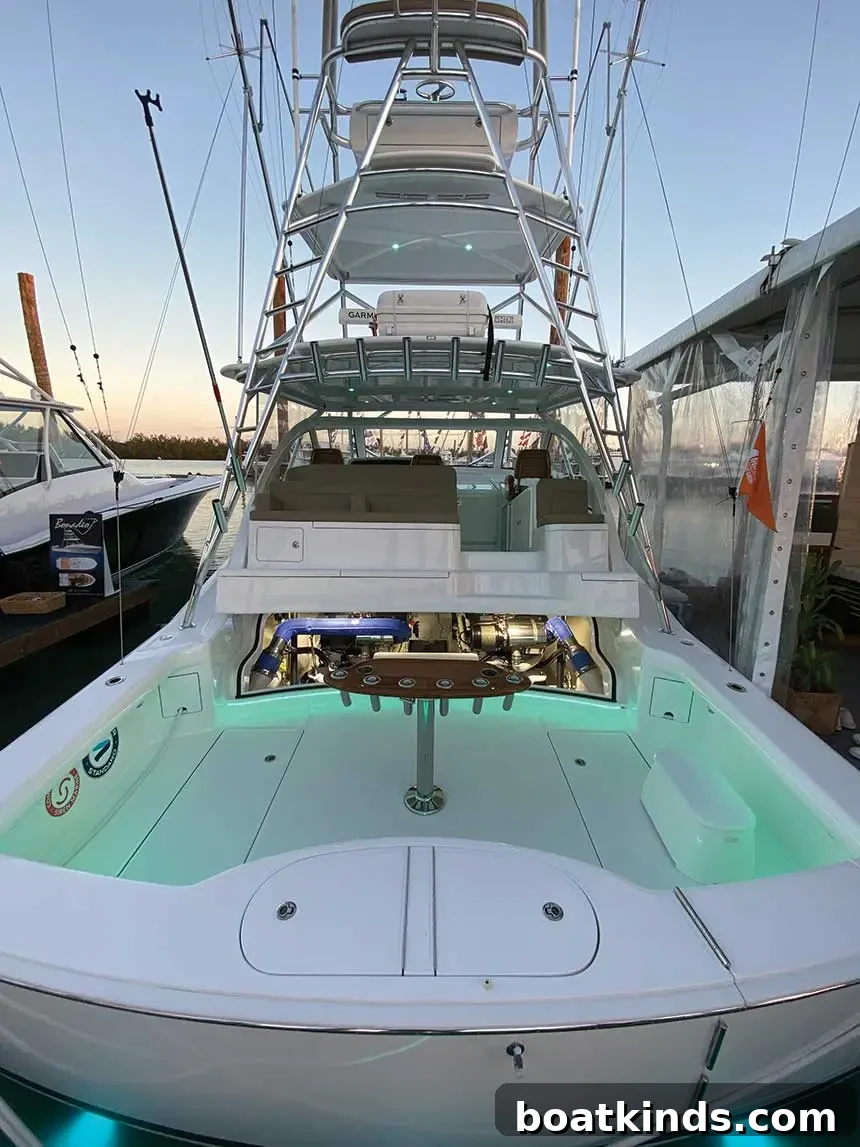
Systems are thoughtfully arranged: electrical runs are portside and plumbing is starboard. Barrett raises the helm console with an electric actuator to reveal tidy wiring beneath. Nothing feels crowded — the layout is deliberate and well executed.
“My goal is to just build the best,” Mike says. “If you’re going to spend this kind of money, you have to use premium products. That was our philosophy at Cabo and it’s ours at Mag Bay. We’re not going to cut corners.”
On the run back toward the boat show someone talks Mike into taking the helm. He hesitates but agrees, and Barrett can’t hide his delight. “He hasn’t touched a wheel since I learned how to drive. He wouldn’t even know how to turn it on,” Barrett laughs as he nudges his dad to “aim for the bridge and slam the thing.”
The diesels come alive and the 42 accelerates. One Garmin screen is dedicated to boat speed, its two large digits filling the display — a fitting reminder that on this express sportfish everything is built big and built to perform.
Specifications
LOA: 42’3”
Beam: 15’7”
Displ (dry): 41,875 lbs.
Fuel: 675 gals.
Water: 100 gals.
Standard power: (2) 1,000-hp Volvo Penta D13 diesels
Base price: $1.25 million
This article originally appeared in the May 2020 issue.