
After years of living aboard, our land “resort” became a refuge—and a strangely unfamiliar place
After years afloat, our house on land feels both like a refuge and a foreign place. We sold our garage, the house attached to it and most everything in the garage back in the early 1980s. We had already been living on our 47-foot motorsailer, Chez Nous, and walking away from the house felt liberating. We left the familiar shores and sailed to islands, free of a fixed address and the obligations that come with it.
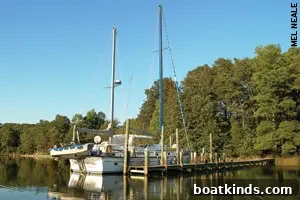
Home, for us, is the boat and the many waters it carries us across. Still, life keeps circling: we move forward and sometimes come back to land.
Living aboard taught me fast that nothing stays new forever. I quickly learned skills I’d never needed at home—mostly because calling a service person from a remote boat often wasn’t an option. I became the family plumber, and later the family mechanic, because hiring help was either impossible or unaffordable. With three women aboard I learned to deal with things I didn’t like to do, and I got pretty good at them out of necessity.
My Perkins diesel was a frequent source of trouble. While others might call a tow boat, park in a marina and wait for a mechanic, we had sold the house and couldn’t afford that luxury. I learned to repair engines, often in cramped, awkward positions—curled up under the salon floor trying to coax an impeller out of a hidden raw-water pump. Dolls and other oddities would tumble down into the bilge and add a surreal touch to the job.

Electricity and fresh water were more lessons in self-reliance. At home you flip a switch; on the boat you check oil, coolant, belts and hoses, press preheat and start buttons, and pray the generator will cooperate. The generator never purred—it shuddered and rattled and drowned out almost everything else. We tried wind generators too, but they had their own loud personality.
Water was another challenge. In the Bahamas we learned that potable water could be hard to come by. I installed a watermaker that produced fresh water from seawater, but running it required the generator and high pressure plumbing that could leak spectacularly when things went wrong. Fixing that plumbing felt like battling a flood with a mop.
The unreal “real” world
On land, do-it-yourself projects are an occasional weekend task. On a boat, “do it yourself” is daily reality. There’s no quick trip to the hardware store when you’re off shore, so you must anticipate problems and carry the right parts. Boats aren’t boxy like houses; they curve and bend, and nothing lines up conveniently. I learned to improvise, often creating solutions that felt a little like magic.
One sobering realization was that when something goes badly wrong at sea—fire, lightning strike or a major leak—there is no calling 911 and standing in a yard waiting for help. You either hold on to your floating home or launch the life raft. Despite the hard parts, I loved living aboard. The sense of freedom and self-reliance, the constantly changing view and the ability to move if you don’t like your neighbors made it worthwhile.
Still, there are times when you need a break from constant maintenance, engine alarms and storm watches.
The unthinkable
My wife, Mel, began to voice concerns about safety and comfort as we aged. She asked what we would do if someone were badly hurt or seriously ill. Turning sixty and dealing with a few injuries had made me more aware of those possibilities. She asked whether I might welcome an occasional break from running diesels, checking sails, fixing pumps or worrying about dragging anchor and lightning. Those questions led to a surprising idea: getting a land house again.
We hadn’t had a house in almost 30 years. Mel, who had been an enthusiastic partner in the decision to move aboard, now began exploring options for a house we could use occasionally—a sturdy, weather-resistant place that wouldn’t sit half-built in the rain and that could be completed on a reliable schedule. We wanted a modular house: factory-built indoors and transported ready to sit on a foundation. Those homes are built to travel on flatbed trucks, so they’re designed to handle wind and heavy handling before they arrive—qualities that appealed to us because they felt familiar, almost boatlike.
A special delivery
We owned waterfront land with a pier and a protected dock—a place that feels safe in a storm. We wanted a home there that would serve as our harbor and retreat. Chesapeake Homes in Lively, Va., had a long history of building modular homes, and their steady workload meant they could deliver on time. Lloyd Dilday, who runs the shop, worked hands-on with us. We placed an order, paid a deposit, and then sailed away while they built our house.
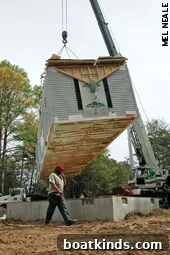
When the delivery day came, the logistics were dramatic. Our property sits beyond state-maintained roads, down a country dirt lane with sharp turns and trees. The house sections could not travel that route, so the builder and neighbors coordinated a creative route: the trucks stopped before our lane, drove down a neighboring farm driveway and crossed wheat fields to reach our land. The image of two house sections lumbering through tall wheat and emerging through trees was surreal.
A giant crane lifted each prewired, plumbed section and set it onto our cinder-block foundation. The sections were delivered complete with appliances and much of the interior finished. By late afternoon the house was weather-tight and secure—more so than some new boats I’d had.
Home, sweet home
When we returned to Chez Nous and later came to the property, the house felt enormous compared with our boat. Turning on a tap produced water without the thump of a pump; flipping lights didn’t require generators or inverters. Windows closed out wind and rain; we sat and watched a storm blow past without having to batten down hatches. It was oddly luxurious.

We furnished the place with a mix of used and new pieces and decided to try an overnight stay. It felt familiar in small ways—our old low glass table was back in front of the fireplace, and for the first meal there we sat and remembered the long arc of our family’s life: living ashore, moving aboard, raising two daughters, learning to fix everything, surviving storms and sailing thousands of miles.
Unfamiliar sounds
Sleeping in a house after years at sea was unsettling. On a boat you sleep with constant awareness: the creak of rigging, the gurgle of water, the bilge pump cycling, or a change in balance that could mean dragging anchor. Those small noises are warnings. A house is quiet in a different way; it doesn’t tell you when a stranger approaches, and it doesn’t shift to signal danger. Instead there are woods sounds—night animals, distant cries, and sudden predatory calls that reminded me of camping as a child.
That first night I lay awake, alert to sounds that a house wouldn’t interpret the way a seaman does. It took months of visits and adjustments before the house began to feel more familiar. I learned the crawl space like a bilge, climbed the attic like a mast, mapped wiring and plumbing and installed a Generac generator to handle power outages. Gradually, this land retreat became more like a secondary harbor—comfortable and practical.
We haven’t abandoned the boat or “swallowed the anchor.” The sea remains part of us and the boat stays home. Our modular house is a resort-style refuge: a convenient, comfortable harbor for recovery, rest and family visits. It gives us the luxury of choice—time ashore without giving up life afloat.
Still, whenever we sleep there, a sound buried in the psyche calls me back: the sea always beckons, and for now it is where we continue to roam.
Tom Neale is technical editor for Soundings and lives aboard a Gulfstar 53 motorsailer. He is the author of the book “All in the Same Boat.” Website: www.tomneale.com
This article originally appeared in the November 2010 issue.