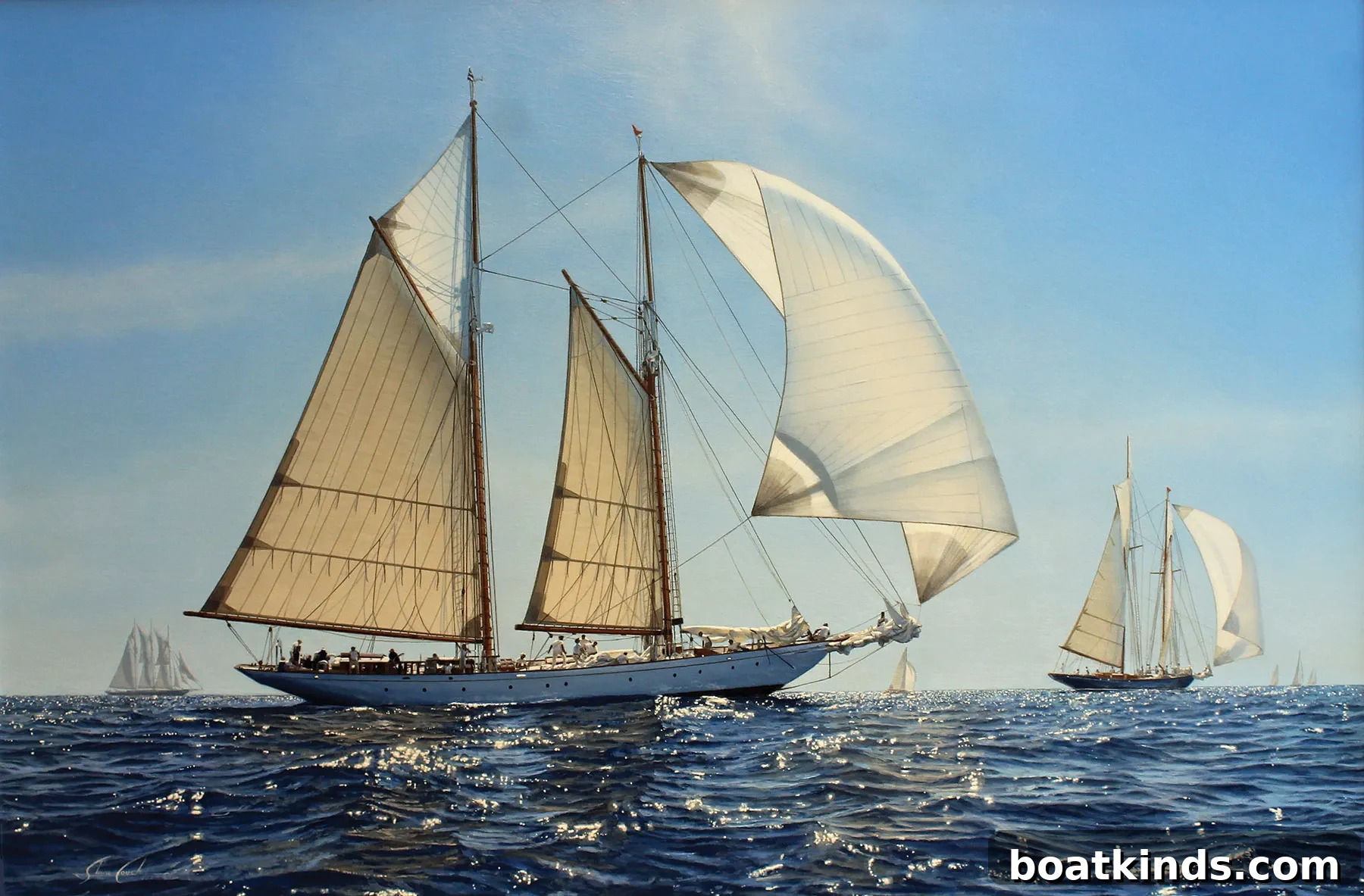
Shane Couch: Painting the Great Classic Yachts
Not every marine artist has the opportunity to stand on the decks of the vessels they paint. Shane Couch is an exception. His lifelong fascination with the grand sailing yachts of the late 19th and early 20th centuries has taken him aboard many of the classic schooners celebrated by the International Schooner Association (ISA). Among the vessels that have inspired his work are Puritan and Mariette, both pictured here, which exemplify the elegance and engineering of that golden age of yacht design.
Couch’s work focuses on the thoroughbreds of their day: large racing schooners, stately superyachts, and the J Class vessels that continue to capture sailors’ imaginations. A self-taught painter, Couch began developing his artistic skill while working as an engineer in the aircraft industry. That technical foundation has informed his approach to composition and accuracy. His first notable professional success came in 1995 when he was commissioned to produce a series of paintings for a book on Kaiser Wilhelm’s five Meteors, a project that helped establish his reputation in maritime art circles.
Oil paint is Couch’s chosen medium. He uses it to explore the shifting effects of light and the dynamic motion of wind and water, concentrating on the details that bring large yachts to life: the sweep of a spar, the tension of a running rig, the delicate translucence of spinnakers when backlit by the sun. In works such as Puritan After the Jibe—which won the Maritime Gallery Yachting Award at the Mystic Seaport International Marine Art Exhibition—Couch captures a decisive racing moment: the 126-foot John Alden–designed schooner has rounded the downwind mark and the crew is busily trimming the chute in pursuit of Mariette, while the three-masted schooner Atlantic shoulders the horizon in the distance.
His paintings are more than accurate renderings of celebrated yachts; they are immersive scenes that place the viewer in the midst of action. Drawing on his engineering background, Couch builds 3-D computer models from original lines and plans. These models allow him to study proportion, perspective, and the interaction of light on complex forms before committing to canvas. The result is imagery that feels both technically faithful and emotionally immediate—work that conveys the scale, the speed, and the personality of classic sailing craft without sacrificing painterly atmosphere.
Central to Couch’s marine painting is the sea itself. For him, the ocean is not a mere setting but the essential character in every composition. Whether depicting a breaking wave on a sandy shore or the curling bow wave of a schooner slicing through swell, he seeks the living quality of water: its constant motion, its changing reflections, and the way it responds to wind, light, and the hulls that cut through it. “The sea in all its forms has long been the focus of my work,” he says, “be it a wave breaking on a sandy beach or the curling bow wave of a beautiful yacht. I’m drawn to the interplay of light on the constantly moving and changing surface of the sea.” That fascination with water is inseparable from his affection for the large yachts that sail upon it.
Maritime art lovers and sailors alike appreciate Couch’s balance of historical respect and sensory immediacy. His paintings resonate with collectors who value both the pedigree of classic yacht design and the vivid way he renders atmosphere and motion. By combining accurate research, technical modeling, and a painter’s attention to light, Couch continues to document and celebrate a distinctive maritime heritage.
This profile highlights work that bridges engineering precision and artistic feeling, offering viewers a sense of being present at key moments in classic yacht racing and cruising. Couch’s dedication to authenticity, combined with an evident love for the subjects he paints, ensures his work remains relevant to contemporary audiences and faithful to the traditions that inspired him.
This article was originally published in the December 2020 issue.