Dee Caffari Becomes First Woman to Sail Solo Around the World Both Ways
Dee Caffari, a former British physical education teacher turned professional sailor, has made history by becoming the first woman to complete solo, nonstop circumnavigations of the globe in both directions. Having already achieved a westabout, against-the-grain voyage in 2006, Caffari recently finished the Vendée Globe and thereby secured her place in sailing history.
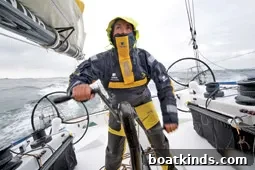
Caffari described her motivation simply: “For me, life is about pushing the limits and stretching boundaries.” That mindset drove her toward the Vendée Globe, widely regarded as the ultimate solo ocean race. She publicly stated her ambition to compete at the highest level and to attempt another world first by entering the event.
The Vendée Globe is a nonstop, single-handed circumnavigation that attracts the world’s top solo sailors every four years. The 2008–2009 edition of the race started on Nov. 9 from Les Sables d’Olonne, France, and features some of the most advanced offshore racing yachts and the most demanding conditions found in any sailing competition. Dee Caffari crossed the finish line on Feb. 16, completing the course in 99 days, 1 hour, 10 minutes and 57 seconds and placing sixth among 30 starters.
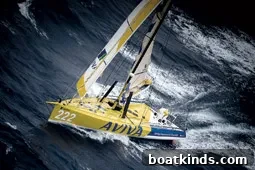
At the time of reporting, six skippers had completed the race, two were within a few hundred miles of the finish, and three remained with more than 2,000 miles to sail. French skipper Michel Desjoyeaux won the Vendée Globe that year and smashed the race record by finishing on Feb. 1 after 84 days, 3 hours and 9 minutes at sea. Many other competitors were forced to retire because of injuries or mechanical failures, underscoring how unforgiving the circumnavigation can be.
Caffari’s path to this milestone has been marked by rapid progression and resilience. She first began sailing with her father as a child and later became a dinghy instructor while attending university. After working as a physical education teacher for a time, she left that career to pursue sailing full time. Her first major solo expedition, the Aviva Challenge, began Nov. 20, 2005, when she departed her home port of Portsmouth, England, aboard the 72-foot class yacht Aviva.
That earlier westabout voyage covered roughly 29,000 miles and culminated when she crossed her outbound track off northwestern Africa, officially completing a “wrong way” circumnavigation—so called because it travels westward against the prevailing winds and currents. At the time, very few sailors had completed a nonstop solo westabout trip; Sir Chay Blyth was one of the pioneers, completing the feat in 1971.
For the Vendée Globe, Caffari campaigned a new Open 60 yacht, also named Aviva. Open 60s are high-performance machines at the cutting edge of offshore yacht technology; they are designed for speed and for the extreme demands of solo ocean racing. Caffari acknowledged that stepping up to this class would be a steep learning curve but also a major advance in her racing capabilities.
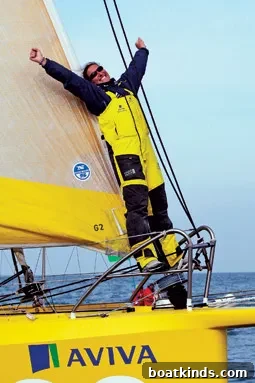
Participating in the Vendée Globe required Caffari to race directly against other elite solo sailors, a very different challenge from her previous solo circumnavigation, where she sailed largely on her own schedule. “There is added pressure from being in a competitive arena, but that is what makes the race so special,” she said before the start. Despite admitting to nervousness, she made it clear she intended to rise to the occasion.
Caffari has spoken candidly about the emotional highs and lows of offshore racing. Recalling her early experiences in Open 60s, she once said she had hated her first solo race and even cried through much of it after being dismasted near the finish. That difficult beginning, however, turned into determination and steady growth as she adapted to the boat and to solo ocean life.
Her achievements highlight both individual perseverance and the technological evolution of modern ocean racing. Completing nonstop solo circumnavigations in both directions demonstrates not only exceptional seamanship and endurance but also mastery of the sophisticated yachts used in contemporary offshore races.
This account originally appeared in the April 2009 issue.
For reference: www.vendeeglobe.org/en and www.avivaoceanracing.com