
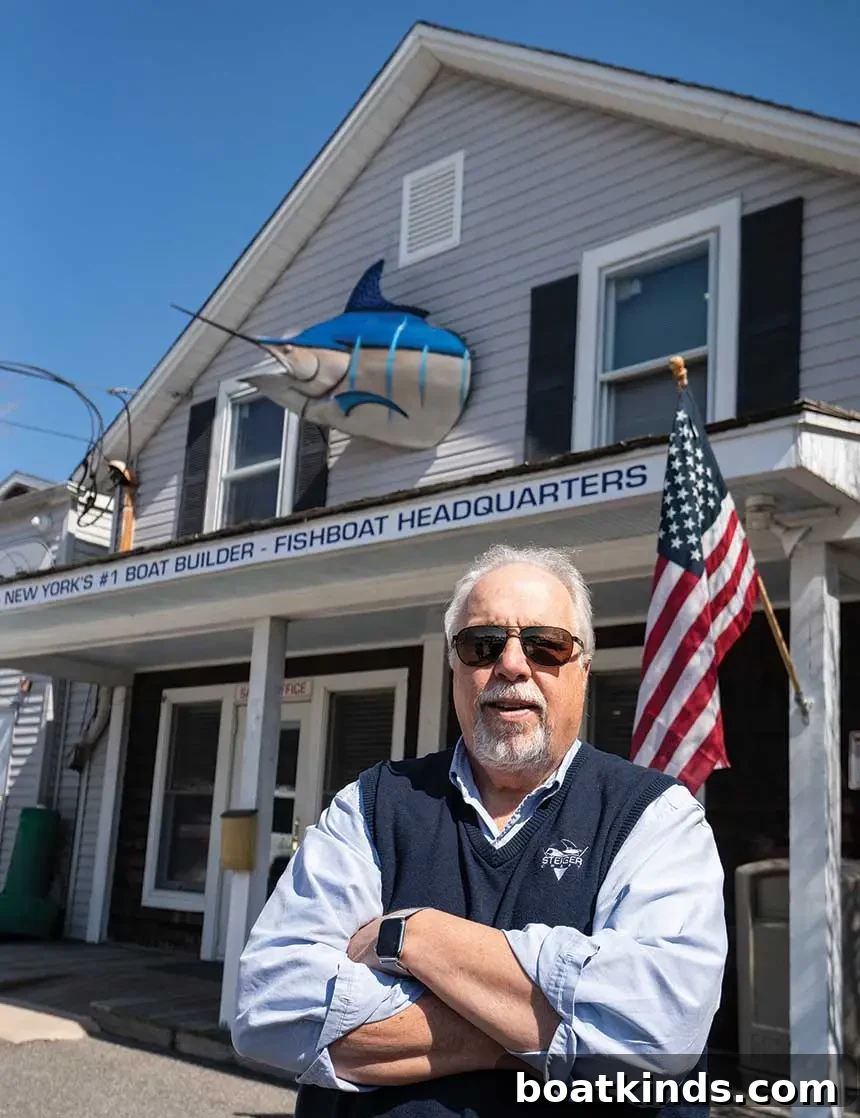
The sharp scent of fiberglass resin hangs over Steiger Craft, a compact four-acre collection of sheds in Bellport, New York, located on the site of a former wholesale bakery. Alan Steiger, 66, the baker’s grandson, runs the yard today and is helping preserve one of the last boatbuilding shipyards on Long Island.
With the Scopinich family recently announcing plans to end boatbuilding at Hampton Shipyard after five generations, Long Island now has far more facilities devoted to maintenance, dockage and storage than to actual boat construction. Dozens of yards built boats here from the late 1800s through the mid-1900s; as condo development and changing buyer preferences reshaped the region, many of those builders closed. Steiger Craft remains one of the few shops still producing locally styled hulls.
Other manufacturers such as Hustler Powerboats in Calverton and Super Boat International Productions in Lindenhurst remain active, but their output is limited, often to a dozen or fewer powerboats each year. By contrast, Steiger Craft’s workforce of about 45 full-time employees—many with 30 to 40 years at the company—produces roughly 120 to 150 boats annually. The company offers roughly 15 models, concentrating on five popular sizes: 21, 23, 25, 28 and 31 feet. The 25-foot model is the bestseller and sells for about $120,000; the top-of-the-line models start at around $225,000. Steiger Craft supports six regional dealers with a total of 16 locations, and annual sales have been in the $8–9 million range with projections toward $10–11 million.
“We build three boats a week,” Steiger says. “Back when we were making 16-foot boats, we could turn out about 10 a day.”
Like the rest of the industry, Steiger Craft was hit hard by the 2008 Great Recession. Orders dropped from about 120 boats in 2007 to just 25 in 2009. To survive, Steiger diversified and did contract work for the U.S. Navy until recreational demand recovered.
Steiger admits he wasn’t always eager to join the family business. Growing up, he preferred being on the water to being inside a building—commercial fishing, clamming, crabbing and scalloping kept him busy during his youth. In high school he began designing boats and maintained a small woodshop on the property, building commercial fishing gear and wooden boats in his spare time. By 1972 he left commercial fishing because it didn’t pay enough and transitioned into selling supplies to other clammers and building boats full-time.
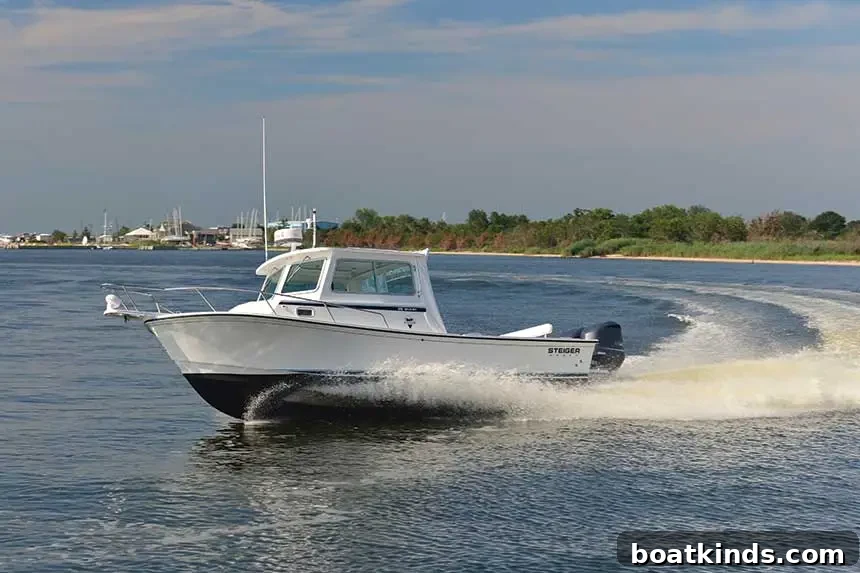
Steiger began building in wood, but by 1975 he had switched to hand-laid fiberglass construction—a method he still uses. Today, the only substantial wooden element in most Steiger Craft boats is the transom. Steiger relies on skilled craftsmen rather than automated assembly, convinced that handwork delivers the quality he wants.
Although Steiger Craft’s boats were originally designed for the shallow waters of Long Island’s Great South Bay, the company broadened its designs in the mid-1990s to include deep-V hulls suited to ocean recreational fishing. Nearly everything that goes into a Steiger Craft boat is made on site: the wooden patterns and molds, many fiberglass components and the interior assemblies. Engines come from manufacturers such as Yamaha, Suzuki and Evinrude, and stainless hardware is purchased, but most wood and fiberglass work is produced in-house.
Design development remains active. Steiger still sketches and refines ideas, sometimes on an erasable board behind his desk that a company carpenter built. “We’re making changes every year to all of our boats,” he explains. Recent updates included raising the freeboard on the 21-, 23- and 25-foot models; similar changes are now being made to the 28- and 31-foot models. Interiors and deck layouts are routinely revised—the 31-footer is receiving a new arrangement, and the 28-footer will offer optional air conditioning and heating, along with an enlarged cabin and additional features.
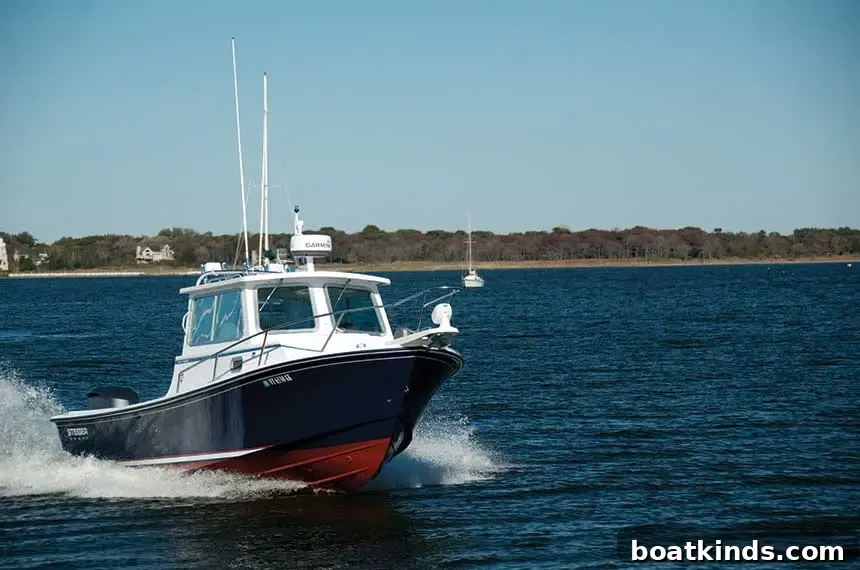
Most Steiger Craft owners are fishermen who also take family outings to the beach or to Fire Island. One of the yard’s most notable customers was Long Island native Billy Joel, who owned more than 20 boats over the years. “Billy Joel had the only Steiger Craft inboard that we ever built, and used it to commute back and forth to the city,” Steiger recalls, referring to Manhattan.
Family remains connected to the business: Steiger’s wife, Erin, initially became a customer before the two began a relationship, and she sometimes helps at the yard. Steiger’s stepson, Connor Brogan, lives nearby and serves as night watchman when he is not working in law enforcement.
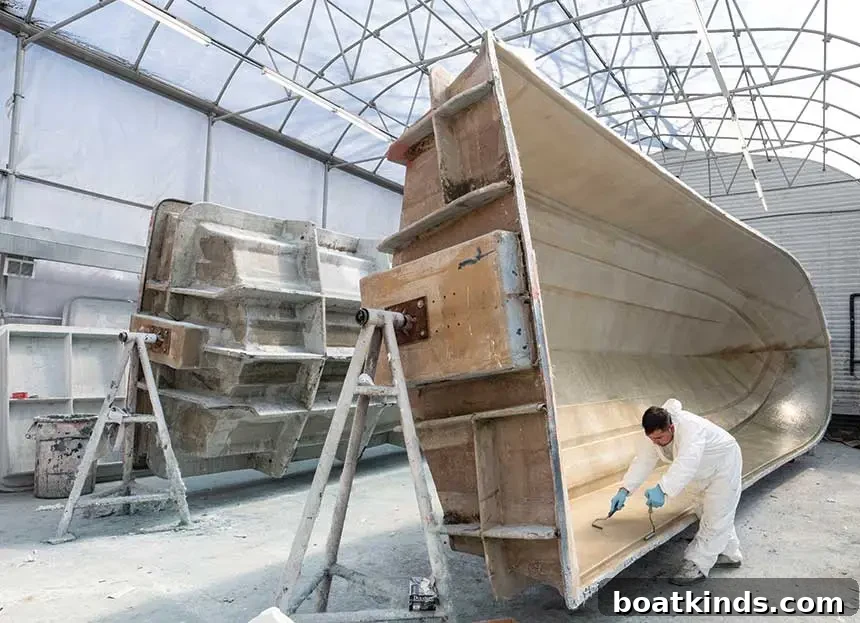
Construction at Steiger Craft is straightforward but labor intensive. Building a single boat typically takes about four weeks and 400 to 500 worker hours. The process begins with hand-carved wooden patterns that are used once to produce a fiberglass mirror-image mold. Fiberglass molds are expensive—Steiger says they cost around $1 million to create—but durable, usable until a model is redesigned. Unused molds sit in a grassy area at the back of the property, bright with color like a small outdoor sculpture collection.
With the fiberglass mold prepared, the team waxes it and sprays on a colored gelcoat, the outermost layer of the completed hull. About 20 layers of fiberglass cloth and resin are applied over the gelcoat. Fiberglass stringers are installed next and injected with foam, which helps stabilize components, reduce noise and add buoyancy in case the boat takes on water. Steiger points to the stringer system his shop developed as a key factor in the strength of their boats.
Hatches and many other fittings are fabricated from StarBoard, a marine-grade polymer, using a computer-controlled router to ensure parts are interchangeable and produced efficiently. Craftsmen then fit rails, cleats and additional hardware by hand with power tools.
Despite an industry trend of relocating operations to regions with lower labor costs, Steiger has no plans to move. He appreciates the work ethic and skills of his Long Island employees and prefers to remain on the island where the company has deep roots. “There’s no place like Long Island,” he says. “The average New Yorker works three or four times smarter and harder than a guy living somewhere else. Even though I pay more, I get more.”
This article originally appeared in the August 2019 issue.