
If you cruise enough, eventually you will face heavy weather. Preparing in advance is ideal, as I described in Part One (February issue) on how to ready a boat and crew for an approaching front. But if you are offshore when conditions deteriorate, you must manage what comes at you. The tactics you choose depend on the sea state, wind strength, your vessel type and your crew’s experience. This article focuses on practical, time-tested techniques for handling heavy weather under sail and power.
Boat size and design have a big influence on how you should respond. A Force 6 gale on a 20-foot cruiser feels very different than it does on a large yacht; perception matters. Sailboats and powerboats react differently in rough seas, but many initial actions are similar: stay calm, reduce risk, and put the boat in the safest attitude relative to the waves.
When wind and seas build, the most effective immediate strategy is often to run with the sea rather than try to fight it. Avoid taking waves dead astern if you can — a stern-on impact is jarring and can lead to uncomfortable or dangerous broaching. Instead, steer off the oncoming waves so the seas hit on the quarter at an angle of roughly 25–30 degrees. This reduces shock loads on the hull and provides better directional control. Keep a vigilant lookout aft; large or irregular waves can spin the boat and cause an unintended broach.
On powerboats, retract trim tabs in heavy conditions if your boat is so equipped. Tabs down can dull rudder response or even cause the stern to “trip” and swing unpredictably. The most capable and experienced helmsman should handle the wheel or tiller in foul weather, watching for oncoming waves and adjusting throttle and steering to keep the boat in the safest attitude. Smooth throttle work helps prevent burying the bow when surfing down steep wave faces.
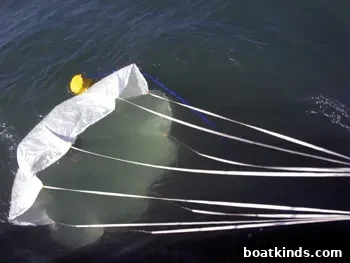
When a boat surfs, speed can become a problem: if you accelerate too far down a wave the bow can bury in the trough and the following sea may overwhelm the cockpit. Towing a long warp looped between stern cleats can help dampen that speed and stabilize the stern. Use nylon rope—its elasticity absorbs shock loads—and try different lengths in benign conditions so you know what works before the weather turns truly severe.
For sailboats, mastering the heave-to maneuver is essential. Heaving-to is an age-old heavy-weather tactic that effectively stops the boat’s forward motion while keeping it in a safe, predictable attitude to the waves. To heave-to, sheet the foresail to weather, ease and secure the mainsail, and lash the tiller or wheel off to leeward. The backed headsail and the trimmed mainsail counteract each other so the boat holds a stable, slow drift with little steerage required. Long-keeled yachts tend to heave-to more readily than fin-keeled boats, but nearly any boat can be brought to a hove-to attitude with proper sail trim and practice.
Practice heaving-to and other heavy-weather techniques in moderate conditions so crew members learn the steps and can perform them smoothly under stress. I use heaving-to frequently when I sail alone to allow time for cooking, navigation fixes or simple rest from the helm. Done correctly, the boat rides the waves calmly, noise and motion diminish, and crew can recover from the strain of high seas.
If you need to keep making way but the boat is running too fast or becoming unmanageable on the downwind faces, consider deploying a drogue. Drogues create significant drag to reduce speed and improve directional stability. Choose the correct type and size for your vessel, fit a robust attachment point—strong mooring bitts or winches rather than a flimsy cleat—and use a bridle if possible to distribute loads. Protect lines against chafe and inspect gear often: drogue loads can be immense and even thick lines can wear quickly.
Finally, remember that in extreme storms it is sometimes not the boat but the crew who loses the fight. During the catastrophic 1979 Fastnet Race, many crews abandoned their boats; several of those vessels were later recovered afloat but battered. Life rafts saved lives but some failed or capsized, highlighting the need for good preparation, seamanship and persistence. Heavy-weather seamanship is as much about mindset as it is about technique—maintain situational awareness, secure the boat, and keep focused on practical measures that improve safety and control.
This article originally appeared in the April 2016 issue.