
The steam barkentine Bear enjoyed an extraordinary 70-year career that few ships in maritime history can match. Built for the harsh demands of sealing and polar work, she later served as a revenue cutter, a search-and-rescue vessel, an Arctic explorer’s support ship, a floating courthouse, a museum attraction and even a movie star. Her varied roles over seven decades made the Bear an enduring symbol of maritime resilience, northern service and exploration.
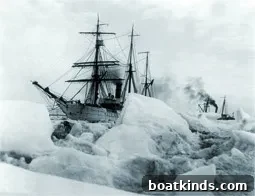
The photograph above shows Bear in the roadstead at Nome, Alaska, captured during the vessel’s 42-year tenure with the U.S. Revenue Cutter Service. While based in Alaskan waters, Bear was a visible presence enforcing law and order in remote regions. She performed harbor surveys and gathered hydrographic data that helped mariners navigate those difficult coastlines, and she stood ready to assist shipwrecked whalers and other mariners in distress.
Bear began life in Scotland, launched in 1874 as a new-generation sealing vessel designed for the Arctic pack ice. Her construction featured a compound steam engine and a robust wooden hull six inches thick, attributes intended to withstand ice pressure and cold-water operations. For roughly a decade she worked the Labrador–Newfoundland sealing trade, mastering the rigors of ice navigation and long northern voyages.
In 1884 the United States government purchased the Bear and put her to immediate use in Arctic operations, including the search for the explorer Adolphus Greeley. The following year she was assigned to patrol Alaskan waters. In that duty she carried out a wide range of missions: policing against seal poaching, protecting coastal communities from illicit trade, aiding stranded and shipwrecked crews, and serving as a mobile court of law when civil authority was needed in far-flung settlements. One of her most famous commanding officers was Captain “Hell Roaring” Mike Healy, who became synonymous with the cutter’s law-enforcement and humanitarian work in Alaska.
Throughout her long life Bear transitioned through roles that reflected the changing needs of the times. By 1926 she had entered a second career as a museum ship, preserving the public’s link to seafaring history and polar exploration. She even appeared on the silver screen, taking part in the 1930 Hollywood film “Sea Wolf.” Her Antarctic credentials were reinforced when she sailed with Admiral Richard Byrd and later with the U.S. Antarctic Service, participating in voyages that supported polar research and logistics.
Bear’s service extended into wartime. From 1941 to 1944 she operated in the Northeast Atlantic Patrol during World War II, where she continued to perform the vigilant, often hazardous duties that had defined her earlier years; during that patrol she captured an enemy supply ship, underlining the cutter’s adaptability to armed service and convoy protection roles.
After the war, Bear’s seafaring days drew to a slower end. In 1948 she was purchased with the intent of returning to sealing, a voyage that ultimately never took place. Instead, the vessel languished in Halifax, Nova Scotia, for nearly two decades, gradually deteriorating as plans for her future fell through. Her long and storied existence finally ended in 1963 when, while under tow to Philadelphia where she was to be repurposed as a floating restaurant, Bear sank in a gale. According to reports from that final passage, a mast broke and punctured the hull, causing the cutter to founder before she could reach her new berth.
By the time of her sinking, the Bear had left a legacy that touched exploration, law enforcement, humanitarian rescue and public history. From icebreaking sealing ship to Revenue Cutter Service workhorse, from Antarctic support vessel and movie player to a museum exhibit, her varied career reflects both the demands of polar maritime service and the many lives one ship can live. The story of Bear remains a compelling chapter in the history of Arctic and Antarctic service, of the U.S. Revenue Cutter Service, and of maritime perseverance in extreme environments.
February 2014 issue