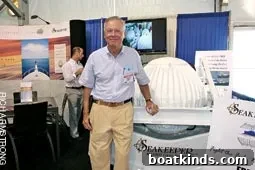
With Shepard McKenney, founder and CEO of Seakeeper.
Shepard McKenney is the founder and chief executive officer of Seakeeper Inc., headquartered in Solomons, Maryland. Seakeeper manufactures gyroscopic anti-roll stabilizers for recreational and commercial boats. A former chairman and owner of The Hinckley Company, McKenney, 68, played a central role in the creation of Hinckley’s celebrated Picnic Boat—one of the first small recreational boats to feature waterjet propulsion and joystick steering.
McKenney began his professional life as a lawyer and later became president of a hotel chain before moving into the marine industry. Seakeeper’s gyroscopes are now offered by many leading builders of cruising and sportfishing yachts. He lives near the mouth of the Potomac River and fishes from a custom 22-foot skiff designed by Bruce King, the Picnic Boat’s designer.
Q: What’s the story behind the Hinckley Picnic Boat?
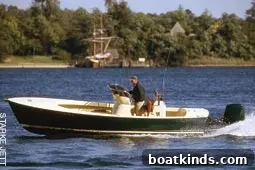
A: When Bob Hinckley and I bought Hinckley in 1982, the company was primarily a sailboat builder. I wanted to return Hinckley to its roots—boats that were designed from the outside in: low freeboard, minimal superstructure and timelessly beautiful lines. At that time the market was moving in the opposite direction, focused on interior accommodations. After years of wrestling with that trend, I decided to develop a powerboat that reflected how owners actually used their boats: as dayboats. My goal was to combine elegant styling with shallow draft, easy handling and the right functionality for short excursions.
At first, sales staff weren’t enthusiastic. The Picnic Boat lacked full standing headroom below and was compact for its length—making it expensive relative to size. It was a risk. I also thought waterjet propulsion would be a niche option and that dual-prop outdrives would dominate. Instead, the jet configuration proved extremely popular—we built only a few boats with conventional drives and more than 500 with jet propulsion.
Q: So it wasn’t an obvious market hit from the outset?
A: Far from it. The Picnic Boat challenged contemporary ideas about boat design. Customers were asking for more accommodations, but product innovation often comes from offering something people didn’t know they wanted. The Picnic Boat answered a real but unarticulated need: a beautiful, easy-to-operate dayboat for shallow water. When a design excites me personally, I trust it will resonate with others even if it’s not what they’re explicitly requesting.
Q: What makes the Picnic Boat appealing to such a wide audience, including high-profile owners?
A: Two things. First, intrinsic beauty—boats with balanced proportions and refined lines attract attention. Second, practicality: the Picnic Boat addresses how most people actually use boats. Even owners of larger yachts often use them as dayboats. The Picnic Boat doesn’t pretend to be a floating house; it is optimized for short outings—comfort, ease of use and style combined.
Q: Tell us about Seakeeper and how gyro stabilization works.
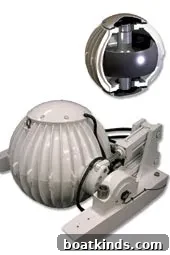
A: Gyro stabilization relies on control-moment gyroscope principles that have been developed for over a century, beginning with work by Elmer Sperry. Unlike a simple gyroscope that provides a reference, a control-moment gyro actively exerts torque to counteract unwanted motion. A heavy flywheel spins at high speed; when the gyro is tilted, it generates torque 90 degrees from the tilt direction. In our installations the gyro tilts fore-and-aft and, by doing so, applies corrective torque around the roll axis to reduce rolling. You can see demonstrations of this technology in company videos and product materials.
Q: Which builders offer Seakeeper gyros?
A: Seakeeper units are offered by many major builders, including Viking, Couach, Azimut, Princess, Fairline, Sunseeker, Ocean Alexander, Maritimo, Icon, Marlow, Silverton, Marquis, Ovation, Pershing, Terranova and Zeelander, among others. Some builders make gyros standard across selected models; others offer them as factory options. There are also numerous retrofit installations for boats already in service.
Q: You’ve consistently introduced new ideas in boat design and technology. Where does that drive come from?
A: It goes back to my childhood in Great Bridge, Virginia, on the Intracoastal Waterway. My father worked on gas engines near a yacht basin where I spent a lot of time around boats by builders such as Huckins and Rybovich. Those early exposures shaped my appreciation for elegant design, lightweight construction and efficient hulls. I’ve loved boats my whole life, and that passion has driven my professional choices—from law to hospitality to boatbuilding and marine technology.
Q: How did you transition from law to the marine world?
A: I trained as a lawyer because I thought it was a pathway to financial success, but after a decade in a large-city firm I wanted a different life. I entered the hotel business and did well but didn’t feel passionate about it. Having owned a Hinckley Bermuda 40 and grown close to the company, I saw Hinckley struggling in the early 1980s. I joined Bob Hinckley to buy the company, and that was the first time my work and my love of boats came together.
Q: What’s your critique of modern powerboat design?
A: Many contemporary designs prioritize packing the most accommodations into the shortest possible hull, which compromises efficiency and beauty. There’s also an excessive focus on very high speeds. Offshore sportfishing boats pushing into the 40-knot range become hard to manage in ordinary seas; high speed often sacrifices comfort and practicality and consumes excessive fuel. I believe there are practical limits to useful speed in real seaways.
Q: How can the industry attract more people to boating?
A: Make boating more accessible, comfortable and less intimidating. Technologies such as joystick docking, marina-based services (launching, fueling, provisioning and maintenance), and motion-control systems like gyros reduce barriers to entry. Gyro stabilization, in particular, eliminates one of the worst aspects of boating for many people—seasickness and uncomfortable roll—making boating appealing to a broader audience.
Q: What are some of your favorite boats?
A: My favorite powerboat ever is a 17-foot Boston Whaler—I owned two and had countless enjoyable days on them. As a child I had a 13-foot Lyman with a 10-horse Johnson. For sailboats, the Hinckley Bermuda 40 ranks high; I owned two. They combined beauty with ease of handling, with roomy cockpits and wide side decks—features that have become rarer in modern sailboat design.
Q: Do you prefer small boats?
A: Yes. I like being close to the water and connected to the experience. Given a choice, I’d choose a simple, well-designed small boat over a megayacht. Large yachts can insulate you from the elements and the direct experience of boating.
Q: Do you currently own a boat?
A: I have a 22-foot fishing skiff designed by Bruce King about a decade ago. It was built to my specifications for fly-fishing—flush cleats, integrated storage compartments, light construction and wide side decks. I use it locally on the Potomac and Chesapeake Bay and on trips to Hatteras and Cape Lookout.
Q: Can Seakeeper gyros be installed after purchase, or only at the factory?
A: Both. Factory installations are generally less costly because the space and foundation can be engineered during construction. Retrofits are possible but installation costs vary depending on available space and structural work needed. For a 50-foot recreational boat, a gyro retail price today might be in the neighborhood of $70,000 plus installation; as a rough rule, gyro costs as a percentage of boat price tend to be around 7–8 percent for smaller recreational boats and closer to 5 percent for larger yachts.
Q: What boat sizes can be equipped with a gyro?
A: We’ve installed gyros on boats as small as about 40 feet up to large yachts of roughly 37 meters (about 120 feet). We are also developing larger and smaller units. Every boat has a natural roll period and will experience roll motion—sometimes a quick, snappy roll that can be more uncomfortable than a slow motion. I expect active stabilization will become standard because a boat that doesn’t roll is simply more attractive and comfortable.
Q: Are there future innovations on Seakeeper’s roadmap?
A: We will continue refining gyros and shrinking units so they can be cost-effectively fitted to smaller boats, including the goal of stabilizing 21-foot center consoles at a price comparable to other propulsion systems. We’re also working on other motion-control technologies and planning to showcase new boat designs that take full advantage of active stabilization. By removing roll and pitch constraints from design, active motion control opens new possibilities in hull form and onboard comfort.
This interview originally appeared in the February 2010 issue.