Why a Tanker Appeared to Hover: The Science Behind Superior Mirages
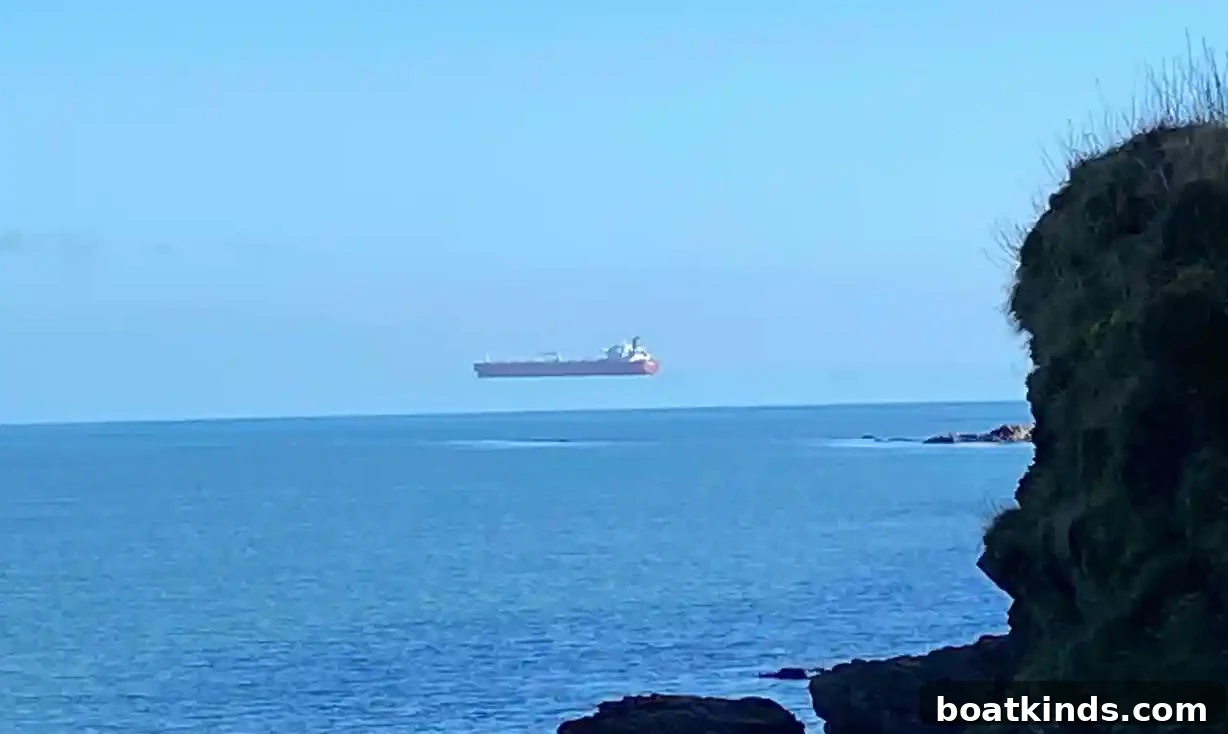
Advances in foiling and marine design have enabled boats to rise above the water on hydrofoils, but those craft are still firmly in the airless realm of physics. So when a resident of a hamlet in Cornwall watched what looked like a tanker hovering above the sea, the surprising scene was not a new kind of flying ship but a dramatic optical illusion. Understanding that illusion reveals an elegant interaction of light and air known as a superior mirage.
What David Morris Saw off the Cornish Coast
On a clear day in Cornwall, David Morris observed what appeared to be a tanker suspended above the ocean surface. The image arrested attention because it contradicted everyday expectations of how ships relate to the horizon and the sea. Instead of a vessel floating at sea level, the tanker seemed elevated, its hull detached from the water in an impossible way. This striking visual effect was the result of atmospheric conditions bending and displacing the light reaching the observer’s eye.
Temperature Inversions and Air Density
Superior mirages arise from a meteorological condition called a temperature inversion. Normally, air temperature decreases with height. During a temperature inversion, a layer of warmer air overlies cooler air near the surface. Because colder air is denser than warmer air, it has a slightly different refractive index, which changes the path of light traveling through those layers.
How Light Bends to Create the Illusion
When light passes from one layer of air to another with a different temperature and density, it refracts—meaning the light rays curve. In a superior mirage, light from an object near the sea is bent downward as it travels through the vertical temperature gradient and then into the observer’s eye. The brain, interpreting light as if it has traveled in straight lines, reconstructs the object’s apparent position along those perceived straight paths. The result: objects that are actually at sea level appear to sit higher in the sky or even above the horizon.
Where and When Superior Mirages Occur
Superior mirages are most commonly reported in polar and subpolar regions, where strong and persistent temperature inversions are frequent. However, they can occur anywhere the right combination of calm air, clear visibility, and layered temperature profiles exists—including temperate coastlines like Cornwall under suitable conditions. Observations are often clearest over large, flat expanses such as the open sea or frozen surfaces, where extended air layers can form and remain stable.
Variants: Fata Morgana and Other Complex Mirages
Some superior mirages take on elaborate, rapidly changing shapes known as Fata Morgana. These complex mirages result from multiple stacked layers of air with varying temperatures that refract light in different ways, producing stretched, inverted, or duplicated images. Mariners and shorewatchers have long reported ships and coastlines appearing fragmented, elongated, or floating—accounts now explained by these refractive phenomena.
Why This Is Not a Flying Boat
Despite the startling impression, no laws of physics have been broken: the tanker was not airborne. Modern hydrofoil boats can lift their hulls clear of the water using underwater wings, but even those remain supported by hydrodynamic forces in the water rather than by aerodynamic lift in free air. The Cornwall sighting illustrates instead how atmospheric layering can trick the eye into misplacing an object’s actual position.
Practical Tips for Observers
If you want to observe a superior mirage, look for long, flat horizons on calm days when a visible inversion is likely—early morning or late evening can be favorable. Binoculars and a steady viewpoint from an elevated shore position improve visibility. Remember that what you are seeing is an optical effect, not a change in the object itself.
Why These Mirages Continue to Fascinate
Superior mirages combine simple physics and rare atmospheric alignment to produce images that seem to defy reality. They have inspired sailors’ stories and shoreline curiosity for centuries and continue to be a powerful reminder that our perception of the world depends not only on the objects we see but also on the air through which their light travels. While boats are not flying, the sight of a tanker hovering above the sea is a beautiful example of nature’s optical artistry.