
With measured praise, the editors of Nautical Quarterly described the Concordia yawl in their Summer 1983 issue as “as much a classic as any sailing yacht in the world for its beauty, its superb construction” and its racing success. Owners and sailors have echoed that sentiment. One owner captured the boat’s appeal in a single line: “She is breathtaking and sails like an angel’s wing.”
The origin of this celebrated Concordia yawl is rooted in a dramatic event at sea. When the Great Hurricane of 1938 swept across Buzzard’s Bay and struck Padanaram, Massachusetts, it left a trail of wreckage and overturned moorings. Boats that had been safely tied up were driven onto the beach and against bridges; among them was a familiar pilot boat named Escape.
Escape was a Colin Archer–style pilot boat, built in 1890 and owned by yachtsman Llewellyn Howland. His son Waldo Howland, working with designer and Marblehead racer C. Raymond Hunt at the Concordia Company yard, faced the loss with practicality and determination. The disaster set in motion a design effort that would produce one of the most admired small cruising and racing yachts of the 20th century.
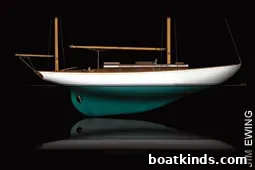
The replacement was conceived as a yawl for versatility in coastal waters and for handling the short, steely chop of Buzzard’s Bay, where afternoon winds often built whitecaps. Hunt and Waldo Howland collaborated on what the company catalogued as Design No. 14. The resulting 39-foot yawl, christened Java, combined graceful lines with practical seakeeping. Its lean, shapely hull was accented by a long cove stripe featuring a star at the bow and a crescent moon at the stern, an aesthetic that quickly became a Concordia signature.
Below decks the Concordia yawl retained the warmth and comfort of a New England home. Knotty pine cabinetry and corduroy cushions gave the interior a cozy, lived-in feel that appealed to cruising families and serious sailors alike. Though the initial intent was not to create a production model—”We never had any plan to build more than one,” Howland later said—the design’s combination of beauty, seaworthiness and onboard comfort made it an immediate success.
Over the next 28 years Concordia built 102 additional examples of Design 14. Those boats attracted devoted owners who prized them for both club racing and extended cruising. Concordias proved themselves on offshore courses and in club regattas, claiming victories in events such as the Newport Bermuda Race, the Halifax-to-Marblehead and the Annapolis–Newport ocean race. Equally important to many owners was the ability to cruise extensively while enjoying a classic, well-finished interior.
Attention to construction quality and the community of devoted owners helped preserve these yachts. Concordia hulls and joinery were maintained with care across decades, and many boats received sympathetic restorations that kept original lines and character intact. Today the near-total survival of the class is remarkable: of the 103 Design 14s built, 102 are still known to exist, testament to the strong feelings owners have for these yachts and to their robust construction.
Beyond racing honors and construction notes, the Concordia yawl occupies a special place in sailing history because it marries form and function. Its lines are admired on aesthetic grounds, while its performance and accommodation satisfy practical demands. That rare combination explains why Concordias continue to appear at classic boat gatherings, in cruising waters and in the minds of sailors who value traditional design executed with skill.
The tale of Java and the Concordia Design 14 began with a violent storm but grew into a legacy defined by timeless design, careful craftsmanship and enduring owner devotion. Whether remembered for its distinctive star-and-moon cove stripe, its comfortable pine-lined interior or its reputation under sail, the Concordia yawl remains a quintessential example of classic yacht design.
January 2013 issue