
Modern life can be complicated. To reach my square-rigger that day I needed a car, a bus, a train and a taxi. When no cab appeared, a young police officer kindly offered me a lift. Reflecting on that last ride I thought, how a touch of gray can change your circumstances.
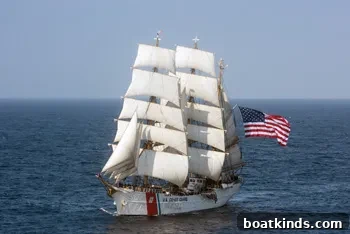
It was May 6 when I arrived in New London, Connecticut, to join the Coast Guard training barque Eagle for the passage to Dublin, Ireland. A damp, biting easterly wind met me at the pier—more like March than May. The city’s church spires and the I‑95 bridge loomed through the murk, and the outline of a submarine hull could be made out across the Thames River at General Dynamics Electric Boat. It felt like a day to sit beside a wood stove rather than sail, but somehow that gray, blustery weather seemed perfectly appropriate for boarding a traditional sailing ship.
The following morning was organized chaos. Cadets hauled sea bags on board while human chains passed stores across the gangway into the ship’s deepest lockers. Station bills appeared and duties were assigned. I met shipmates in narrow passageways and on deck. Boatswain Aaron Stapleton taught me how to use a climbing harness and escorted me — along with the mayor of New London — up the foremast. That climb qualified me for future work aloft.
When we were ready for sea, all hands mustered amidships. Departing crew said their farewells and newcomers were welcomed. The pilot came aboard and the mayor returned ashore. We slipped the lines and headed out toward the ocean.
Departure
We passed New London Ledge Lighthouse, a brick mansard structure that looks more like a lonely townhouse than a mariner’s beacon. Under power, the 295‑foot Eagle pushed through a lingering swell, passing Fishers Island, Race Rock and Montauk before entering a cloak of fog. Every line, spar and shroud dripped like the canopy of a maritime rainforest. Aboard were 225 people: 57 permanent crew, about 150 cadets from the Coast Guard Academy, reservists, auxiliaries and me, all under the command of Capt. Matthew Meilstrup, a 24‑year Coast Guard veteran and the ship’s 28th American master.
Though lilacs might be blooming elsewhere in New England, the North Atlantic presented a turbulent picture. Weather charts showed gales sweeping across the ocean with winds exceeding 50 knots, and a particularly nasty low churning near Ireland. But Eagle was built in the tradition of the great steel Cape Horners — robust, sea‑worthy vessels designed for hard weather. A sailing ship depends on wind, and we were ready for it.
Shakedown Street
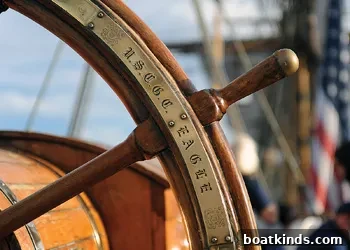
A day later the fog cleared, skies brightened and fair winds filled the sails. Those who had suffered from seasickness began to recover, and the crew wasted no time putting everyone to work: setting sail, bracing yards and trimming lines. Most cadets aboard had little or no experience with square rig, so the permanent crew led, coordinated and taught. Two groups of cadets sailed with us: an upperclass cadre who had just completed their third year at the Academy, and a larger group fresh from their first year. The senior cadets had been aboard two years earlier, but square‑rig seamanship takes practice.
A shipboard community is a microcosm of society, and the first days are about establishing that community and settling into the ship’s routines. The daily choreography—cooking, cleaning, dishwashing, training, learning, working, eating and sleeping—forces people to make friends and to cooperate with those they don’t naturally click with. It’s practical life training in a condensed, immersive setting.
Passagemaking 1
After a few days of steady progress, everyone had acclimated. Then the wind built from the northwest: 20, 25, 30, even 35 knots. Eagle came alive, sailing east along the 40th parallel with power and grace. We set and struck sail as conditions demanded and braced the yards for speed and stability. Our velocity ranged from 10 to 15+ knots, routinely hitting 13 or 14. Navigator Tom Crowley found a slot between low pressure north and high pressure south that funneled a river of fair wind aligned with the Gulf Stream. Under those conditions, the ship was exactly what she was designed to be.
Training Days
Early lessons for cadets include memorizing roughly 200 line names that control 23 sails on three masts rising 147 feet above the waterline. Cadets clutch diagrams like prayer books, running hands along pin rails and calling out unfamiliar names — port main topgallant bunt‑leechline, starboard fore royal clewline, port main tack jigger. This is no mere exercise: hauling the wrong line can damage gear or injure a shipmate, and the captain expects competence and care. Passing the line exam is also the ticket to liberty in Ireland, which is strong motivation.
But sail training serves a larger purpose than seamanship alone. A ship under sail is a demanding classroom for leadership, teamwork, coordination and the discipline of doing things correctly. The sea demands competence; it exposes complacency. The challenge for trainers is to impart those lessons while keeping everyone safe.
Between sail evolutions, cadets also rotate through practical training led by faculty, ship’s crew and specialists from the Coast Guard Reserve and Auxiliary. Sessions cover damage control, firefighting, navigation, meteorology, engineering and maintenance—skills they’ll need when assigned to their first cutters. The North Atlantic itself is an instructor: clear skies bring sextant practice, calm seas allow boat drills, and commercial traffic prompts radar plotting lessons.
Upperclass cadets play a central role in mentoring and supervising the juniors, learning to pass on knowledge rather than hoard it. Everyone aboard—officers and enlisted—models Coast Guard professionalism because their careers will intersect again; they must be able to rely on one another, sometimes under stressful conditions. As Capt. Meilstrup often says, “If you can’t make it fun, what’s the point?” and that outlook sets a positive tone on this ship.
Passagemaking 2
At times the wind fell directly aft and the ship began to roll spectacularly. It’s not unusual to see someone topple from the dining table, their face replaced momentarily by the soles of their boots. In true Coast Guard fashion, friends and shipmates often rescue meals and mugs in heroic, sometimes comic, fashion.
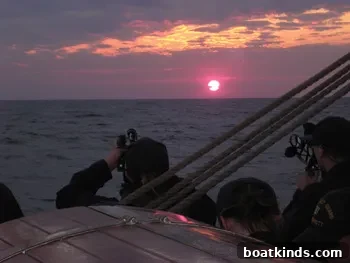
As twilight approached, cadets took positions on the fantail with sextants in hand, practicing celestial navigation. A program called Stella simplifies the math: enter the time, sextant angle and celestial body, and it provides a line of position plotted on screen. While Stella skips much of the manual computation, it demonstrates the reliability of celestial techniques independent of satellites—a valuable lesson today when GPS can be disrupted or spoofed.
To reinforce traditional navigation skills, the captain limited the ship’s GPS for most of the voyage—though it could not be fully shut down—requiring dead reckoning and celestial observations. That exercise taught students to make decisions from imperfect information, an essential real‑world skill.
History Lesson
Eagle began life in 1936 as the Horst Wessel, built at Blohm + Voss in Hamburg as one of a family of four sail training ships crafted for the German Navy. Sail training remained an important tradition in Germany even after commercial sail fell away. In 1946 the Coast Guard took custody of the vessel, renamed her Eagle, and brought her to the United States, where she has served as a training ship ever since. Her sister ships continued to serve similar roles for other nations, a testament to the sound design and enduring value of these barques.
Passagemaking 3
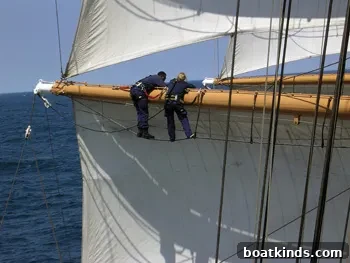
About 150 miles southwest of Ireland, the engine had been silent since somewhere off Nantucket. For two weeks the winds stayed fair—southwest, west and northwest—sometimes strong, sometimes lighter, but always favorable. Now the breeze sat on our port quarter at 25 knots and Eagle leaned into the sea, charging along at 12 to 13 knots. It was a passage to remember.
Psalm 107 speaks to those who venture on the great waters seeing the wonders of the deep, and we had our own wonders: dolphins played alongside the ship, full of exuberance; whales and the occasional pilot whale appeared off New England; and far less inviting, we sighted several large sharks that quickly quenched any thought of swimming. I also spotted a lone ocean sunfish and a few exhausted land birds seeking sanctuary in our rigging.
Landfall
At 1621 on May 23, a lookout called out Ireland. Crew and cadets crowded the rail, eager and quiet, taking in the sight and talking about plans for Dublin. There’s a special thrill in crossing an ocean under sail and watching land rise over the curve of the horizon—an emotion that’s hard to put into words.
Through the long Irish twilight we passed islands, headlands and distant mountains until the Fastnet Lighthouse began its steady five‑second flashes. Lights from shore twinkled across the water—an almost poignant reminder that for many immigrants those first lights were their last view of home.
Fair winds abandoned us before the harbor, and we motored the final miles, passing the waters off Cork where the Lusitania was lost in 1915. On the morning of May 25 a real emergency unfolded when a crewmember working overside fell into the water. Because of the safety measures in place—flotation, an assigned monitor and immediate alarm—everyone responded swiftly and professionally. The seaman was recovered within 13 minutes, cold and wiser but otherwise unharmed. Experiencing a man‑overboard event in calm conditions was an invaluable, sobering lesson for the cadets that no classroom drill could fully replicate.
Our entry into Dublin went smoothly, though we had to squeeze through a drawbridge to reach the berth. The buoyage in these waters is opposite to what many U.S. mariners expect—“Red Right Returning” must give way to “Green”—but adapting to local practice is part of seamanship, and Dublin welcomed us in the land of the shamrock.
This article originally appeared in the August 2016 issue.