Peter Truslow and EdgeWater Power Boats
Peter Truslow is the president of EdgeWater Power Boats, a company based in Edgewater, Florida, known for producing rugged, durable, high-quality open boats designed for serious boating families, commercial users and enforcement agencies. Truslow has spent virtually his entire career around boats — from growing up on Long Island and summers in Maine to selling advertising for MotorBoating magazine before joining EdgeWater. “I’ve never really been away from boats or the boating business,” he says.
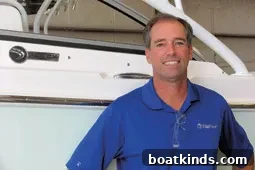
His connection to boating is literal and lifelong: born in May, he spent his first summer on his parents’ 27-foot sailboat. EdgeWater emerged in the mid-1990s after North Technology Group acquired Dougherty Marine in 1994. Truslow and CFO Bryan Powderly joined the company in 1995 to help grow the brand; Truslow created the EdgeWater trademark and branding that helped define the company’s identity.
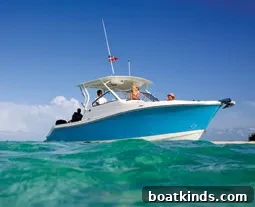
EdgeWater’s product range spans center consoles, crossovers/dual consoles, inshore boats and an express model, along with custom boats for military, law enforcement and commercial uses. The line includes center consoles from 15 to 38 feet, three crossover/dual-console models from 20 to 28 feet, four inshore boats from 19 to 24 feet, and a 33-foot express. Truslow enjoys testing and refining new models and is particularly excited about a new 36-foot center console set for its formal debut at the Fort Lauderdale International Boat Show Oct. 30–Nov. 3.
Truslow values new propulsion technologies and tinkers with alternative systems — including electric outboards — for custom builds, even while respecting the advances of modern 4-stroke engines. He lives in New Smyrna Beach, Florida, with his wife Andrea and their three teenage children. Outside the factory he fishes, scuba dives with his kids, skis and golfs, and keeps a 17-foot EdgeWater at his summer home in Maine.
EdgeWater (www.ewboats.com) continues to focus on safety, dependability and performance for boaters who spend a lot of time on the water.
Q: How would you describe EdgeWater boats to someone unfamiliar with the brand?
A: We build premium, offshore-capable utility boats that prioritize safety, performance and durability. Our boats serve a wide range of uses — fishing, watersports and general family boating — and we also deliver custom solutions for military, law enforcement and commercial customers.
Q: What sets EdgeWater apart?
A: Our slogan — “it’s better on the edge” — reflects the balance of performance, safety and reliability in our boats. That combination comes from thoughtful construction techniques, careful component selection and strong customer support backed by a limited lifetime warranty.
Q: Which features are you most proud of?
A: Our hull designs deliver offshore capability while remaining fuel-efficient and easy to handle. Our single-piece infusion (SPI) process integrates well with these hulls, producing consistent, high-strength laminates. I’m also proud of our wraparound bow seating and one-piece, fully lined consoles — features copied across the industry because they work so well.
Q: What new models are coming?
A: We’re launching a new 36-foot center console, the 360CC, with twin or triple outboards. It blends the best elements of a center console and a comfortable dayboat, offering more seating and a compact cabin within the console that includes a lounge, bunk, microwave, shower and sink. The prototype will be heavily used and refined by our team before its Fort Lauderdale debut. We’re also developing another version of our new 28-foot hull, which currently exists as both a center console and a CX (dual console).
Q: How has production changed since the boom years?
A: At its peak in the mid-2000s we built nearly 600 boats a year; this year we will build close to 400. Though volume has shifted, our company is larger and more capable due to the complexity and size of our current models. Our focus has always balanced growth with product quality and profitability — and we’re proud we never shut down during the downturn and retained the same core team.
Q: Are customers asking for joystick controls?
A: Some owners of our larger models, generally 31 feet and up, request joystick controls. But most EdgeWater models remain highly maneuverable without them.
Q: Are outboard autopilots ready for widespread use?
A: Yes. Hydraulic pump systems are solid, and newer electric steering solutions are making autopilots for outboard boats easier to rig and operate. Autopilot will become an integrated part of a boat’s electronics suite.
Q: How large will center consoles get?
A: Center consoles and outboard-driven boats continue to grow because buyers want versatile dayboats. As larger outboards become common, we can expect center consoles to reach 50 feet and beyond.
Q: What changes have you observed in boatbuilding?
A: Advances in design, engines and electronics are significant, but traditional building methods remain widespread. EdgeWater’s adoption of SPI for hulls 22 feet and larger is a major step forward from conventional open molding, producing stronger laminates and consistent chemical bonds. We select laminate materials and methods carefully for each part of the boat and use lean assembly teams and custom bills of materials to manage options and ensure quality.
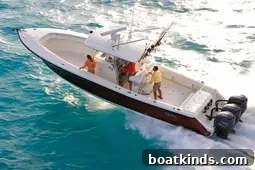
SPI gives us an excellent strength-to-weight ratio. Our goal is strength and reliable offshore performance rather than simply the lightest boat. Each boat’s components bond consistently and perform as designed.
Q: Where should boatbuilders improve?
A: The industry has made many improvements thanks to standards and modern satisfaction programs, but there’s room to make boats easier to maintain and operate. Manufacturing methods—especially how hulls, decks and small parts are fabricated—could advance further. Digital design tools and documentation have helped, but the evolution to cleaner, more precise composite parts has a long way to go.
Q: What will boats between 20 and 40 feet look like in 5–10 years?
A: Hull designs will favor fuel economy and all-around performance, moving away from traditional deep-vee forms. Digital integration of engines and onboard systems with owner devices will accelerate. Overall, buyers will seek multipurpose, low-maintenance boats with more seating and sensible electronics rather than unnecessary complexity.
Q: Any favorite boats or designers outside EdgeWater?
A: I appreciate simple, well-conceived designs and have a soft spot for classic yacht designers. My great-grandfather, Clinton Crane, was a naval architect who designed everything from speedboats to luxury yachts. Designers like Raymond Hunt set standards that still inspire modern builders.
Q: Tell us about your family’s nautical history and your own boats.
A: Nautical tradition runs deep in my family. My great-grandfather was a naval architect, my grandfather an avid fisherman, and my grandmother owned boats. Growing up I learned to operate a custom 40-foot express-style dayboat in Maine. I restored my first personal boat, a 20-year-old Mako, in 1991 and used it extensively for fishing and trips to the Keys and Bimini.
Today I keep a 17-foot EdgeWater in Maine and use prototype and demo boats through the business. On weekends I fish around Daytona Beach and dive with my children. Each year I lead a weeklong Bahamas trip for EdgeWater owners and friends.
October 2014 issue