The Mack Attack is a new Viking 48 Convertible flybridge model that looks familiar from the outside but hides a surprising powerplant belowdecks: high-performance Scania DI16 diesel V8s. Built as a collaboration between Scania, Mack Boring—the largest Scania distributor in the U.S.—and Viking Yacht Company, this boat serves as the test platform for Scania’s 16-liter, 1,150-hp DI16 engines, introduced recently to the U.S. recreational market.
Scania may not be a household name among many U.S. recreational boaters, but globally the company is synonymous with durable, efficient diesel engines. With more than 130 years in business and an annual output exceeding 100,000 engines, Scania’s product line primarily serves trucks, buses and industrial applications, while a significant portion is built for marine use. The brand’s long history in commercial U.S. marine service has earned it a reputation for economical operation, long life under heavy duty cycles, and straightforward maintenance. Translating that pedigree into pleasure-boat applications requires adjustments, and Scania has been steadily expanding its offerings in that arena.
Two years prior, Scania and Mack Boring partnered with Viking to install DI13 900-hp six-cylinder engines in a Viking 46 Billfish, named Mack 900. Those DI13s impressed for their power-to-weight ratio, quiet operation and lack of visible smoke. After field testing, Viking added the DI13 to its options list. The DI16 V8s now extend that promise of high performance to larger yachts like the Viking 48 Convertible.
Pat McGovern, president of Mack Boring, recalls earlier ties between Scania and other diesel brands: “As a distributor for Yanmar diesels, we became acquainted with Scania in 2004,” he says. At that time Scania manufactured higher-horsepower Yanmar engines under contract, giving Mack Boring direct experience of Scania’s engineering and quality. The 2008 recession interrupted that partnership, but Mack Boring later began representing Scania in the U.S. commercial marine market. The recent DI13 and DI16 introductions bring Scania’s recreational engine ambitions full circle.
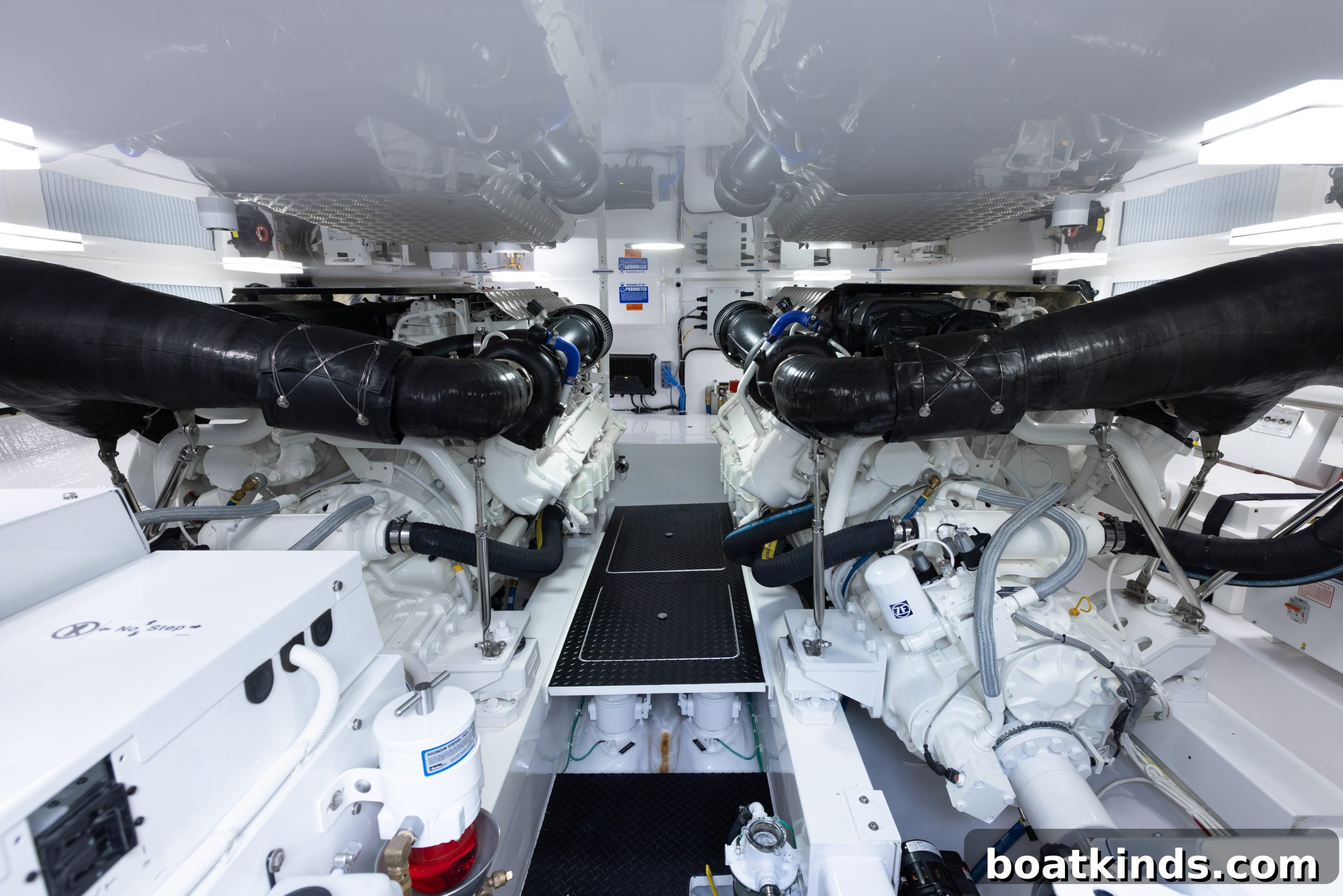
“Scania engines provide a number of benefits over the competition,” said Alberto Alcalá, U.S. senior sales manager at Scania, who joined the sea trial aboard the Viking. “They are lighter, occupy less engine-room volume, and deliver one of the best power-to-weight ratios in their class. Service intervals are longer, routine maintenance is easier, and they produce exceptional acceleration and fuel economy. They’re also among the cleanest diesels available, emitting little to no visible smoke.”
Scania’s DI series derives from its proven commercial marine diesels but is adapted for recreational use. Commercial engines typically use unit injection and a simple wastegate turbocharger suited to continuous, lower-rpm operation. For pleasure craft, where higher peak horsepower and rapid transient response are required, Scania equips the DI series with a high-pressure common-rail fuel system. Multiple injection pulses improve combustion control, reduce particulates and support higher power output.
A key element of Scania’s cylinder design contributes to durability and efficiency. Rather than the common “hanging” cylinder liner supported at the block’s top, Scania uses a “standing” liner supported at the base. This construction allows coolant jackets to approach the combustion chamber more closely, reducing operating temperature and improving combustion. It also creates space for a “saver ring” at the top of the cylinder that helps remove carbon build-up from the piston edge. The result is better oil control, reduced cylinder scoring, improved combustion and longer intervals between oil changes.
Another practical benefit is Scania’s use of individual cylinder heads. Each cylinder has its own head, allowing top-end work without heavy hoists and enabling the replacement of a single liner if necessary. Commonality of heads, cylinders and pistons across a family of engines yields roughly 30 percent parts commonality, simplifying logistics and spare-parts availability. Scania’s U.S. parts warehouse near UPS headquarters in Louisville, Kentucky, supports fast overnight shipments and stocks about 98 percent of parts used in Scania marine engines.
Scania builds its engine blocks from compacted graphite iron rather than gray iron. This material is stronger and, after machining, lighter than a comparable gray iron block. Combined with the standing-liner design and other engineering choices, the result is a lighter, stronger engine that resists deformation under load, extends service life and improves power-to-weight performance. Scania’s distributor network in the U.S. coordinates dealer support and can route service to the nearest qualified facility as part of an owner-introduction program that begins when the engine is registered.
I experienced the DI16s firsthand aboard the Viking 48C Mack Attack. Departing Cape May’s Canon Club and running offshore, the acceleration from a dead stop was dramatic: immediate, smoke-free thrust that pinned me back in the seat and pushed the boat to a top speed around 38 knots. At a comfortable fast cruise of 1,900 rpm the boat held 30 knots while consuming about 82 gallons per hour total, and noise levels remained restrained enough for easy conversation in the salon and cockpit. At trolling speeds the engines were nearly whisper-quiet.
The DI series combines proven commercial diesel robustness with recreational-focused features—high-pressure common-rail injection, standing liners, saver rings, individual heads and compacted graphite iron blocks—that together deliver strong performance, fuel efficiency and long-term serviceability. For builders and owners considering new builds or repowers, Scania’s DI13 and DI16 engines present a compelling option worth evaluating.
This article was originally published in the November 2024 issue.