
If you’re new to saltwater fishing or want to sharpen your skills, consider the Boaters University course Angler’s Bootcamp: The Basics of Saltwater Fishing.
Sign up today — use code SOUNDINGS for 15% off.
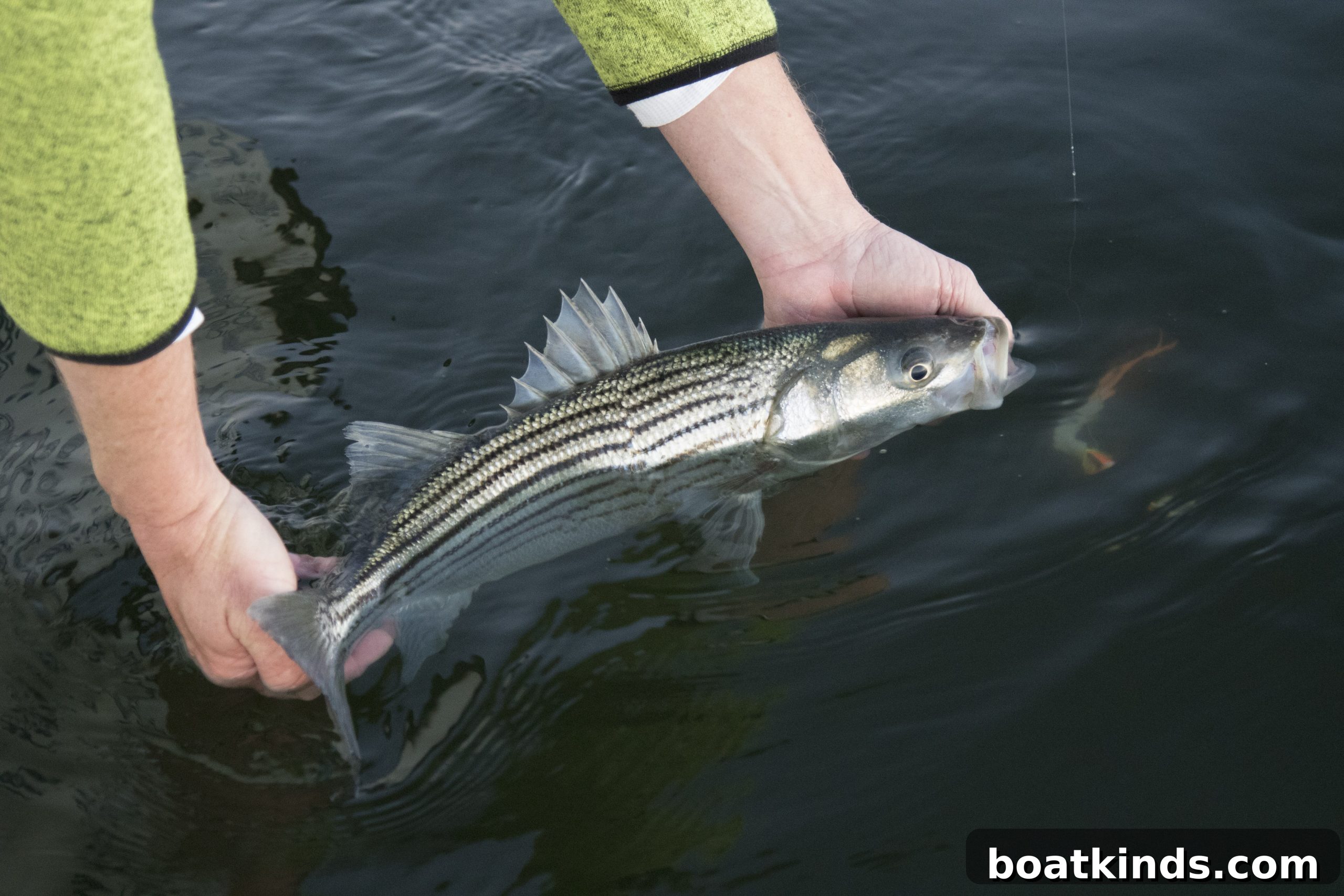
For me, the connection with fish goes beyond predator and prey or a meal on the table. Releasing the fish I catch is a practical way to help sustain good fishing in my local waters.
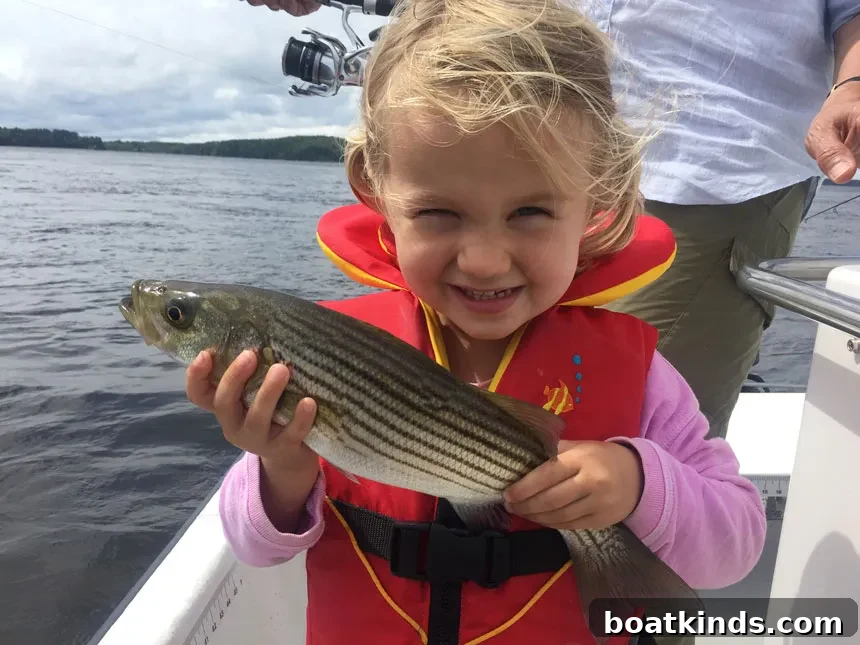
When I return to the dock after a morning on the water, my daughter Lily’s first question is always the same: “Papa, did you catch anything?” On a great day — which we have many during summer along the Maine coast — the answer is yes. Often, though, I come back empty-handed, and explaining that to a curious three-year-old isn’t always easy.
She wants proof. I rarely have any to show. Instead, I tell her that I let nearly every striped bass I catch swim away. Inevitably she asks, “Why?” I tell her I want those fish to stay with their friends and families. She pauses to consider whether a fish can have a family, then moves on to inspecting my lures and the spinning-reel handle.
Releasing fish isn’t just an act of kindness or a sentimental notion. For me it’s a practical, even selfish, decision rooted in a deep love of fishing. Angling keeps me balanced when work is heavy, when obligations pile up, or when life grows bleak. If I want this pastime to remain available and rewarding in years to come, it makes sense to give back to the resource by practicing catch-and-release whenever possible.
I remember a time when striped bass were virtually gone from our coast. In the 1980s, overfishing and poor environmental conditions drove the fishery to the brink of collapse. I was a child then, standing with my father along the granite ledges of Bailey Island in Casco Bay, and the fishing felt empty. It took a moratorium and years of rebuilding for the population to recover — and those years left a lasting impression on me.
Today the picture is better, but not without concern. In 2015, the Atlantic States Marine Fisheries Commission estimated roughly 180 million striped bass older than one year along the Atlantic Seaboard. These fish undertake one of the most impressive migrations among gamefish, moving from Chesapeake Bay north to Maine and then back again. Still, while the overall number is large, management challenges persist.
Consider how removals stack up: recreational anglers nationwide removed or inadvertently killed about 2.1 million fish in a recent year, and combined with commercial harvest the total removed exceeded 3 million. Those numbers matter because many of the fish kept are the older, larger females — the most valuable breeding stock that spawn in places like the Chesapeake and Hudson River each spring. Fisheries managers have observed that female spawning stock biomass has declined steadily since the early 2000s despite regulations designed to protect the resource. That decline is real and troubling.
Put simply, the keepers many anglers prize are less abundant today than they were a decade ago. Add environmental variability — such as poor river conditions that disrupt spawning — and the future becomes even less predictable. A few subpar spawning seasons in a row, which climate change makes more likely, could magnify the impact of even modest harvests and angling mortality.
Maine’s position near the northern edge of the striped bass migration makes the state particularly vulnerable. Think of the migration like an accordion stretching along the Eastern Seaboard: in strong years it reaches well into Maine; in weaker years the range contracts southward. When fewer fish are around, the “music” fades and anglers up north are more likely to go home empty-handed.
That geographic difference helps explain why attitudes toward regulation vary. Anglers who fish the heart of the range often still enjoy good seasons and may resist tighter rules. In places with poorer fishing, people are more inclined to support stronger measures. Fisheries policy is inherently a mix of science and politics, so communicating your perspective to elected officials and managers matters just as much as practicing stewardship on the water.
All of this is a lot to explain to a three-year-old who’s discovered the dock hose and is already spraying me. Later in the season she’ll ask again, and I’ll give her the short answer: I love being on the water, and fishing for striped bass is my favorite reason to go. Letting the fish go so others — including future generations — can enjoy the same experience is how I do my part.
This article originally appeared in the January 2017 issue.