
For this young sailor, paying to crew around the world seemed the fastest way to learn
I was trying to sell a book. That was the simple aim when I struck up a conversation with a trim young woman who seemed like the perfect reader for my new title, Sustainable Sailing. I asked what kind of sailing she did, partly to make conversation and partly to size up whether she might buy a copy.
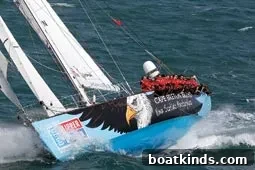
“Right now I’m sailing around the world in the Clipper Race,” she said. Elisa Jenkins, 31, from Sydney, Nova Scotia, was on a stopover in San Francisco. The Clipper Round the World Yacht Race, conceived by Sir Robin Knox-Johnston and run biennially since 1995, uses ten 68-foot sloops that sail more than 35,000 miles split into legs and stopovers. Amateurs pay to join as crew alongside professional skippers—a model that stretches back to early paid-crewing traditions from the 1930s. Participation prices vary by leg, from roughly $6,000 for a single leg to about $49,000 for the entire race; the full-race package includes a mandatory 19-day training course and branded clothing.
I’m old enough to find the idea of paying to get wet, cold, hot, exhausted and to share a bunk with a stranger strange—after all, outfitting a boat for a global cruise can cost more than $50,000, and at least then you call the shots. Yet Jenkins’s enthusiasm was persuasive, and she told her story in a way that made the concept of paid crewing easier to understand.
Hitching a ride to learn
Jenkins grew from a nervous beginner—someone whose goal was simply to “get across the bay and back in one piece”—into a sailor determined to accelerate her education. She admired Canadian circumnavigator Derek Hatfield and Naomi James, who became the first woman to sail around the world solo, and spent time in Australia and the South Pacific to gain experience. When the Clipper Race visited her hometown in 2008, a conversation with a female crew member changed everything. “I sat there for an hour and decided that I wanted to do this,” she recalled. “Not in 20 years. Now.”
Realizing that her salary as a physical therapist wouldn’t fund a global race, Jenkins pursued an alternative: sponsorship. When the Sydney Ports Corporation decided to sponsor an entry to promote Cape Breton Island, she applied and won a spot as the region’s unofficial ambassador for the entire race. In return for sponsorship, she agreed to represent her community at events and media appearances. “I love racing, but I consider it skill acquisition,” she said. “In 10 months, this race teaches me what I need to know for outfitting my own boat for a long voyage. Had I done it by myself, it would have taken 20 years.”
Her plan was deliberate: instead of spending decades cruising sporadically, she spent two concentrated years raising funds, preparing and sailing an intense global campaign. The arrangement let her learn rapidly while promoting her home region—a pragmatic and effective route to becoming an accomplished bluewater sailor.
A trial by storm
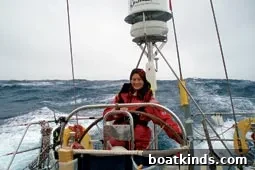
Still, questions remained. How do you live and cross oceans with strangers, many of whom have varying levels of experience and differing personalities? What happens if someone cracks under pressure? Jenkins explained that the Clipper Race tries to balance sailing experience and professional skills when assigning crew during the three-week training period. “Most people are level-headed and show an ability to meet challenges,” she said. “Surprisingly, the slow, light-air passages can be more difficult than howling storms, which often bring out the best in people.”
One storm left a lasting impression. On the 6,000-mile, 29-day leg from Qingdao, China, to San Francisco, one entry from California was dismasted in a knockdown, while the Cape Breton Island boat fared well and ultimately won the leg. Sailing under the Golden Gate Bridge, Jenkins described, was the most spectacular port entrance she had experienced. Yet the leg also produced a terrifying moment: a wall of white foam and breakers, two stories high, submerged their stern and cockpit in an instant. Jenkins was clipped in but was struck hard by the traveler bar when a large wave hit; the blow to her lower back was severe—but in her words, “the impact was life-saving.”
She declined to discuss the specifics of her tether and deferred safety questions to race organizers. Remembering past fatal incidents in ocean racing, it’s clear she was fortunate to escape a worse outcome. Despite that close call, Jenkins looked forward to the remaining legs and, in particular, the scheduled stop in Cape Breton Island, where crew and families would reunite and she would meet her sister’s new baby for the first time.
As the Clipper Race continued toward its finish back in the United Kingdom, Jenkins remained an enthusiastic ambassador for the event. She voiced a simple conclusion for anyone considering paid crewing: do your research, think through the commitment, and decide for yourself. That’s exactly what she did in 2008, and her choice transformed how quickly she learned and how far she’s come as a sailor.
Dieter Loibner is sailing editor for Soundings. His newest book, “Sustainable Sailing” is currently available at www.sustainablesailing-book.com.
This article originally appeared in the Home Waters section of the July 2010 issue.