
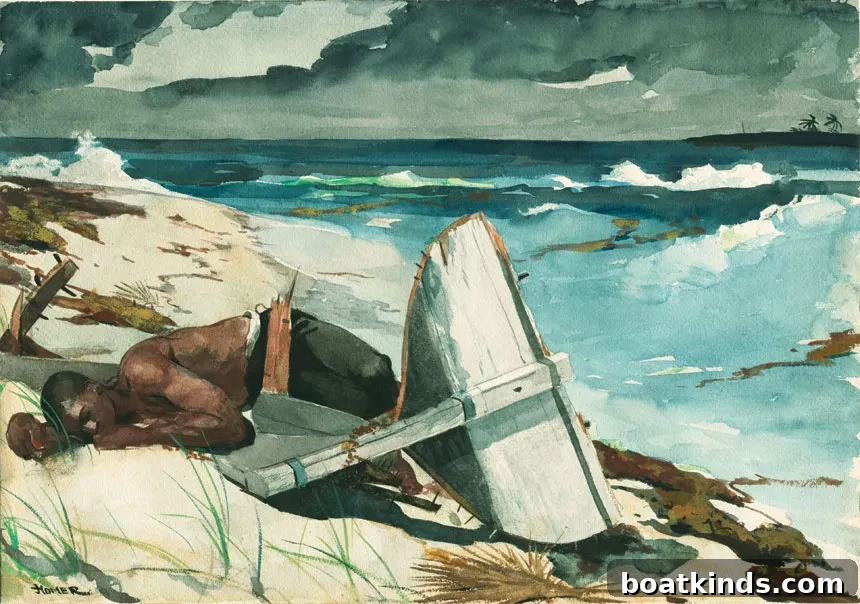
After the Hurricane — Winslow Homer’s Masterful Watercolor of Sea and Storm
A veil of rain and receding storm clouds lift away from a dark, restless sea, leaving the aftermath of a tropical hurricane in their wake. On the shore a lone sailor sits among the broken timbers of his boat, while pale blue-green waves roll up the sand and whitecaps break over an offshore bar. This scene—both stark and vividly alive—is Winslow Homer’s After the Hurricane, a work that captures the drama of weather and the fragile human presence against the power of the ocean.
Homer first traveled south in 1884 on commission from Century magazine, leaving the rockbound, gray-green coast of Maine for the brighter, crystalline waters of the Bahamas and later for Key West and Cuba. Those tropical experiences altered his palette and his approach: the intense blues of the sea, the brilliance of the sky, and the intense sunlight of the region inspired a sustained interest that would redefine his work.
By the time he created After the Hurricane on a second southern sojourn in 1899, Homer had largely shifted from oils to watercolors. In that medium he found a directness and freedom that suited his acute sensitivity to atmosphere and motion. After the Hurricane demonstrates his mastery of washes and rapid brushwork—techniques that suggest light and movement rather than describing every detail. He balances cool maritime blues with the warmer browns of sand and wreckage, and he uses the stark white of breaking waves to heighten contrast and focus attention on the scene’s emotional center: the solitary, unfortunate sailor.
The painting is notable for how it conveys both weather and mood. The sky, still heavy with weather, filters sunlight so that the sea becomes a range of shifting hues rather than a single flat tone. Homer’s watercolors translate that variability into layered color and expressive marks: the water’s surface reads as an expanse of shifting tints and reflections, while the shoreline and scattered wreckage ground the composition in human consequence. Rather than offering a narrative of rescue or resolution, the scene lingers on the ambiguous moment after danger has passed—an observation of survival, loss, and the indifferent beauty of the natural world.
At the time Homer’s tropical watercolors appeared, critics praised their freshness and originality. Yet conservative collectors and traditional buyers were sometimes slow to accept the immediacy and apparent spontaneity of these works. What once seemed radical for watercolor’s looseness is today recognized as the mark of a mature artist who understood how to use the medium’s fluidity to convey motion and light.
Among Homer’s series of southern watercolors, After the Hurricane stands alongside The Gulf Stream as one of his most enduring and iconic maritime images. Both paintings reveal his fascination with the sea’s moods and its capacity to frame human vulnerability. In watercolors Homer achieved an economy of means that felt paradoxically more powerful than the weight of his earlier oils: sparse detail, deft washes, and expressive brushstrokes combine to produce a visceral sense of place and weather.
“Winslow Homer became one of the masters of the watercolor medium, known for the visceral force of the waves in his oil paintings. His watercolors are an antidote to any visual heaviness and weight. As his early paintings reveal, watercolor is where he ultimately shined as an artist.” —Steve Knauth, Artists Network
Today After the Hurricane is valued as the work of a master who transformed marine painting with a fresh eye for light, color, and atmospheric effect. Its lasting appeal lies in Homer’s ability to condense a dramatic natural event into a quietly powerful moment—one that invites the viewer to contemplate both the sea’s beauty and its indifference.
This article originally appeared in the November 2018 issue.