
Illustration by Jim Ewing
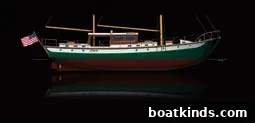
William Hand is widely recognized as one of America’s foremost yacht designers, and his most enduring contribution is a distinctive group of 42 robust cruisers now known as the Hand motorsailers. Designed between 1927 and 1942, these vessels blended dependable powerboat engineering with practical sailing capability to create a true hybrid—boats that could motor long distances with economy and safety, and also continue underway under sail when conditions or fuel considerations dictated.
Hand’s motorsailers were conceived to provide maximum range and seakeeping. With gasoline engines and generous fuel tanks—some boats carried as much as 1,000 gallons—these craft could cruise hundreds of miles under power, with reported ranges up to about 1,500 miles. Yet the ketch rig added a vital layer of versatility: properly trimmed sails could steady the vessel in heavy seas, reduce fuel consumption at cruise speeds, or become the primary means of propulsion when desired. The result was a platform that combined the comfort and command of a power yacht with the redundancy, silence, and economy of sail.
Stylistically, Hand’s designs reflected his admiration for the hardy working boats of New England. The lines recalled Banks fishermen and knockabouts, with a full, heavy displacement hull that prioritized seaworthiness over light-air performance. Above the hull sat a rugged superstructure and a commanding pilothouse—features that emphasized control in heavy weather and long-range offshore cruising. Masts were stout and often fitted with traditional ratlines, giving these yachts a purposeful, seaworthy appearance rather than a purely racing aesthetic.
Hand’s career began in New England. Born in Portland, Maine, in 1875, he taught himself the fundamentals of boat design and established his practice in Fairhaven, Massachusetts. He first gained attention as a designer when his 16-foot racing sloop Little Nellie won nine of ten races at the Royal Canadian Yacht Club regatta in 1905, a success that launched his reputation. He later turned his attention to powerboats—his V-bottom Countess won the 1916 New York to Block Island race averaging better than 27 mph—and designed substantial working vessels, including the rugged early-20th-century schooners used for exploration, most notably the Arctic vessel Bowdoin.
Those practical roots helped shape the motorsailer concept. Hand was an enthusiastic offshore fisherman—swordfishing was among his pursuits—and he designed many of his motorsailers with functionality in mind. Though fundamentally yachts, several of his motorsailers were adapted for commercial fishing; MacNaughton notes that some were fitted with a crow’s nest and extended forward pulpit for swordfishing. The combination of range, sturdy construction, and adaptable deck arrangements made them attractive both to cruising owners and to mariners needing a reliable work platform.
The Hand motorsailers have endured in part because their design priorities—safety, range, and ease of handling—still appeal to sailors who cruise offshore or live aboard. Their heavy displacement hulls breathe confidence in rough seas, the pilothouse offers shelter and excellent visibility in all weather, and the ketch rig provides flexible sail plans for short-handed crews. While modern yacht design has explored faster hull forms and lighter construction, the Hand hull and superstructure remain a classic template for those who prize dependability and seaworthiness above all.
Today, owners and enthusiasts continue to restore and sail these vintage motorsailers, preserving a chapter of American yacht design that combined innovation with practical seamanship. The Hand fleet stands as a testament to a designer who pushed beyond incremental change—creating a class of vessels notable for their hybrid capability and uncompromising sea-kindly behavior.
January 2014 issue