
Recent Coast Guard Responses
Spreading the Word
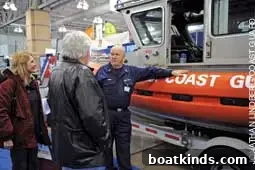
Coast Guard Auxiliarist Thomas Nyman, a member of Flotilla 8-1 in Ocean City, N.J., spoke with attendees at the 32nd annual Atlantic City Boat Show in February. The Auxiliary’s presence at the show focused on informing the boating public about Coast Guard responsibilities and safety protocols along the New Jersey coast, emphasizing safe navigation, vessel preparedness, and how to report emergencies.
Boat Found Adrift, Sailor Missing
Virginia Beach, Va.
Coast Guard and local agencies launched a search after a good Samaritan reported finding the sailing vessel Wampeter adrift near Little Creek Inlet on Feb. 3 with no one aboard. The initial report to Coast Guard Sector Hampton Roads Command Center came at approximately 8:20 a.m. from a crewmember aboard the fishing vessel Markim II, who observed an approximately 40-foot sailboat drifting toward the rocks with its lights on and engine running.
Responding assets included two 25-foot response boat crews and a 45-foot response boat crew from Coast Guard Station Little Creek, as well as an HH-60 rescue helicopter crew from Coast Guard Air Station Elizabeth City, N.C. Local partners that assisted in the search included Hampton Fire Rescue, the Norfolk Police Department, Virginia Marine Police, Virginia Beach Police Department and Virginia Beach Fire Department. The coordinated response demonstrates how the Coast Guard routinely integrates air, surface and local agency resources during missing person and vessel-assist incidents.
Anyone with information related to this case is asked to contact the Coast Guard Sector Hampton Roads Command Center at (757) 638-6635. Timely reporting of sightings, vessel information or suspicious circumstances helps search planners narrow areas of interest and improves the chances of a positive outcome.
Mineral Oil Spill in the Potomac River
Baltimore
Coast Guard and local agencies responded for several days to a mineral oil release that began Jan. 23 in the Potomac River near Alexandria, Va. Initial reports indicated a transformer at a Pepco substation was leaking oil into the river, and response teams worked to contain and recover product from the water.
Response crews recovered approximately 1,500 gallons of mineral oil from the Potomac out of an estimated 5,500 gallons released, leaving roughly 4,000 gallons unaccounted for in the immediate recovery effort. Coast Guard Sector Baltimore’s incident management division, notified by the National Response Center, coordinated with Pepco and contracted environmental responders Triumvirate Environmental and Clean Harbors to deploy containment and recovery equipment and to monitor the affected shoreline.
Deployed resources included about 2,000 feet of hard containment boom to block movement of the product, 1,700 feet of absorbent boom to capture sheen and surface oil, and 750 feet of sweep — a system of absorbent pads strung together to collect dispersed oil. At the time of reporting, the visible oil sheen extended roughly 2,000 yards north of the Pepco substation and reached as far south as the Woodrow Wilson Bridge. Crews continued containment and recovery operations while assessing environmental impacts and safety risks to navigation.
Petty Officer 1st Class Anthony Matulonis, a marine science technician at Sector Baltimore, noted that much of what responders observed was an oil sheen. When oil spreads thin over the water’s surface, mechanical recovery becomes increasingly difficult because the spread increases surface area and reduces recoverable thickness. Natural processes such as sunlight, wave action and microbial activity can contribute to biodegradation over time, but coordinated containment and recovery efforts are essential to minimize localized impacts and protect sensitive shoreline habitats.
Ongoing Coordination and Public Safety
Both incidents underscore typical Coast Guard roles in the Mid-Atlantic region: responding to search and rescue cases, coordinating multi-agency searches, and leading or supporting pollution response and mitigation. The Coast Guard works closely with state and local authorities, environmental contractors and volunteer groups to secure scenes, protect people, and limit environmental damage.
Boaters and shoreline residents can help by reporting emergencies or pollution sightings immediately, providing precise locations, vessel descriptions and any relevant witness information. Quick, accurate reports assist authorities in prioritizing resources and accelerating response efforts.
This article originally appeared in the Mid-Atlantic Home Waters section of the April 2011 issue.