
Sail Newport’s Fourth-Grade Sailing Program Builds Life Skills and Local Connection
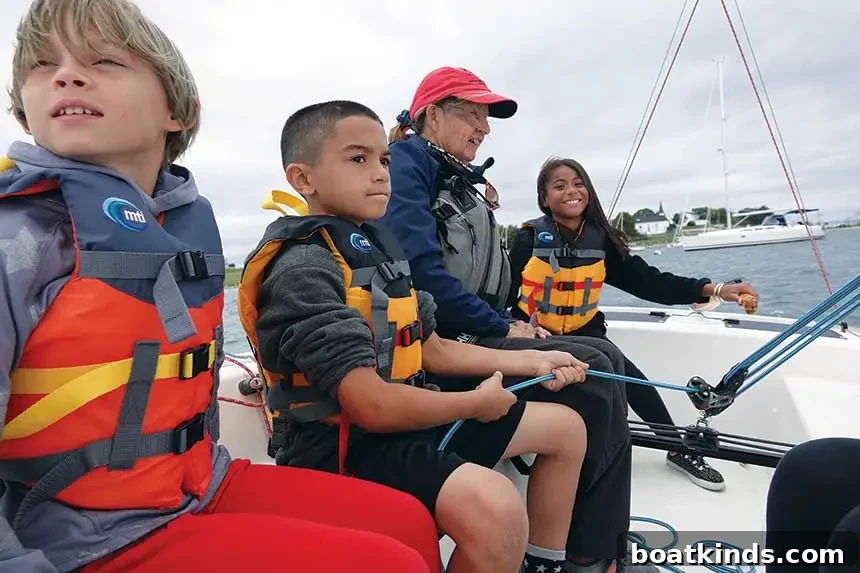
At 9:45 a.m., the school bus disgorges a steady stream of fourth-graders at the Sail Newport Sailing Center. Some students head upstairs to a classroom led by teachers, while others don life jackets and walk down to the docks with sailing instructors. A fresh breeze fills the sails of the center’s J/22s—mainsheets reefed for safety and jibs furled—yet the nimble 22-foot keelboats move briskly once they leave the dock. This balanced approach keeps the experience both safe and engaging for every child on board.
The program is part of a weekly series: this is only the third of 16 lessons offered across the school year for roughly 160 students from Newport public schools. Many of these children come from families without regular access to boats, and the curriculum is designed so every participant gets hands-on time at the helm. Each boat carries a student driver, and instructors intentionally step back so that children learn by doing.
Sail Newport’s Program Director, Kim Hapgood, actively monitors sail trim and steering but resists intervening unless safety demands it. She gives feedback, points out landmarks, and encourages independent decision-making. Her approach is deliberate: instructors provide guidance but allow students to take responsibility. “This is not about racing,” Hapgood says. “It’s about learning life skills.” That emphasis—on teamwork, communication, situational awareness and decision-making—defines the program’s educational goals as much as the technical skills of sailing.
In the classroom on the sailing center’s second floor, teachers follow a tailored curriculum that complements the on-water lessons. During the fall, students explore mapping, weather patterns, erosion and landforms—topics that tie local geography to practical navigation and coastal awareness. In spring, the focus shifts to ocean sustainability, habitats, food chains, environmental organisms and salinity, broadening students’ understanding of the marine ecosystem that surrounds their community.
The program launched three years ago through a partnership between Sail Newport and Newport public schools. That collaboration grew from the work of Donna Kelly, a Newport teacher who also served at Sail Newport. Financial support comes from grants, donations and community fundraisers; the nonprofit sailing center supplies boats, life jackets, foul-weather gear, teaching materials, snacks and busing, while the school district provides students, teachers and scheduled time. As a result, every fourth-grader in the city participates in the program, ensuring equitable access to maritime education.
Participation can begin with hesitation—some children are reluctant to try something new—but peer influence and a welcoming teaching style quickly change attitudes. “At first, some kids don’t want to go,” says Sail Newport’s marketing director, Kim Cooper, “but then they watch their friends do it and the other kids come back and say, ‘Hey, you made a big mistake.’” That mix of encouragement and hands-on success helps transform initial fear into curiosity and pride.
Beyond the technical elements of steering, trimming and seamanship, instructors emphasize transferable skills: how to communicate clearly with teammates, how to read conditions, and how to make thoughtful choices under pressure. “By the end of spring, the kids have sufficient skills so they can manage the boats themselves,” Cooper explains. For many students, these accomplishments represent a significant confidence boost that carries over to the classroom and other areas of life.
Teachers and parents have noticed measurable benefits: increased focus, improved mood and greater productivity after sailing sessions. One teacher initially worried that a busy day on the water would leave students tired, but instead observed children returning to school more attentive and cheerful. These outcomes reinforce the program’s dual mission of physical education and social-emotional development.
Sail Newport’s executive director, Brad Read, highlights the program’s deeper value: helping young people connect with the place where they live. “In Rhode Island, it’s the water,” Read says. “We live on an island. Our kids need to learn how to sail. It gives the students a different perspective.” By grounding local identity in nautical knowledge, the program fosters stewardship and a stronger sense of belonging to the coastal community.
Structured, well-supported and designed to be inclusive, Sail Newport’s fourth-grade sailing program combines classroom learning with on-the-water practice to produce confident, engaged young learners. The model demonstrates how experiential education—rooted in local environment and accessible to all students—can build practical skills and character in equal measure.
This article originally appeared in the December 2019 issue.