
Debate Over Speed Limits and New Technology to Protect North Atlantic Right Whales
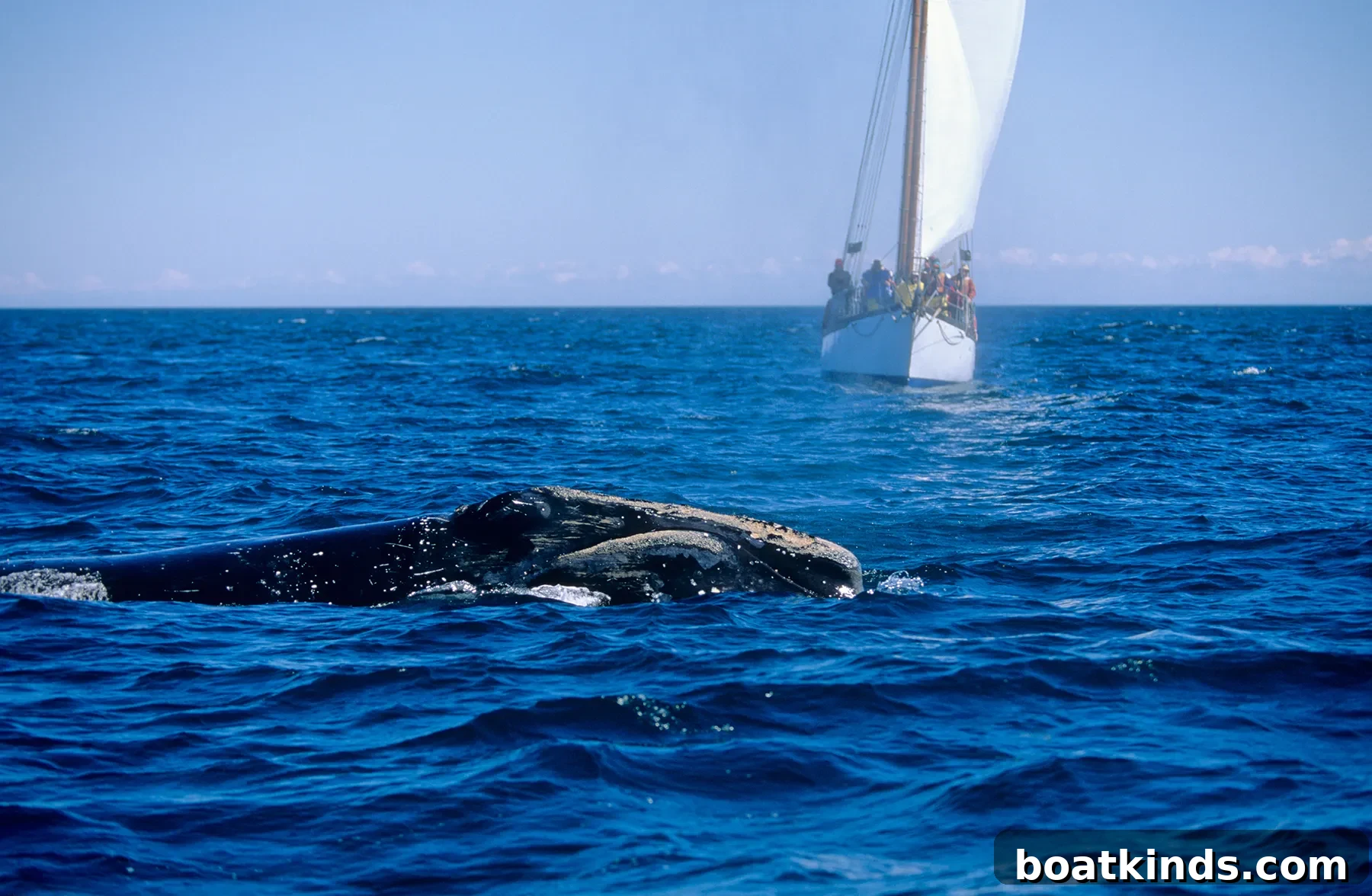
On June 6, the head of the National Marine Manufacturers Association (NMMA) urged Congress to fund research into real-time marine mammal monitoring technology as an alternative to broad fleetwide speed restrictions. The NMMA’s leader warned that NOAA’s proposal could limit access to the Atlantic for as many as 63,000 boaters from Massachusetts to Florida and would significantly affect coastal economies that depend on recreational and commercial boating.
The NMMA president and CEO, Frank Hugelmeyer, testified before the U.S. House Committee on Natural Resources Subcommittee on Water, Wildlife and Fisheries that NOAA’s plan represents “the greatest restriction of public access to our nation’s cherished waterways in our time.” His testimony came during an oversight hearing focused on a proposed rule by NOAA’s National Marine Fisheries Service to expand seasonal 10-knot speed zones along much of the Eastern Seaboard to protect endangered North Atlantic right whales.
NOAA’s proposal, first announced amid concerns about a troubling population decline in July 2022, would change existing speed rules in several ways: extend go-slow zones out to as much as 90 miles offshore for large portions of the year, apply 10-knot limits for longer seasons—sometimes up to seven months—and lower the size threshold for affected vessels from 65 feet down to 35 feet. Supporters say those measures are necessary to reduce deadly vessel strikes and entanglements; opponents say the approach is a heavy-handed, one-size-fits-all restriction that fails to consider technological and operational differences among boats.
The hearing exposed a stark partisan divide. Committee chairman Rep. Bruce Westerman (R-AR) criticized NOAA’s process and said the agency acted without sufficient coordination with affected industries, describing the move as bureaucratic overreach. Rep. Jared Huffman (D-CA), the committee’s top Democrat, urged immediate action to prevent additional deaths and cited projections that, without intervention on vessel strikes, the species could be functionally extinct by 2037. Huffman called criticism of NOAA’s approach “extreme hyperbole” and emphasized the complexity of the crisis.
NOAA deputy administrator Janet Coit defended the proposed restrictions, citing vessel strikes and entanglements as primary drivers of the species’ decline. “We cannot afford to cause even one mortal take per year of a North Atlantic right whale and achieve our recovery goals,” she told the committee, underscoring the agency’s urgency.
Industry representatives say the process left stakeholders scrambling. Boatbuilders and commercial operators—particularly builders of larger yachts such as Viking Yachts—said they were surprised when NOAA published the rule and that the proposed changes bypassed the more collaborative regulatory processes typically used for fisheries and maritime rules. The industry was given a comment period after the proposal, initially 60 days and later extended to 90 days at stakeholders’ request.
In response, Viking and other industry partners formed the Whale and Vessel Safety (WAVS) Task Force. WAVS aims not merely to oppose speed limits but to promote technological solutions that provide real-time whale detection and location information directly to boaters’ chartplotters and smartphones. The group believes that improved detection and timely alerts could reduce collisions without imposing blanket speed limits on a broad spectrum of vessels.
WAVS and other industry voices also point to enforcement and compliance issues in existing whale-management areas. A study cited by WAVS found high rates of noncompliance in some regulated zones, suggesting that expanding zones alone will not ensure better protection. “We don’t want to hit whales. It’s catastrophic for our boats, for our passengers and for the whale,” said John DePersenaire, Viking’s director of government affairs and sustainability, emphasizing support for solutions that combine safety, technology, and conservation.
All sides acknowledge the dire status of the North Atlantic right whale. Once hunted nearly to extinction, the species regained some numbers but now faces a new decline. Global protections enacted in the mid-20th century and later under the Endangered Species Act helped recovery at times, but ship strikes and entanglement in fishing gear remain persistent threats. Recent studies indicate that a large majority of these whales have experienced entanglement injuries, often severe.
Between 2008 and 2022, 12 right whale deaths were documented from vessel strikes, with vessels under 65 feet implicated in five of those deaths. Current estimates cited in testimony place the population at roughly 340 animals, with just 72 females of reproductive age—numbers that raise serious concerns about the species’ ability to recover under current conditions.
Many proponents of a technology-focused approach point to rapid advances in detection tools. Companies such as Whale Seeker, co-founded by biologist Emily Charry Tissier, combine aerial photography with artificial intelligence to speed up population surveys. What once took years to analyze can now be completed in hours by pairing human expertise with AI analysis, and the firm hopes to integrate drones and other remote sensors into a live-alert network accessible to mariners.
Conservation groups are also building digital tools. The International Fund for Animal Welfare helped develop Whale Alert, an app that aggregates sightings and official data to notify boaters where they should slow down. Aggregation of multiple data sources into a single, public-facing feed is seen as a practical step toward improving situational awareness on the water.
Emerging technologies under discussion include infrared cameras, drones, forward-facing sonar and radar tuned to detect whale spouts. Earlier proposals to use whale-mounted AIS tags have lost favor due to health risks associated with tagging. For now, stakeholders across industry, conservation, and government are debating whether a combination of targeted speed rules, stronger enforcement, and real-time detection systems can be balanced to protect the whales while minimizing unnecessary restrictions on boating and commerce.
Jessica Redfern, associate vice president of ocean conservation science at the New England Aquarium, welcomed the creation of the WAVS task force but cautioned that avoiding a single whale mortality cannot be the only objective. “Why are we so focused on losing one whale?” she asked. “It’s because there’s 72 breeding females. It’s because the risk of extinction for this species is real.”
This article was originally published in the August 2023 issue.