
Winslow Homer’s “Boys in a Dory”: A Glimpse of Childhood and the Sea
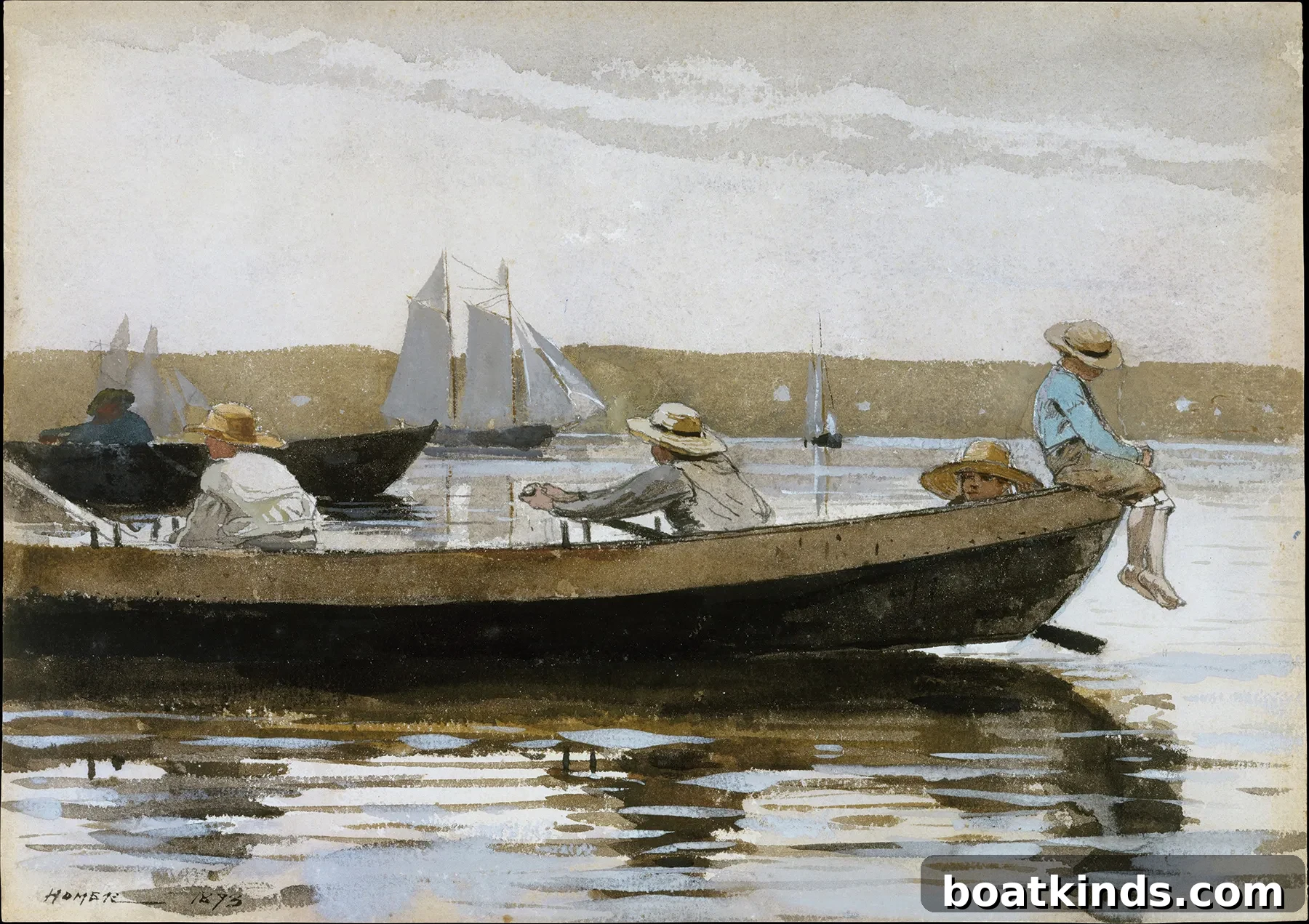
Winslow Homer’s 1873 watercolor “Boys in a Dory” captures a simple, luminous moment: four boys in straw hats rowing a small boat across calm water near Cape Ann, Massachusetts. The scene is spare and direct, an honest celebration of childhood at the water’s edge. Light dances across the ripples, and in the distance other boats glide through Gloucester Harbor, creating a gentle sense of place without clutter or sentimentality.
Born in Boston in 1836 and raised in Cambridge, Homer came from a New England family and showed artistic talent early. Largely self-taught, he also benefited from lessons his mother gave—she was a competent amateur watercolorist—and he trained briefly in a commercial setting through an apprenticeship with J.H. Bufford, a Boston lithographer. That early experience in illustrations and lithography informed his strong compositional sense and ability to distill scenes to their essential elements.
Homer’s career moved through several phases. As a young artist he produced landscape and illustrative work, and after the American Civil War he gravitated toward subjects that celebrated ordinary life. In the 1870s he produced a notable body of watercolors and small-scale pieces depicting coastal life: children on beaches, fishermen at work, dories and wharves. These studies showed both his observational acuity and his growing mastery of watercolor as a medium.
During the summer of 1873, Homer stayed in Gloucester and completed a series of watercolors that marked his first major professional commitment to the medium. The Gloucester watercolors—including “Boys in a Dory”—are characterized by an economy of means: delicate washes, careful use of negative space and a focus on atmosphere and light. Contemporary critics responded to these works with admiration. One review in the Evening Mail in 1874 captured the effect many viewers experienced: “You feel the blow of the salt sea breezes and shade your eyes from the dazzling sun glare.” That response underscores Homer’s ability to make viewers sense as well as see the coastal environment.
Homer’s Gloucester series also reflected a willingness to engage with the social realities of his time. In the years following emancipation he depicted the lives of newly freed African Americans and other figures outside the mainstream of genteel subject matter, which provoked criticism from some quarters. Yet his intent was to present honest depictions of American life in its many forms, and his work from this period broadened the subjects considered appropriate for serious painting.
By 1883 Homer sought greater solitude and moved to Prouts Neck, Maine, where he settled for the rest of his life. In Maine his focus on maritime themes deepened: the coast, the surf, and the human figures who make their living or find refuge along the shoreline became recurring motifs. Art historian H. Barbara Weinberg has observed that Homer’s Maine work explores “the struggle of people against the sea and the relationship of fragile, transient human life to the timelessness of nature.” That contrast—between human vulnerability and nature’s enduring forces—became central to his mature vision.
Technically, Homer’s watercolors evolved to convey texture and motion with spare, confident strokes. He found ways to suggest the roar of surf, gusting wind and the spray of waves without excessive detail, relying on brushwork, tonality and compositional rhythm to evoke sound and movement. These seascapes, whether calm scenes like “Boys in a Dory” or more tumultuous pictures of surf and storms, demonstrate his skill at using watercolor to capture atmosphere and emotion.
Homer died in 1910 at the age of 74, leaving a legacy as one of the foremost American watercolorists and painters of maritime life. He expressed his own faith in the medium: “You will see—in the future, I will live by my watercolors.” That confidence was borne out by his influence on subsequent generations of artists and by the lasting appeal of his coastal images, which continue to be admired for their clarity, restraint and emotional resonance.
— Lidia Goldberg
This article was originally published in the June 2023 issue.