
“What the @#$%! was that?” I yell, half to myself and half toward the wheelhouse, where Capt. Andy Dangelo’s head snaps around. He’s probably hoping it was me — his deckhand — and not a client who’s somehow managed to skewer himself with a jig hook.
“What’s what?!” he shoots back.
“That,” I reply, pointing to what looks like a six-foot crater in the water about 40 yards off our port stern. “Around 8 o’clock — something huge just exploded out of the sea. You see it?”
“Probably a porp …” he starts.
“Nope,” I cut him off. I know porpoises, dolphins, whales and seals. I’m only a deckhand, but I know what I saw — and it wasn’t a mammal.
It’s the familiar routine: one of us glimpses something unbelievable and will keep seeing it, while the other, squinting to find the commotion, misses every moment and eventually wonders whether his mate needs glasses or perhaps a vacation with fewer responsibilities and more knitting.
The captain refocuses on our westward heading while I keep scanning the horizon for more eruptions. A cluster of terns wheels and dives nearby, clearly keyed on the same disturbance. Minutes later something huge rolls, sending a shower of foot-long herring skittering across the surface. Before I can form a coherent sound, a refrigerator-sized, coppery flank rockets five feet into the air, hangs for a beat, then missiles back through the dark skin of the ocean with a splash that seems impossibly small for the size of the animal that caused it.
“You saw that one, right? Tell me you saw that …” I blurt, as the bow swings toward the action.
“Giants,” the skipper says flatly. “Looks like a few of them, probably chasing herring. Better get those lines up for a minute.”
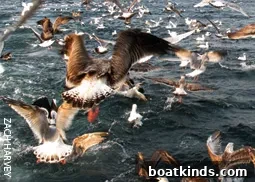
As we close the distance to the last splash, the water boils across a hundred square feet. Bluefin tuna — the kind that look to be in the 400- to 600-pound range — roll purposefully at the surface. Herring are topside, and within minutes the scene fills with birds: herring and black-backed gulls, then a cloud of sea birds and a dozen gannets climbing high, pinning their wings and diving like missiles to snatch full-grown herring on their kamikaze plunges.
Our charter guests begin swarming the cockpit in chaotic excitement, rods swinging, tackle boxes opening, plugs that would be perfect if the birds were pigeons and the tuna were pond trout. I try to calm them, not because we can necessarily capitalize on the event — tuna like these rarely cooperate when you see them — but to get them to inhale and enjoy something few anglers witness in a lifetime.
There’s a truism in tuna fishing, and it’s especially true when giants show: you rarely catch the ones you actually see. The odds were even longer this brisk late-November morning, given our position in roughly 30 feet of water a cast and a half outside the cove on the east side of Watch Hill Light, Rhode Island — excellent striper water and fair tautog bottom, plus a decent bluefish bite from Point Judith earlier that morning, but not exactly world-class bluefin territory.
Before long four of us, each armed with a cheap digital camera, are trying to immortalize the airborne giants. After ten minutes we’ve taken roughly 310 shots: dozens of four-foot circles on the surface, a scatter of terns, gulls and gannets, not a single sharp tuna image, and perhaps a fin in one blurry frame.
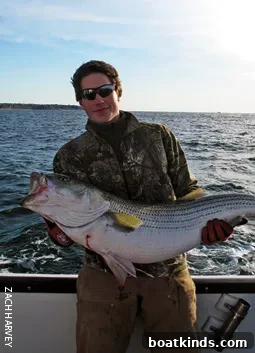
Fortunately, this wasn’t the only herring show of the day. We jogged east and, outside Fresh Pond Rocks in Charlestown, Rhode Island, found another massive cloud of birds. A quarter-acre of water was ripped by tail-slapping predators — a mix of bluefish and striped bass — and by the look of things, a few hefty specimens in both species. A couple passes along the edges of that blitz with umbrella rigs on short wires put a mix of bluefish into the mid-teens and about half a dozen bass, the largest pushing 30 pounds, before the tide eased and the herring scattered.
One of the great things about herring-driven action from southern New England down the south shore of Long Island is that timing matters more than being first out. The bite often runs on a daylight schedule: success depends on locating the bait schools, not beating the sun to the grounds. Not all herring schools announce themselves with a mushroom cloud of birds or a porpoise-style show; sometimes you need to sample different patches with patience and persistence until you hit one with fish on it.
Methods here are refreshingly simple. Casting plugs that imitate fleeing Atlantic herring — poppers or soft-plastic shads in blue/white or black/silver — can work well. Larger-profile metal lures, like Kastmasters or diamond jigs, are effective trolled or worked vertically around the edges of the schools. Another common approach, especially in the rips from south of Block Island to Montauk, is using sabiki rigs to catch live herring and then live-lining or three-waying that natural bait wherever your sounder shows life.
For those of us who have long since satisfied the urge to push the limits of hardcore fishing, the herring run offers something else: an up-close look at a major temperate-climate migration. Watching the westward ebb of these baitfish — and the predators that follow them — is humbling and beautiful. It’s a spectacle you’ll appreciate even more when the fish stream back the other way after the dark months have passed.
November 2012 issue