
Devlin’s Solar Sal 27: A Pure Solar-Electric Dayboat Designed for Protected Waters
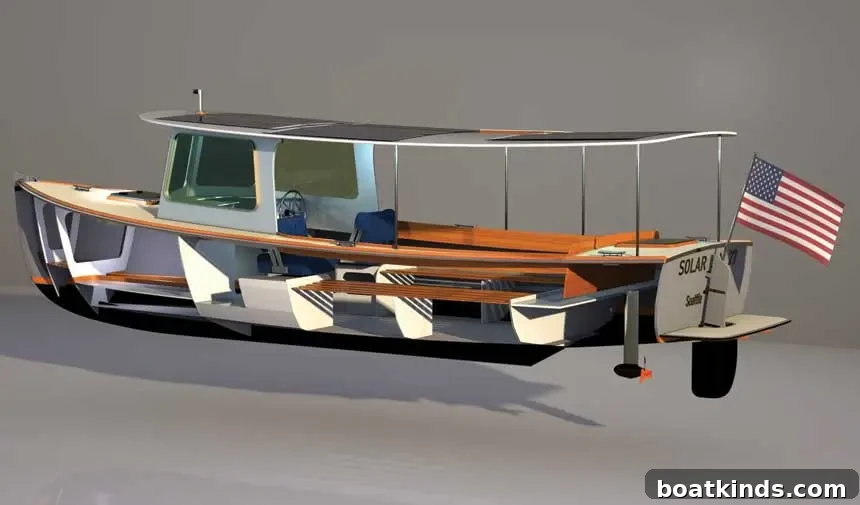
Sam Devlin and his firm, Devlin Designing Boat Builders, have taken a clear stand on the future of small craft propulsion: electricity powered by the sun. Devlin unveiled his first pure solar-electric model, the Solar Sal 27, at the Seattle Boat Show in January. Built under contract for Sustainable Energy Systems (SES) of Troy, New York, the 29-foot Solar Sal 27 is offered at a base price of $275,000 and targets owners who want quiet, emissions-free boating on lakes and other protected waters.
The Solar Sal 27 is configured to carry up to eight guests and features two berths in a forward stateroom. For onboard sanitation the boat uses Dry Flush’s Laveo system, a dry-flush toilet that eliminates the need for a holding tank—an advantage for owners who prioritize simplicity and low maintenance on day cruises and weekend outings.
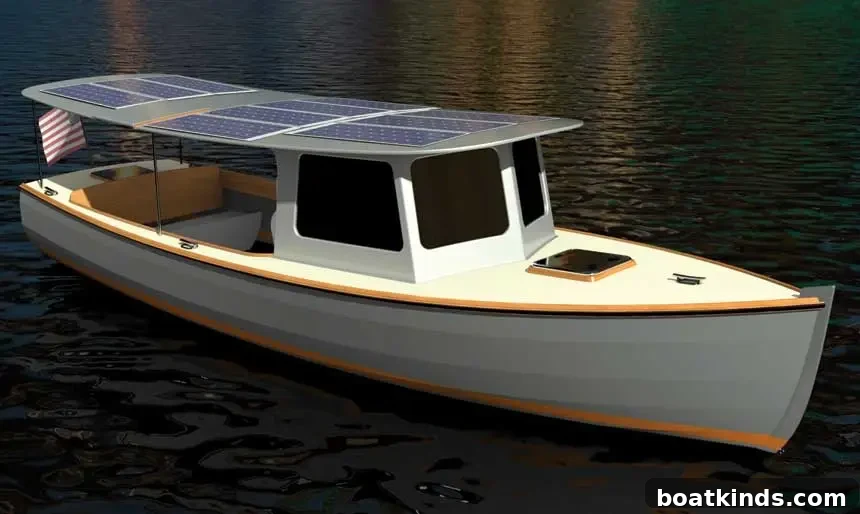
As an integrated solar-electric design, the Solar Sal 27 relies on ten roof-mounted flexible solar panels that together produce about 1.44 kWh. Those flexible panels were chosen in part because they conform to the roof’s crown, resulting in a sleeker, more refined appearance than rigid panels can provide. Energy from the panels charges two Victron LiFePO4 batteries that power an integrated 4-kW Torqeedo pod drive. The propulsion package delivers a range of operating profiles: roughly two hours at full speed and up to 10 hours at a 4-knot cruise, with real-world running times extending on sunny days as the solar array replenishes battery charge.
Owners can also recharge the batteries from shorepower, and Devlin is exploring optional hybrid solutions—such as EFOY methanol fuel cells—if customers request extended range or supplemental charging. “It will depend on what owners want,” Devlin notes, emphasizing that the Solar Sal 27 is intended as a living prototype that can be adapted to customer needs.
Construction uses a stitch-and-glue method that allows Devlin to modify hull and cabin shapes efficiently, making customization more economical for small production runs or one-off builds. That flexibility supports SES’s goal of offering solar-powered vessels for both recreational and commercial applications while letting early market feedback guide subsequent design choices. Devlin is also working on a larger all-electric cruiser for SES in the 36- to 46-foot range, indicating a roadmap toward bigger, longer-range electric models as demand develops.
Beyond the boat’s technical features, Devlin views the Solar Sal 27 as part of a broader transition in the marine industry toward electric propulsion. He compares the current shift to changes in the auto industry: as drivers grew comfortable with hybrid systems, many transitioned to fully electric cars. “I’m excited about this electric stuff,” Devlin says. “As people developed confidence in hybrid car systems, they became more comfortable with the step to full electric. I think we’re going to see that in boats, too. It’s going to happen very quickly.”
For buyers interested in quiet operation, low onboard emissions, and minimal fuel logistics, the Solar Sal 27 presents a practical near-term electric option for protected-water use. Its solar array, battery system, and electric pod drive are packaged to provide useful day-cruising endurance while retaining the simplicity and cleanliness that make electric boats attractive for marinas, lakes, and short coastal hops.
Devlin and SES are positioning the Solar Sal 27 as both a production model and a prototype platform—one that will evolve as owner preferences and real-world experience clarify priorities for range, comfort, and optional hybrid capabilities. For boaters curious about cleaner alternatives to combustion engines, the Solar Sal 27 illustrates how solar panels, modern lithium batteries, and efficient electric drives can be combined into a practical recreational craft.
This article originally appeared in the March 2019 issue.