
Why I Still Love My Boston Whaler 17 Montauk
After a lifetime spent on the water and hundreds of boats seen—from canoes to yachts—one model has always stood out to me for its dependability and practical design: the Boston Whaler Montauk. My pride and joy is a 1985 Boston Whaler 17 Montauk, powered by a willing 90-hp Yamaha outboard. This is the second Whaler I’ve owned; my first was a 17 Tashmoo with an 85-hp Johnson Sea Horse. I bought the Montauk more than 20 years ago and have repowered it once, and it has rewarded me with countless memorable days afloat.
The Montauk’s reputation for durability and versatility is well deserved. I’ve used mine for everything from fishing and clamming to cruising for pleasure and learning new boaters how to handle lines and docks. Whether I’m heading to Treasure Island on New Jersey’s Manasquan River, joining friends at F-Cove on Barnegat Bay, running up the beach to meet people on Shark River in Belmar, or watching fireworks on a summer night, I always come back to the slip with a smile.
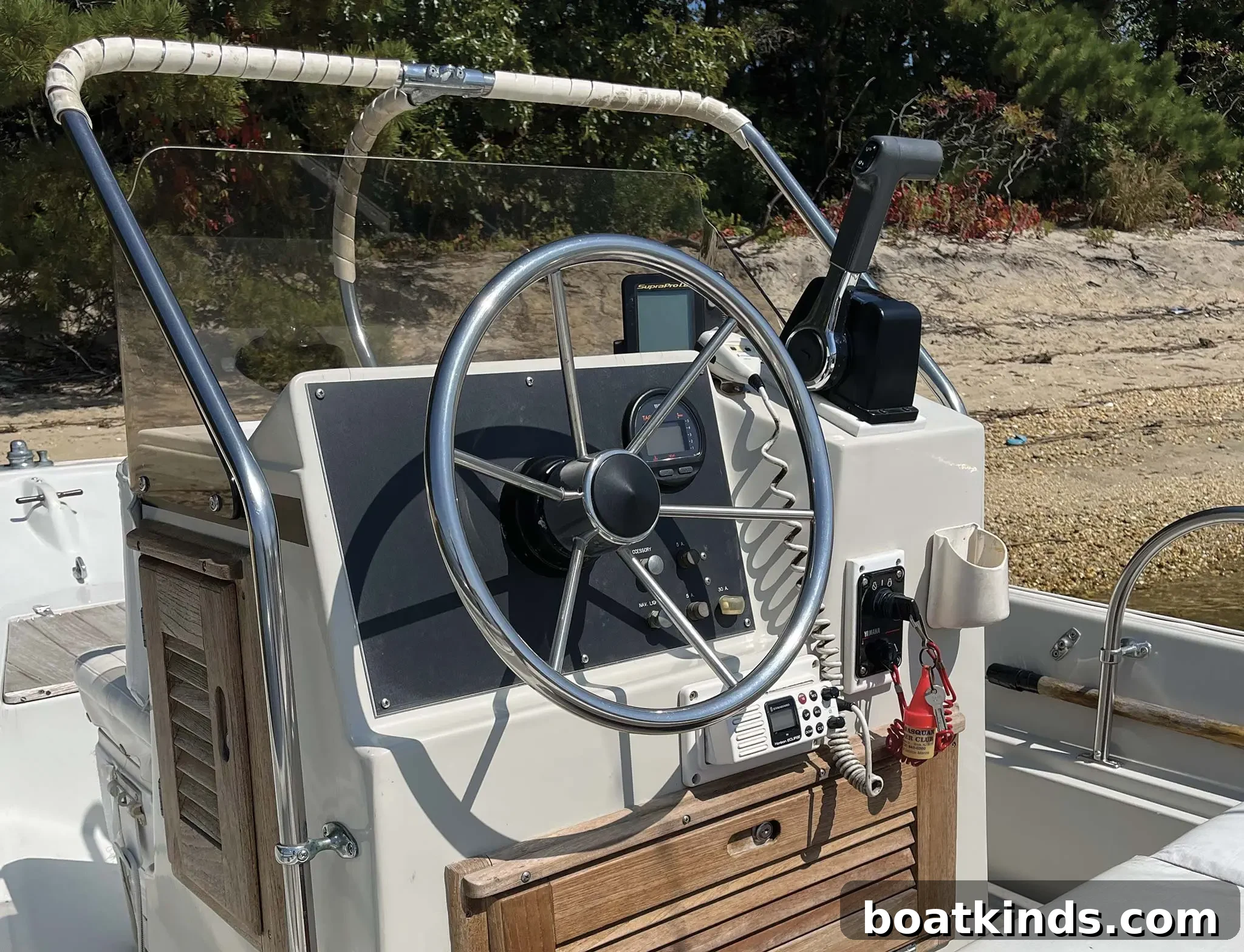
This Montauk is a second-generation hull. Boston Whaler introduced the Montauk hull in 1961, and in 1976 designer Bob Dougherty refined the running surface with a deeper V and a sharper entry, while shaping the outer hull sponsons to form the distinctive smirk beneath the bow rub rail. The design changes improved performance and handling in a variety of conditions—a quality that remains evident in mine.
What makes the Montauk exceptional for me is its simplicity and safety-first construction. The hull is built with thin inner and outer fiberglass laminates that sandwich a dense foam core, producing an unsinkable boat. It’s also self-bailing: if the drain plug is removed at the dock, water entering the hull equalizes with the outside waterline leaving only a minimal amount of water inside, often just a fraction of an inch. I leave a small automatic bilge pump on board for convenience, but I sleep better knowing the foam-core hull and self-draining design provide a passive safety margin if electrical systems fail.
The cockpit is practical and comfortable. The molded nonslip fiberglass sole gives sure footing for bare feet and wet decks, and the motor well is thoughtfully engineered with two drain plugs I remove when leaving the dock. That motor well clears water quickly if it comes over the transom while trolling for bluefish or striped bass or while drift fishing for fluke. Where other small open boats might let water flood the cockpit, the Montauk’s well channels and expels it fast.
Boston Whaler’s attention to functional details extends to the helm. When mine was built, Whaler emphasized parts commonality across models, so the helm console on my Montauk matches the layout used on the company’s 18-foot Outrage. There’s space for bracket-mounted electronics, a Ritchie PowerDamp compass and a VHF radio. The tinted acrylic windshield is framed by a sturdy stainless-steel grab rail for security while underway.
Storage and organization are well thought out. A pair of teak louver doors leads to an interior locker that stows five Type I PFDs, a toolbox, flares, maintenance supplies, a stern light, a portable horn and miscellaneous gear. A Kidde fire extinguisher sits in an easy-to-reach starboard compartment. Forward of the console are six rod holders and an Igloo cooler that doubles as a seat—simple, durable, and multi-purpose.
The reversible teak helm seat blends classic style with functionality: ladderback design, integrated rod holders, grab handles, and a rear compartment for tackle and tools. Beneath the seat are two 7.5-gallon fuel tanks that give me more than enough range for the kinds of trips I run.
Practical modifications over the years have made the boat even better for how I use it. I removed the bowrail because I dock bow-in and found it awkward to climb over when loading gear. A large teak hatch now provides a solid step and opens to a self-draining anchor locker that houses a Danforth anchor and about 250 feet of nylon rode—enough scope for most anchoring situations I encounter.
I’ve logged many nautical miles aboard New Attitude and feel secure whether I’m tooling around the river, bay or taking short ocean runs. I enjoy quiet mornings with the Yamaha off, listening to the water lap against the hull, teasing trout-sized jacks at the inlet sea buoy, or drifting and trolling for larger game. The Montauk can be unforgiving in a chop due to its size and hull shape—at speed it can ride a bit brusquely—but standing at the helm with one hand on the wheel and the other on the throttle smooths the ride, and feathering the throttle helps tame vertical acceleration when conditions demand it.
For me, a new boat should be at least as good as the one it replaces. After decades of ownership and daily use, I have yet to find a 16-ft, 7-in boat that matches the Montauk’s combination of safety, simplicity and utility for my purposes. That’s why I still own this 17 Montauk and expect to keep it for many years to come.
March 2025