The Cruis-Along: How a 20-Foot Plywood Cruiser Captured Postwar America
The modern recreational boating industry began to take shape in post-World War II America as a growing middle class looked for affordable ways to enjoy leisure time on the water. Shipyards that had converted to production-line methods to meet wartime demand were uniquely positioned to supply inexpensive, practical cruisers. One of the most successful production boats to emerge from this period was the 20-foot plywood Cruis-Along, built by M.M. Davis & Son Shipyard in Solomons, Maryland. Launched in 1946, the Cruis-Along met immediate demand and became a defining example of mass-produced recreational craft in the late 1940s.
From Custom Yachts to Production Boats: The Story of M.M. Davis & Son
M.M. Davis & Son was founded in 1883 by Marcellus Mitchell Davis and grew into one of Solomons’ largest industries by the early 20th century. Known for custom wooden yachts, the yard developed a strong reputation throughout the 1930s for quality craftsmanship on the Chesapeake Bay. Leadership passed to Clarence E. Davis in 1924, who continued the emphasis on traditional boatbuilding until his death in 1936.
After Clarence Davis’ death the yard was purchased by George Townsend of Greenwich, Connecticut, a prominent figure in powerboating who had served multiple terms as president of the American Power Boat Association and who had won the Gold Cup Motor Boat Classic twice. Facing the economic challenges of the Depression and shifting market demand, Townsend sought ways to keep the shipyard profitable. As Europe moved toward war and demand for custom yachts fell, the yard began to explore the concept of an affordable stock boat that could be produced in larger numbers.
Early Attempts and Wartime Transformation
In 1939 the yard produced a 26-foot plywood cruiser known as the Davis 36 as its first attempt at a stock model. The boat failed to attract buyers after a short period on the market, and the company shelved plans for production. Nevertheless, the design work and lessons learned during this period informed later projects.
When the United States entered World War II, M.M. Davis & Son retooled for military contracts with the U.S. Army Transportation Corps. Wartime production required modernization of facilities and the adoption of production-line processes, establishing a manufacturing base that would later support civilian production. After the war, Townsend renewed the plan to produce an affordable plywood cruiser aimed at returning servicemen and a public eager for leisure opportunities.
Design and Practical Appeal of the Cruis-Along
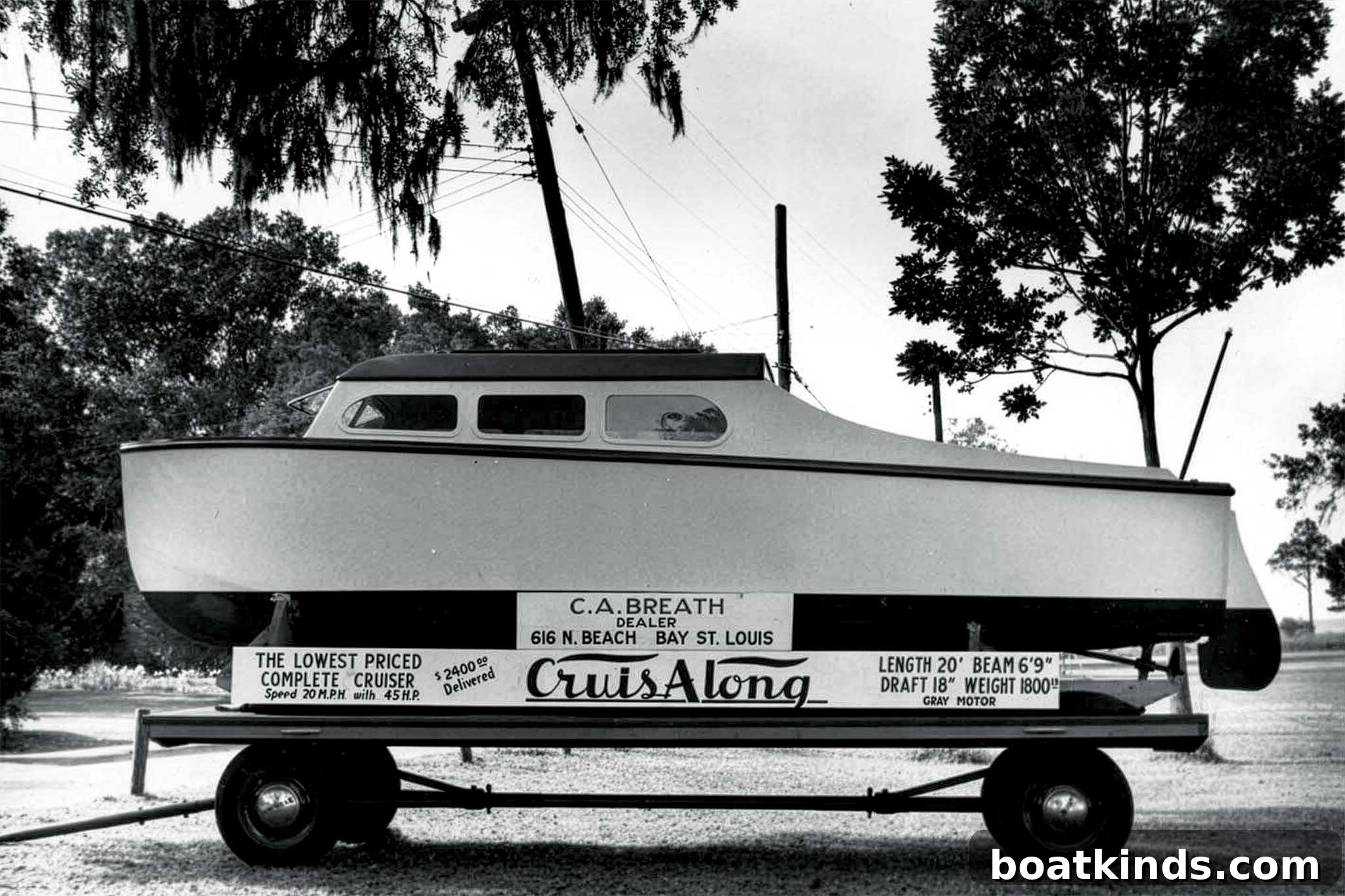
The first Cruis-Along prototype was developed in 1945 and entered production in March 1946 following testing in Essex, Connecticut. At 20 feet long, the Cruis-Along was intentionally simple and functional rather than luxurious. Built of plywood, the boat weighed about 1,500 pounds, making it easy to trailer and tow with the typical family car of the era. Its 6-foot, 9-inch beam and 18-inch draft provided stable performance for coastal and inland waters, while the layout prioritized efficient use of space.
Despite its modest size, the cabin offered two full-length berths and included a marine head, sink, stove and icebox—features that allowed weekend cruising or short overnight trips. The open cockpit provided room for socializing and practical use, keeping the overall design economical and straightforward. As Yachting magazine observed in January 1946, the Cruis-Along was aimed at “yachtsmen with Spartan tastes and slim pocketbooks,” a demographic that represented a large portion of potential buyers at the time.
Pricing, Performance, and Market Success
M.M. Davis & Son offered several engine options to balance cost and performance. The Economy Model came with a 16-horsepower inboard and had a base price of $1,980. For an additional $100 buyers could upgrade to a 25-horsepower engine capable of about 14 knots. The faster Speed Model, equipped with a 45-horsepower engine, cost $2,140 and could reach approximately 17 knots. These price points and engine choices allowed buyers to select a configuration that matched their budget and intended use.
Demand for the Cruis-Along was strong despite lingering postwar material shortages. In its first year of production M.M. Davis & Son delivered more than 300 hulls. The following year, at the National Motor Boat Show in New York, the yard received an extraordinary response—500 orders came in during the first days of the show, representing more than $1 million in sales. That year roughly 500 Cruis-Alongs were built and shipped, establishing the model as one of the era’s notable production successes.
Legacy and Relevance
The Cruis-Along captured a moment in American recreational boating when demand, manufacturing capability and accessible design converged. By pairing plywood construction with production-line techniques developed during wartime, M.M. Davis & Son delivered an affordable, practical cruiser that opened boating to a wider audience. Its success in 1946–1947 illustrates how postwar industry adapted to peacetime consumer needs and helped lay the groundwork for the broader recreational boating market that followed.
This article was originally published in the October 2026 issue.