Corey Silken
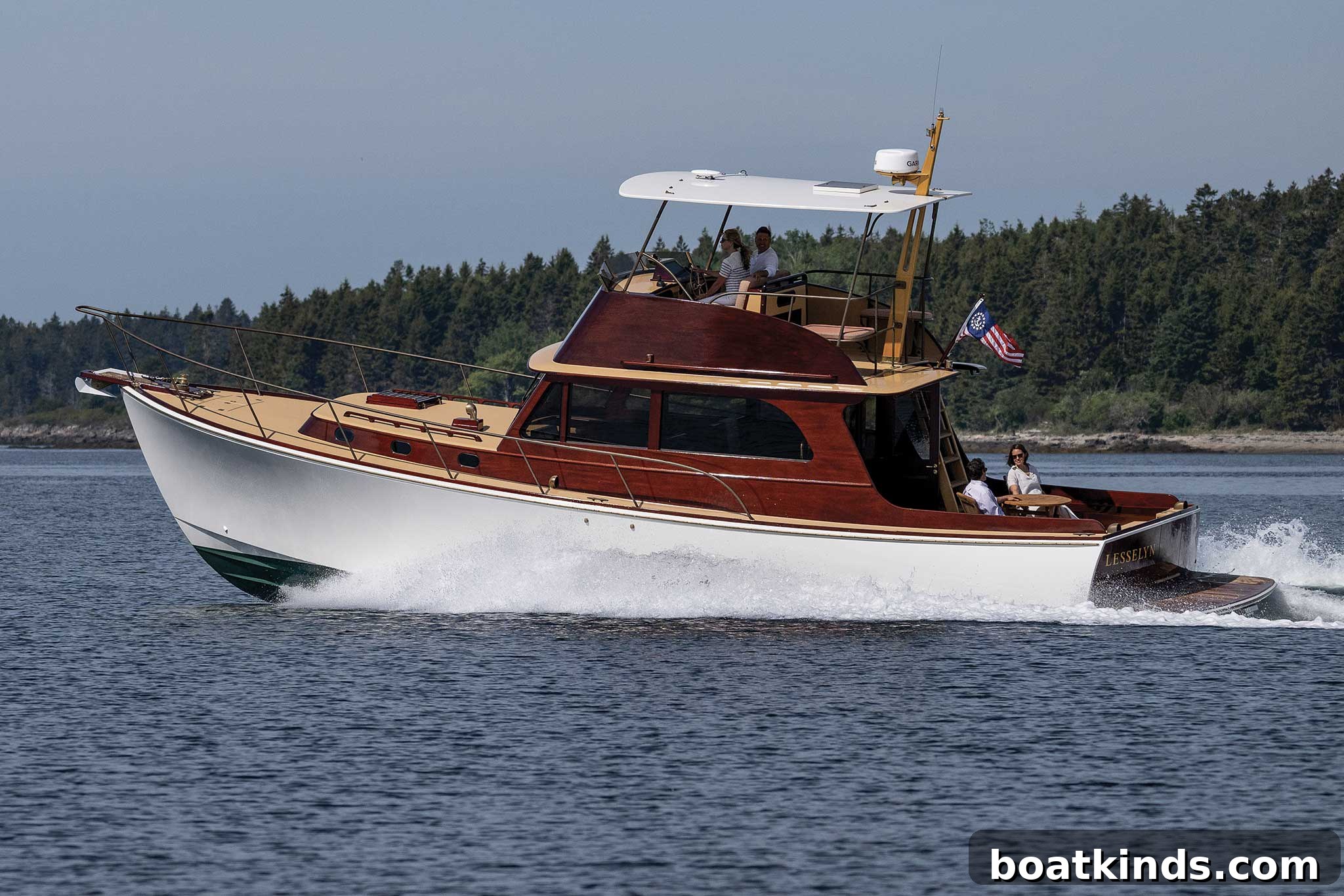
When Marblehead, Massachusetts design studio C.W. Hood teamed with Lyman-Morse Boatbuilding in Thomaston, Maine to create a new 42-foot Downeast-style flybridge yacht, they had a key collaborator beyond the shipyard and designer: the owner. Preferring to remain anonymous, the client wanted a boat with the classic presence of a Nathanael G. Herreshoff–inspired Buzzards Bay 25, but with modern systems and comfortable, easy operation.
Sea Trial
On a trial run on Maine’s St. George River, the Hood 42 LM revealed thoughtful integration of technology and traditional styling. The custom electrical panel, mounted on the port side of the companionway, is engraved with the yacht’s profile and features inset LED indicators for each system. Four mode switches—Running, Day, Night and Away—simplify power management by selecting groups of breakers with a single action. Instead of powering accessories one by one, the owner can activate the configuration needed for cruising, relaxing at anchor, overnight, or for leaving the boat unattended.
A CZone digital switching system manages the onboard systems behind the scenes, while high-capacity batteries and charging equipment address the owner’s requirement to use air conditioning and accessories overnight without running a generator. Integrel Solutions E-Power units, effectively high-output alternators, mount to the twin Volvo Penta D6-480 diesels and deliver 160 amps at 48 volts, replenishing the twin 300 Ah Victron battery banks in as little as two hours. Those batteries power a Termodinamica air-conditioning system and a Seakeeper 3 gyroscopic stabilizer, among other conveniences.
“It’s a complicated boat but incredibly easy to run because of the way it’s set up,” says Adam Wolf, marine systems installation manager at Lyman-Morse. “With the different modes, it’s one switch and you can go to bed.”
Run Silent
To minimize noise and vibration, Lyman-Morse engaged J&A Enterprises of Salem, Massachusetts. They diverted the stock exhaust and installed large mufflers outside the engine room. The twin Volvo Penta DPI DuoProp sterndrives are connected via short shafts to allow operation in shallower water than traditional shaft or pod drives. Additional mitigation measures include heavy-duty rubber gaskets on engine hatches, vibration-reducing stiffeners on the outboard hull stringers, and sound-dampening tiles to reduce structure-borne noise such as wave slap.
On the water the 42 LM felt composed. The twin Volvo Penta sterndrives pushed the hull to a top speed near 37 mph at 3,600 rpm with a comfortable cruise speed around 34 mph. In tight S-turns around lobster-pot buoys the boat responded with agility, and in a firm, banking turn she held a steady arc with predictable tracking.
The vessel blends classic Downeast styling above the waterline with a modern running surface below. The modified-V hull has hard chines, two lifting strakes per side and a sharp 67-degree entry at the bow. The hull section eases to about 21 degrees amidships and roughly 18 degrees at the transom. Humphree Interceptors and the DPS drives make it possible to fine-tune trim and ride characteristics underway.
Built like other C.W. Hood models at Lyman-Morse, the 42 LM—named Lesselyn after a small Scottish town—uses a cold-molded hull of Douglas fir and western red cedar, vacuum-bagged in West System epoxy with an epoxy-infused E-glass outer skin. The classic aesthetic is achieved through extensive mahogany joinery finished with 15 coats of varnish.
“We favor a strong hull structure and will accept some added weight to ensure a good ride,” Hood explains. “Where practical, we save weight through choice of bulkheads, deck materials and equipment. The result is a robust hull that doesn’t feel heavy.”
The flybridge hardtop is carbon fiber, faired and painted to match the boat. Lyman-Morse’s fabrication shop crafted the bronze rails with exceptionally smooth welds; the subtle greenish patina contrasts beautifully with the varnished pilothouse trim. CNC-machined hatch latches and fender hangers were supplied by Seasmart in Pesaro, Italy, while engine-room exhaust cowls and flybridge windshield brackets were made by New England Castings in Standish, Maine.
At the flybridge helm a Garmin multifunction display sits in a raised mahogany binnacle trimmed in bronze. The helm package includes twin digital Volvo Penta tachometers, a digital fuel gauge and a fire-suppression monitor. Joystick controls mounted to either side of the console and multifunction display allow precise docking from port or starboard. The centrally mounted bronze Edson wheel is complemented by Volvo Penta digital shift and throttle controls to starboard, with seating for two at a comfortable bench and additional jump seats built into the hardtop aft corners.
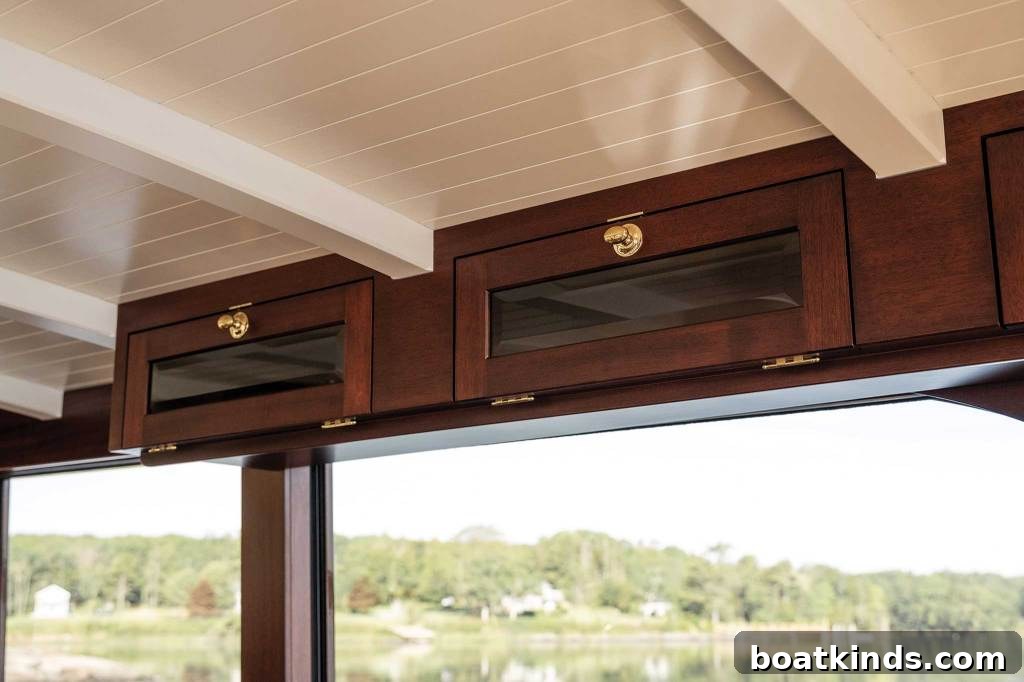
“It’s old school but with new-school ergonomics,” Hood says. Rather than applying retro styling at the expense of comfort, the team paid close attention to seat heights, wheel placement and visibility so the boat is comfortable whether steering seated or standing.
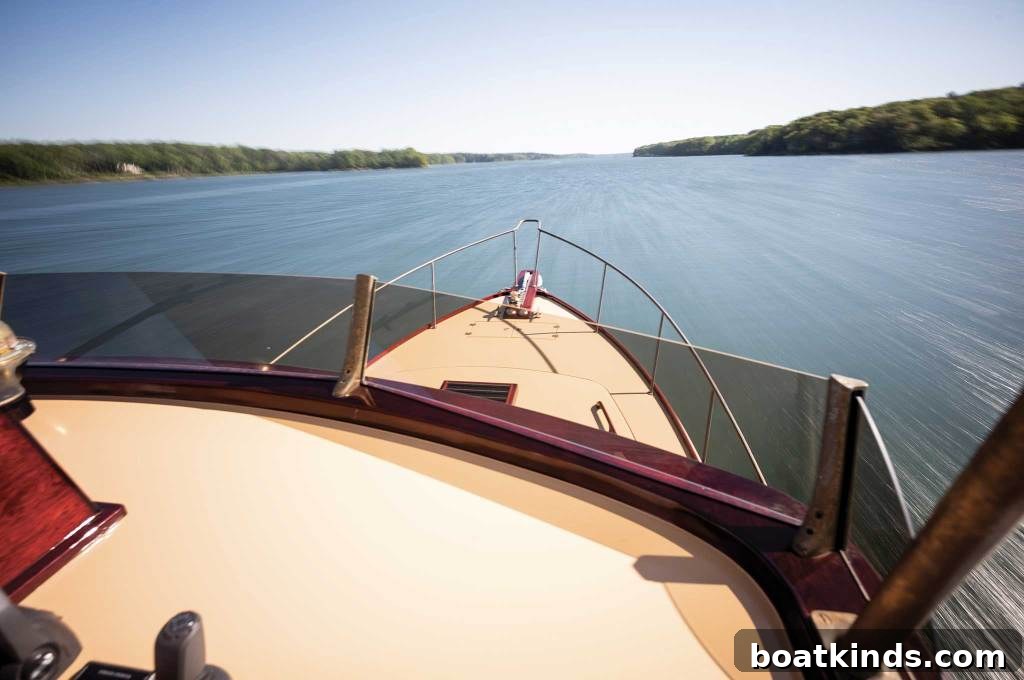
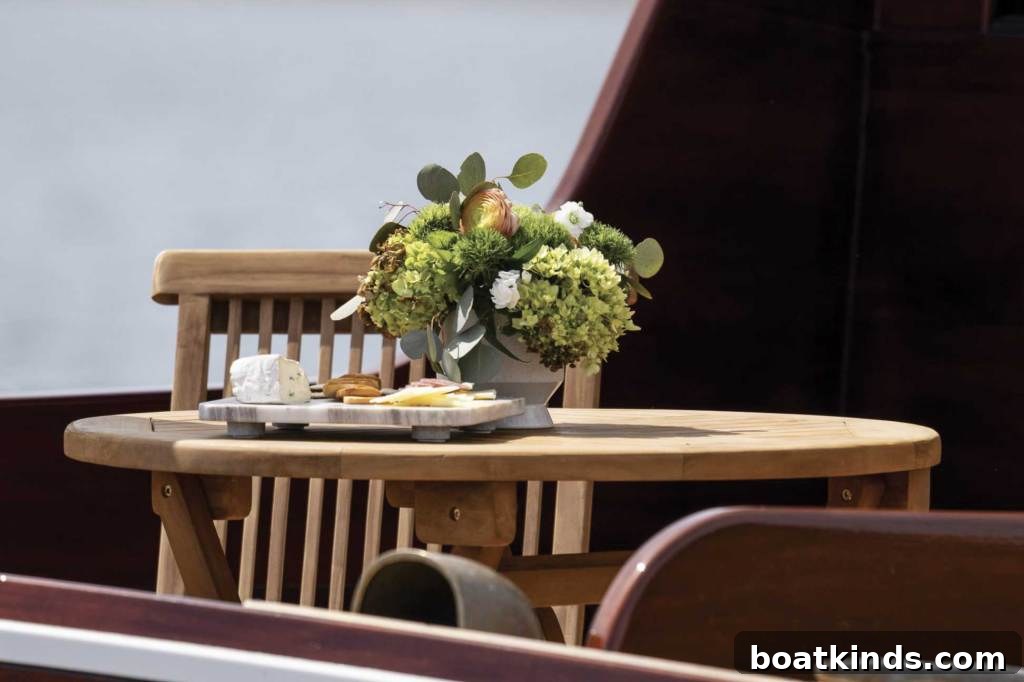
A removable Sitka spruce ladder, finished to match the radar mast, provides safe access between the flybridge and cockpit. The deck features wide teak planking and the cockpit offers varnished spruce chairs and a table for entertaining. Practical touches reflect the builder’s experience: steps and handholds are positioned for easy movement up to broad side decks, and mahogany handrails along the pilothouse aid forward passage. The bow is equipped with a custom roller assembly and Muir windlass, with bronze-capped foot controls and windlass switches at both helms.
A hefty 3-inch-thick mahogany cockpit door houses a counterbalanced glass window that lifts easily, while salon windows lower at the push of a button—another example of hiding modern technology within a classic aesthetic.
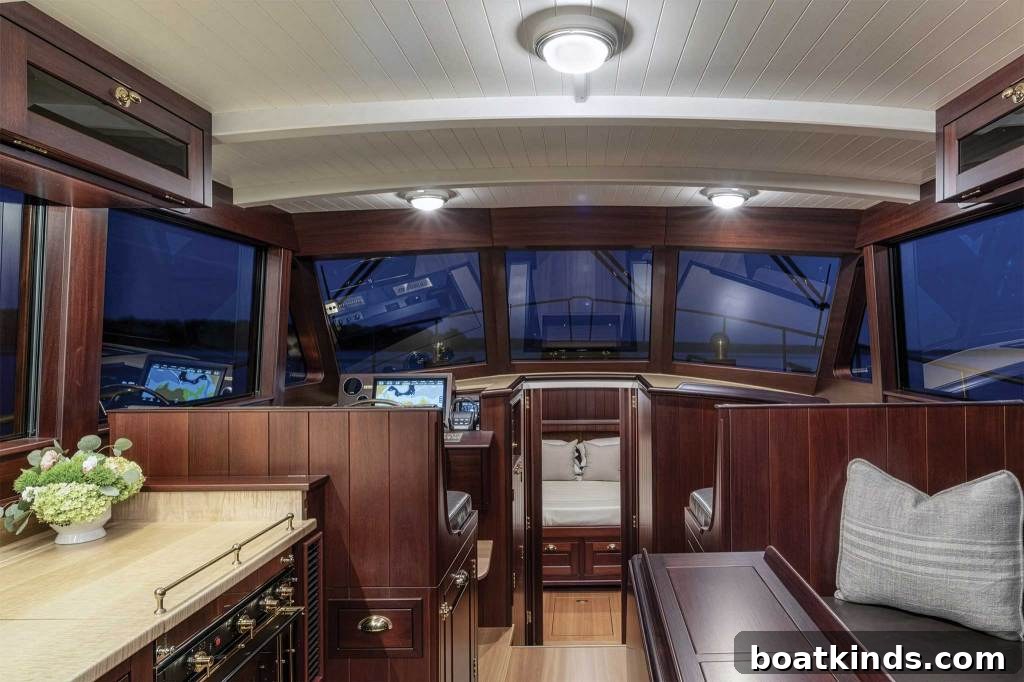
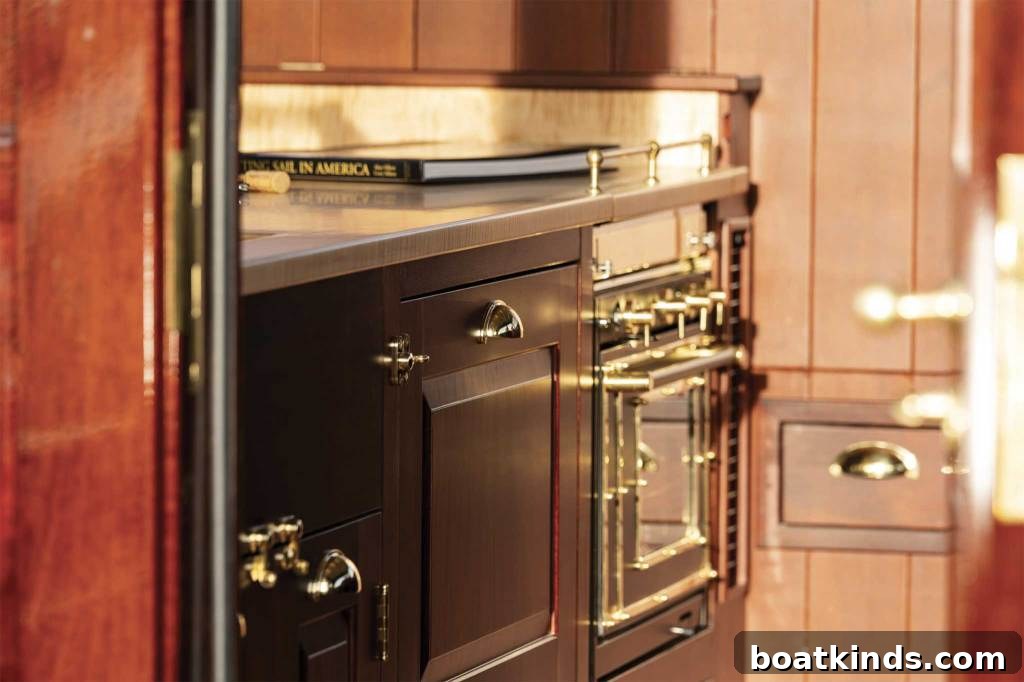
The salon’s raised L-shaped lounge sits to starboard. Lyman-Morse planned a bronze base for the table with a mechanism that allows it to slide fore-and-aft and athwartships. The port-side galley features a brass sink, maple countertop, drawer-style refrigerator/freezer and a three-burner stove and range.
Forward, the lower helm seat adjusts on waxed-wood rails. When docked, the panel holding the Garmin MFD and Volvo Penta instruments can be lowered into the dash and covered with a removable wood cap, keeping electronics out of sight when desired.
“The theme was to hide the technology throughout the boat,” says Lance Buchanan, Lyman-Morse’s boatbuilding division manager. Belowdecks, a stand-up shower sits to port and a removable access panel reveals neatly labeled helm rigging—each wire, hose and cable is tagged for straightforward troubleshooting. The starboard head offers a brass sink, marble counter and ample storage, while the owner’s berth is centered forward with hanging lockers and drawers beneath the berth.
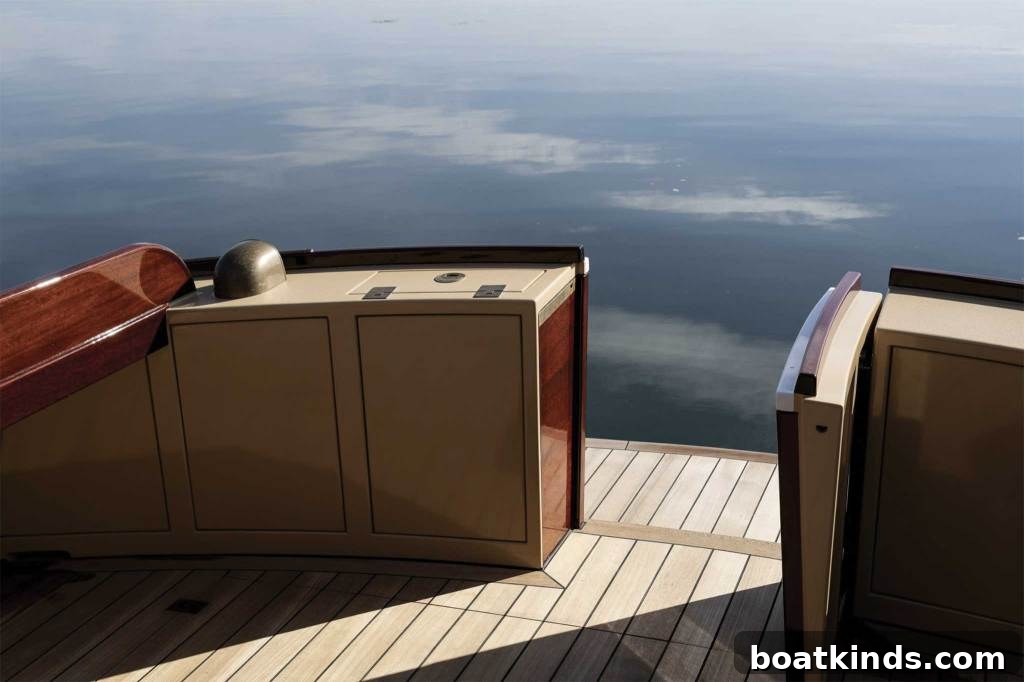
Serviceability is a strong focus. A large in-sole hatch in the salon opens to the mechanical bay housing the battery banks, Seakeeper, Racor filters, twin 80-gallon water tanks and the 200-gallon diesel tank. Battery chargers, monitors and the inverter are easily accessed at the forward end of the compartment, and two large cockpit hatches provide clear access to the engines. For major work, the center rail for those hatches can be removed to expand the opening.
“When we build boats together, we try to make the work easier for the person who has to service them,” Hood says. “If it’s easier to maintain, it’s more likely to be well cared for.”
The Hood 42 LM combines traditional Downeast lines that will turn heads with modern systems that make running and living aboard straightforward and comfortable. It’s a demonstration of what a practical owner, thoughtful design and a world-class yard can achieve together.
LOA: 42’
Beam: 13’
Draft: 3’4”
Displ.: 21,000 lbs.
Fuel: 200 gals.
Water: 80 gals.
Power: (2) 480-hp Volvo Penta
D6 diesels with DPI
DuoProp sterndrives
This article was originally published in the October 2026 issue.