Is it already time to consider putting the boat away for winter? For many boat owners, the season is drawing to a close. In colder regions you may soon face leaving your boat unattended for several months—often four to six. During that interval many things can go wrong: batteries can drain, water can intrude, systems can freeze or fail, and theft or accidental damage can occur. The good news is that modern boat monitoring systems give owners a way to keep tabs on their vessels remotely.
Remote boat monitoring has been available for over a decade. Early adopters often encountered systems from Siren Marine (now part of Yamaha Marine), but many manufacturers now offer solutions focused on safety, security and readiness. While most buyers initially envision these systems for use during the boating season, the same capabilities are highly valuable during winter layup and long-term storage.
Monitoring systems are conceptually straightforward: they collect data from a range of sensors on the boat, check values against expected limits, and then notify you if something is wrong. Most units communicate via cellular networks and deliver alerts through a dedicated mobile app, email or text messages. Typical monitored items include boat location, battery voltage, bilge pump activity, onboard temperatures, door and hatch sensors, motion or impact alerts, and more. Advanced units can integrate with the boat’s NMEA 2000 network to report engine diagnostics, tank levels, digital switching states and other vessel data.
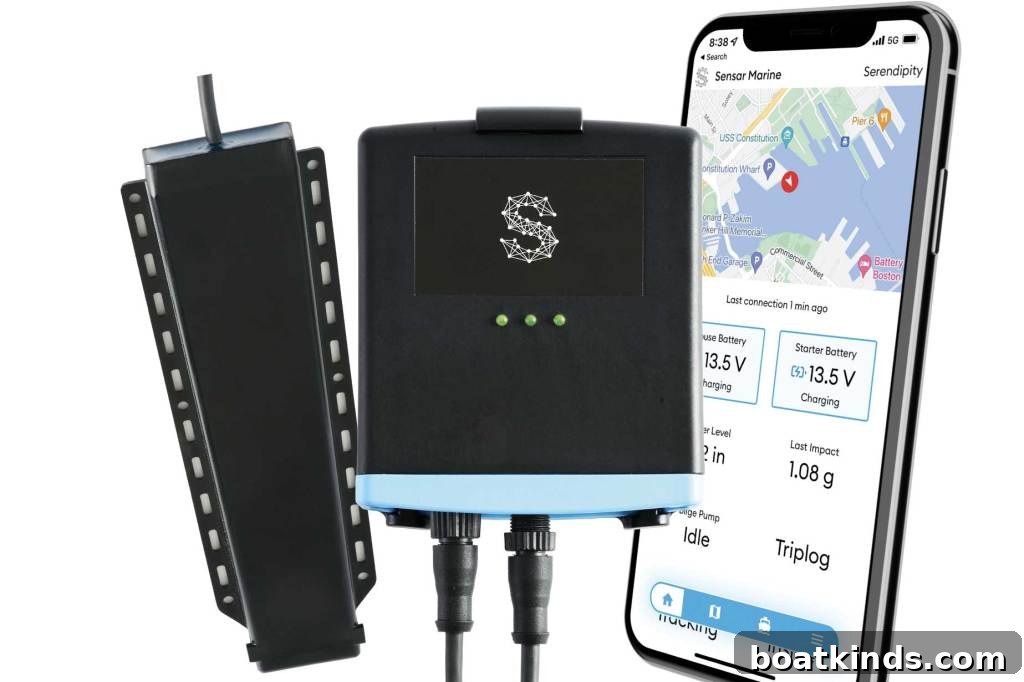
Sensar
The value of remote alerts is clear. If your boat is hours away, an alert that the starting battery is low can save you a wasted trip. Location alerts confirm the boat remains where you left it when tied to a mooring or dock. Notifications of unexpected bilge pump run time, water-in-bilge warnings, or sudden temperature swings let you act before small issues become costly repairs.
Systems vary widely in cost and capability. Entry-level monitors start around $500 and cover a handful of essential sensors; higher-end bundles can reach into the thousands for extensive monitoring and integration. For example, Sensar Marine’s base package monitors two battery voltages, bilge pump activations, bilge water level and temperature, impact sensing, and location. Siren’s Long-Distance Cruiser Bundle, priced around $1,500, adds shore power, an entry sensor, temperature monitoring and NMEA 2000 data including engine parameters and digital switching. Satellite-based or security-focused products from companies like Global Ocean Security Technologies (GOST) provide additional coverage for owners who need broader connectivity or advanced surveillance.
Selecting a system with the off-season in mind is important. A monitoring unit that draws continuous power from the boat can itself become a liability by discharging batteries during storage. To address that, several modern monitors include internal power sources designed to run independently for months. Sensar Marine, for instance, offers a hardwired device with a rechargeable internal battery that can operate without external power for up to four months; its design minimizes any parasitic drain on the vessel’s batteries and works in extreme temperatures down to -40°F. Sensar’s CEO Austin Bliss emphasizes that the system focuses on the fundamentals—location, battery voltages, bilge activity, impact sensing and ambient temperature—while avoiding a constant draw on onboard power.
Another approach comes from Skyhawk Oversea, which uses an all-wireless architecture powered by long-lasting, non-rechargeable batteries. That enables the hub and sensors to be placed hundreds of feet apart and avoids drawing any power from the boat’s batteries. Skyhawk’s design makes it feasible for a single Oversea hub to monitor multiple boats in storage, and the company offers a broad set of sensors for batteries, bilges and environmental conditions. Founder and CEO Rich Shevelow notes the system’s simplicity, long battery life and suitability for off-season deployments.
When choosing a monitor, consider year-round needs—both active cruising and months in storage. Ask how the system is powered, whether it integrates with your boat’s existing electronics, what sensors are included or optional, and how alerts are delivered. If your boat uses lithium-iron-phosphate batteries, for example, monitoring to prevent over-discharge is especially important because deep discharge can permanently damage those cells.
A well-chosen monitoring system gives peace of mind and practical protection. During the off-season it verifies the assumptions owners often make: that a trickle charger is maintaining battery health, that the bilge remains dry, or that no unauthorized access or movement has occurred. Remote alerts dramatically improve the odds your boat will be ready and trouble-free when the next season begins.
This article was originally published in the October 2026 issue.