Northwest 55: First Look at the Reimagined Coastal Cruiser
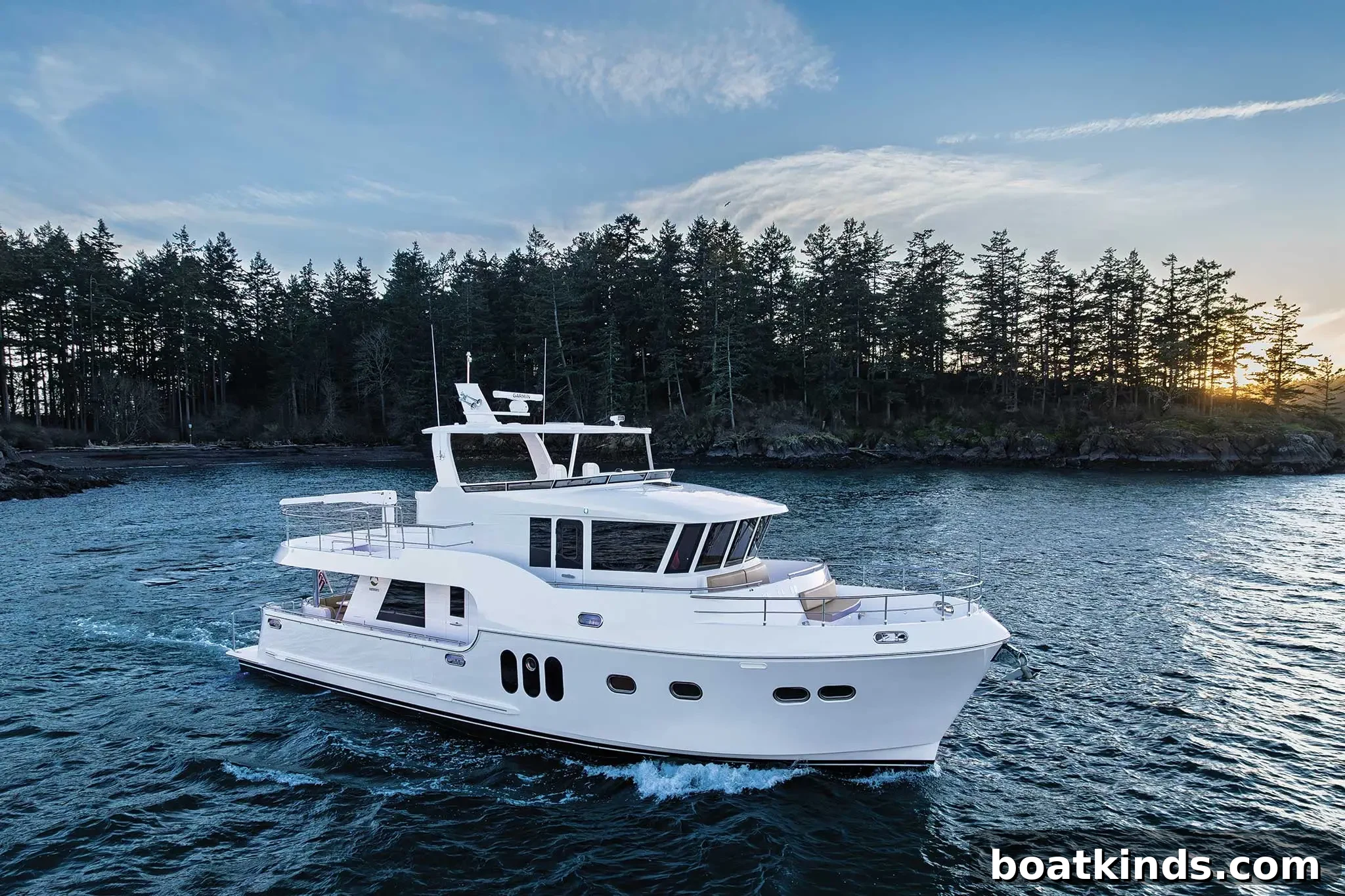
Just after 7 a.m. under low, iron-ore skies, I stood on the dock at Cap Sante Marina in Anacortes, Washington, bracing against wind-driven rain. From the finger pier I stepped back twice to take in the Northwest 55 in full — hull No. 1 cuts an assertive profile with a tall bow and more than 25 feet of air draft, a presence that looks ready to take on Puget Sound and beyond.
The twin John Deere diesels were idling as I climbed aboard via the swim platform, rose the molded fiberglass stairs and moved through the cockpit into the salon. The Northwest 55 is the debut model of the relaunched Northwest Yachts line, spearheaded by founder Peter Whiting of Seattle Yachts. The brand enjoyed early success in the 2000s before production paused when its Asia facility was sold and the economy turned. In recent years Whiting saw an opportunity to bring the marque back, teaming with designer Steve Seaton to develop a family of semidisplacement power cruisers aimed at coastal and near-coastal boaters — including those who might tackle passages such as the Inside Passage — and partnering with Jeff Chen and the Shanghai facility that builds Hampton and Endurance yachts to produce the new line.
Northwest’s initial trio of models spans 52 to 58 feet but shares a consistent platform: a 17-foot, 2-inch beam, solid fiberglass hull with two additional Kevlar layers in the layup, an asymmetrical layout with a wide starboard side deck, a dedicated pilothouse crowned by a Portuguese bridge, a capacious flybridge and a boat deck equipped with a Steelhead davit. The boats are similar from the galley forward; length differences translate into added space in the salon, aft deck and flybridge.
Owners can personalize layouts and systems: two- or three-stateroom plans, a variety of interior finishes and single or twin John Deere propulsion options up to 750 hp each. Standard fuel capacity is 1,200 gallons, with expanded tankage available as an option.
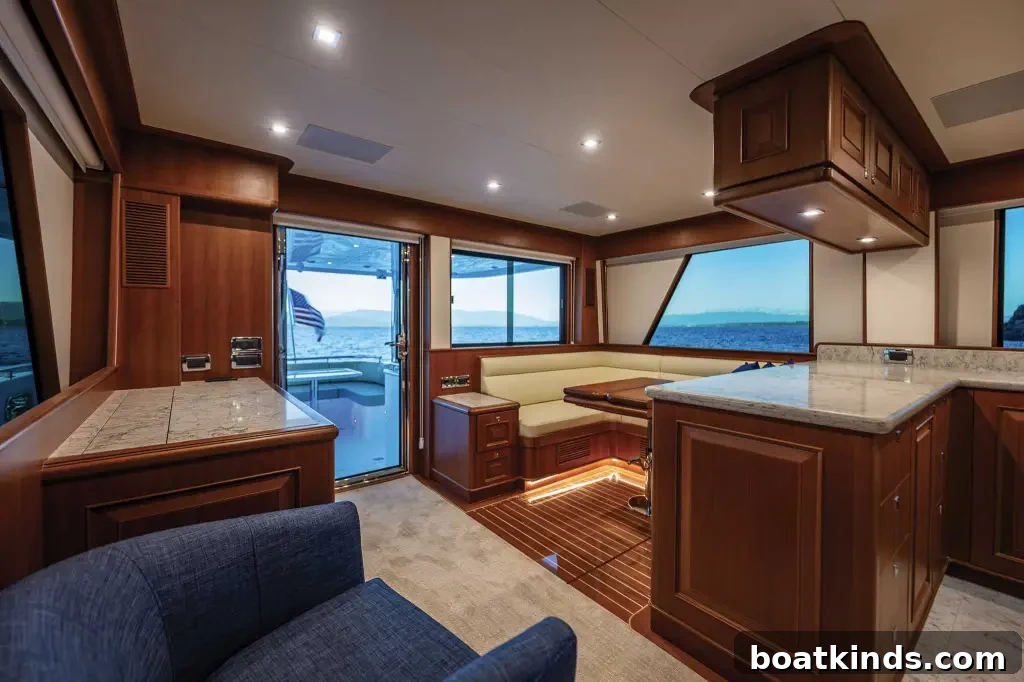
Hull No. 1 arrived at the builder’s Anacortes headquarters for final commissioning and made a run to the Seattle Boat Show before I inspected her on that rainy morning. Stepping into the salon, I was struck by the cherry joinery. Seattle Yachts managing broker Martin Snyder told me the woodwork receives 12 coats of varnish followed by a satin finish to achieve its depth and sheen. The craftsmanship is a definite highlight and gives the interior a warm, refined atmosphere.
The amidships galley separates the pilothouse and salon, creating a practical flow for guests and crew. The galley feels larger than its footprint suggests thanks to the asymmetrical hull and tall windows; heated Silestone soles, abundant stowage and a full-size GE Profile refrigerator/freezer complete the picture. It’s a layout that serves both the salon and pilothouse well and keeps the social spaces connected.
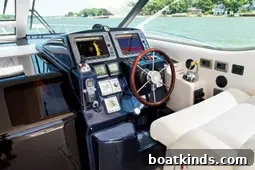
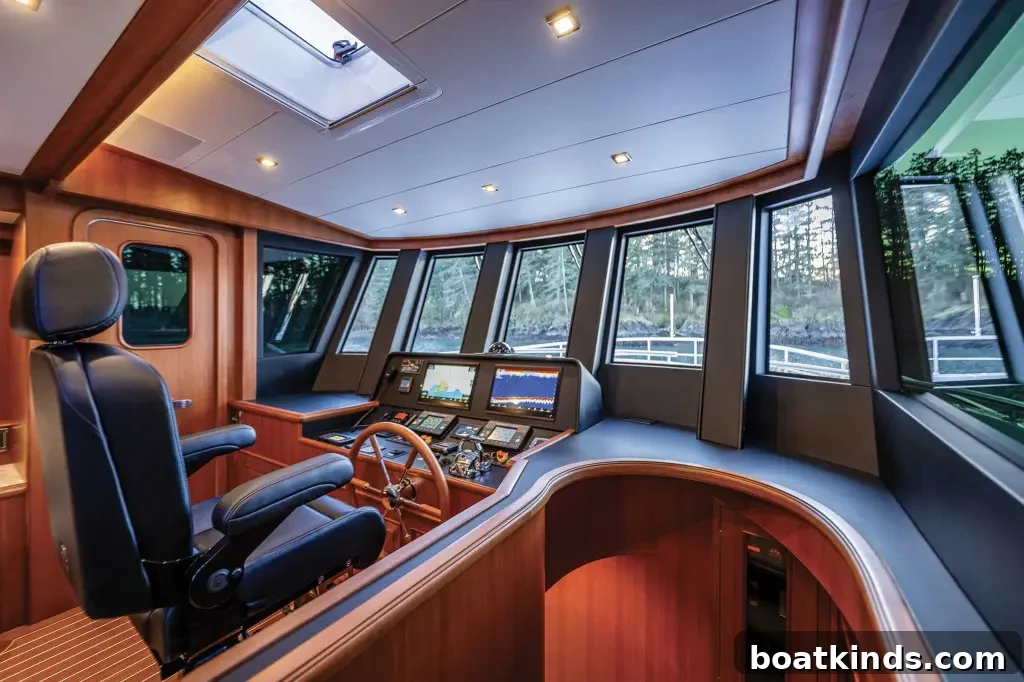
The pilothouse sits five steps above the salon and offers more than 8 feet of headroom over a single Pompanette helm seat; a plate in the sole allows for a companion chair if desired. An L-shaped settee against the aft bulkhead converts to an off-watch berth, and matte-black window mullions contrast attractively with the cherry woodwork. Pantograph doors open to the wide side decks, and an internal staircase connects to the flybridge.
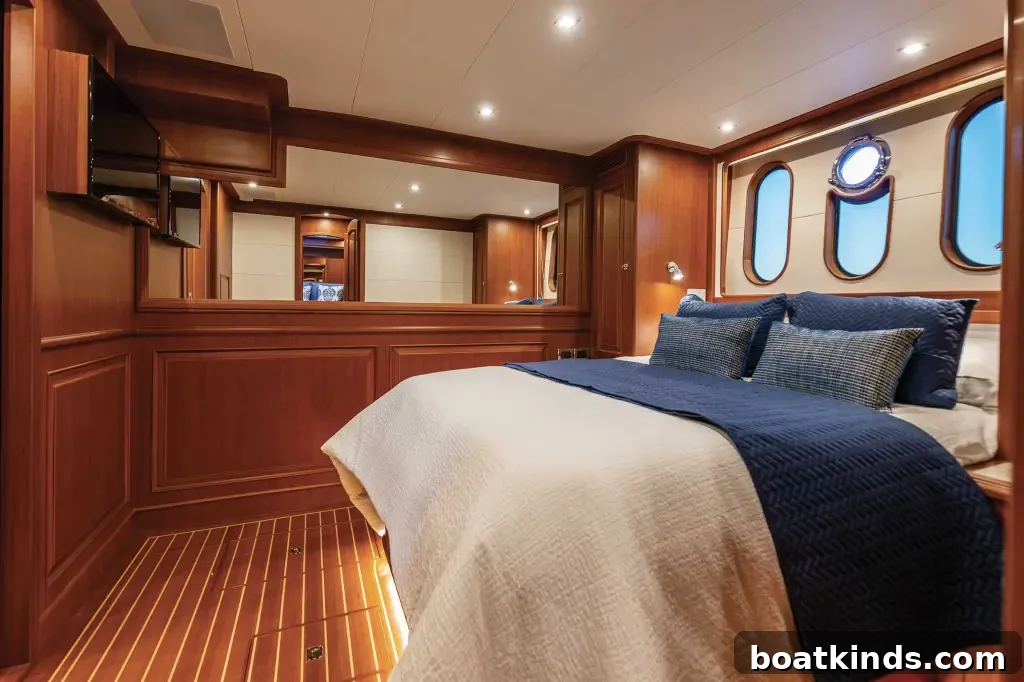
Below, hull No. 1 features a three-stateroom, two-head layout with a full-beam amidships master, a forward VIP and a versatile guest stateroom with bunks that can be converted into an office with a desk and upper berth. Both heads mirror the salon’s joinery quality and feature the same heated soles found in the galley.
Propulsion on hull No. 1 comes from twin 330-hp John Deere 6068 engines, and the boat’s dry displacement is 61,800 pounds. On our sea trial through the San Juan Islands the 55 handled sloppy conditions with composure. Cabin noise remained restrained, with decibel readings in the mid-50s to mid-60s across the rpm range, making for a comfortable ride and quiet wheelhouse environment.
Snyder described the twin 330s as an optimal match for a coastal cruiser that can also undertake longer voyages. The performance figures back that up: a reported range of 1,645 nautical miles at 5 knots, 1,000 nm at 6.1 knots, 731 nm at 7.5 knots and 589 nm at 8.2 knots. Top speed is quoted at 10.1 knots, where the vessel’s range is about 500 nm.
Because of the weather we spent the trip running the boat from the dry, comfortable pilothouse. Returning to port, docking felt straightforward thanks to an aft-facing camera, wide protected side decks with high bulwarks and large hawseholes with oversized cleats. Up top, the flybridge features a C-shaped seating area under the hardtop plus twin Pompanette helm chairs, seating for roughly eight guests, and a boat deck that can carry a 13-foot tender up to 1,100 pounds.
The cockpit is protected beneath the boat deck and opens to the swim platform via boarding gates. A centerline C-shaped dinette, a wet bar and barbecue built into a forward port credenza with a wing station make the space well suited to entertaining. A molded fiberglass stair on the starboard side accesses the flybridge, and a lazarette in the sole leads to an engine room with generous space between the mains and about 6 feet, 4 inches of headroom.
Overall, the Northwest 55 presents as a comfortable, well-equipped coastal cruiser with an upscale finish and thoughtful systems. Seattle Yachts has revived a noteworthy model line and partnered with an experienced builder to deliver a yacht that suits owners seeking a capable, comfortable boat for coastal cruising and extended passages.
LOA: 55’7”
Beam: 17’2”
Draft: 4’6”
Displacement: 61,800 lbs. (dry)
Fuel: 1,200 gals.
Water: 300 gals.
Power: (2) 330-hp John Deere 6068 diesels
This article was originally published in the November 2026 issue.