
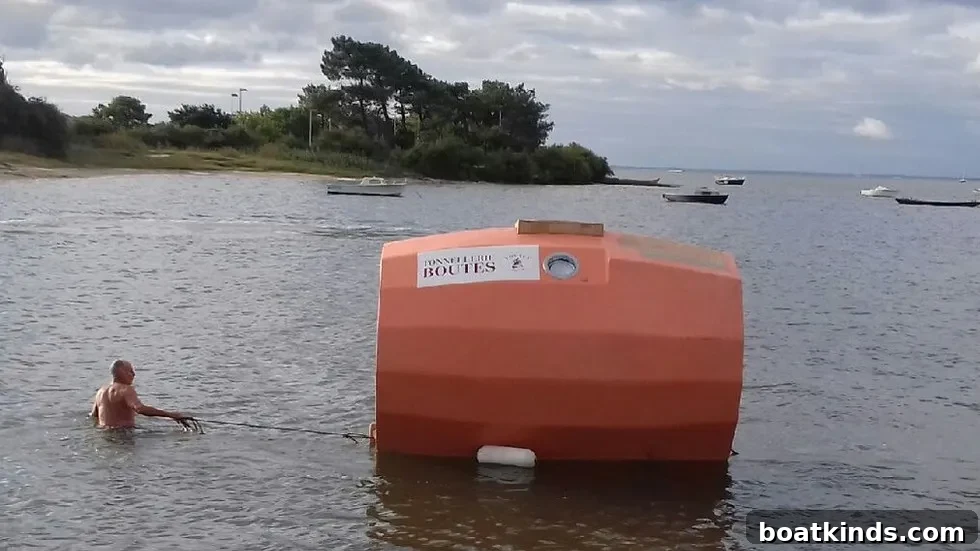
At 71 years old, French adventurer Jean-Jacques Savin has taken a strikingly original approach to solo ocean travel: he built a barrel-shaped vessel to cross the Atlantic using only the force of the sea. Rather than relying on engines or sails, Savin’s plan is to drift with the ocean currents, letting the natural movement of water carry him from the Canary Islands toward the Caribbean.
The barrel itself is roughly ten feet long and was specially constructed to serve as a small, self-contained living space for the journey. Savin set off from the Canary Islands on December 26, 2018, and he expected the crossing to take approximately three months. The voyage blends traditional craftsmanship with extreme adventure: the project received some financial support from French cooperages—barrel makers—who were interested in backing his unconventional expedition.
Preparing to spend weeks alone at sea, Savin stocked modest provisions for the passage. Among the items he took aboard were a block of foie gras and a bottle of white wine, which he planned to enjoy for a New Year’s Eve celebration while adrift. Those personal touches underscore the human side of what is at once an endurance challenge and a deliberate experiment in patience and navigation by natural forces.
Relying solely on currents means that the trip involves considerable uncertainty. Ocean drift voyages are dictated by complex and often changing patterns of sea movement, weather systems, and winds. By choosing this method, Savin accepted the unpredictable nature of the route and timetable: there is no fixed speed or direct course when a vessel is principally transported by the ocean itself. The aim is to let prevailing currents move the craft steadily westward toward the Caribbean basin.
The idea of crossing vast stretches of ocean in a compact, minimally powered craft is rooted in a long tradition of experimental seafaring, where inventiveness and a willingness to accept risk are central. Savin’s concept stands out for its blend of whimsy and resolve—transforming the familiar image of a wooden barrel into a tiny drifting cabin capable of making an intercontinental passage. His voyage invited widespread curiosity precisely because it defies standard expectations about how to cross an ocean.
Observers noted the symbolic resonance of the project: a barrel, typically associated with aging wine or storing food, becomes a vehicle for exploration, solitude, and endurance. The involvement of French barrel makers also highlighted a cultural link, merging artisanal craft with adventurous ambition. That juxtaposition—craftsmanship and extreme travel—helped the voyage attract attention from the public and the media.
Beyond the novelty, the expedition drew interest for what it reveals about human motivations for undertaking such challenges. For some adventurers, the allure lies in testing personal limits; for others, it is about drawing fresh attention to traditional crafts or raising awareness of the sea’s power and unpredictability. In Savin’s case, the voyage combined a clear, unusual image with a personal determination to complete a passage across one of the world’s busiest oceans by nonconventional means.
Whatever the outcome, the voyage was a reminder of how ingenuity and a simple concept can capture the imagination: a single person, a barrel, and the vast Atlantic as the route. The project resisted the modern tendency to rely on speed and technological control, instead embracing a slower, more uncertain relationship with the natural environment. That choice—deliberate, risky, and poetic—was central to the story of Jean-Jacques Savin’s barrel crossing attempt.