
John Stobart’s Aucoot Cove: A Quiet Harbor on Buzzards Bay
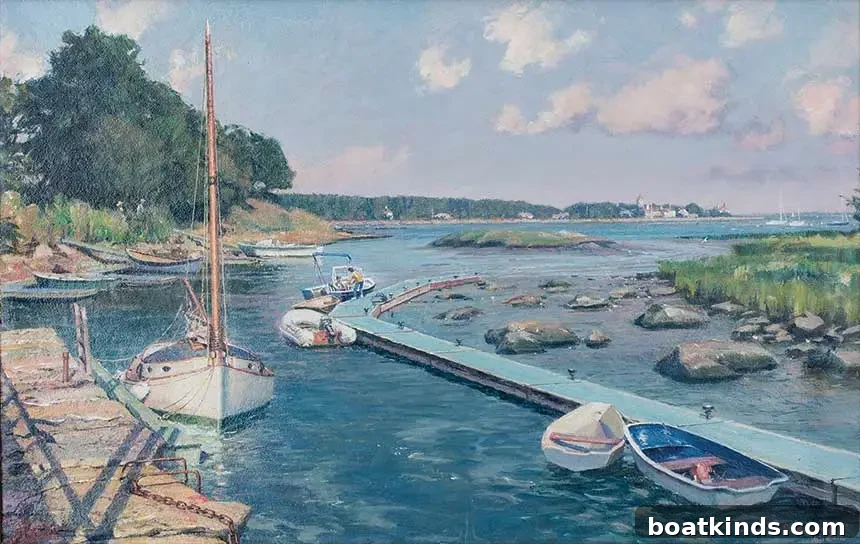
Picture marine artist John Stobart standing on the shore of Aucoot Cove, eyes fixed on Converse Point across the water. It’s a clear, calm day on Buzzards Bay along Massachusetts’s southern coastline—an ideal day for small-boat outings and a perfect subject for a harbor painting. The scene offers a variety of craft to admire: a couple of dinghies and an inflatable near the beach, an outboard runabout preparing for a day trip, and a classic New England catboat whose single sail and shallow hull speak to the region’s long maritime tradition.
Aucoot Cove is one of the many little inlets, bays, and coves that punctuate the New England shoreline. These sheltered waters were once essential havens for the commercial and fishing vessels of a bygone era and today continue to attract recreational sailors and powerboaters who enjoy gunkholing—cruising from cove to cove and visiting the small harbors, towns, and villages that line the coast. The charm of these places lies not only in their natural beauty but in the human details: moored boats, lobster traps, weathered docks, and the small bursts of activity that animate an otherwise quiet waterfront.
Stobart has an unmistakable feel for harbors of every size, from busy urban ports to intimate coves like Aucoot. Widely regarded as a dean among contemporary American marine painters, he has a long personal history with the sea. Born in England in 1929, Stobart developed an early fascination with maritime life. He began serious artistic study at 16, and a formative sea voyage to South Africa gave him firsthand experience of open water and its shifting moods. His career took off when an early painting of the steamship on which he was traveling was sold to the shipping company that operated the vessel.
After moving to the United States in the 1960s, Stobart turned his attention to North America’s historic harbors, recreating scenes from the Great Age of Sail with a careful, evocative hand. His works are notable for their clarity and restraint: he restricts himself to a compact palette—red, yellow, green, blue, and brown—augmented by titanium white and the use of a single brush. As New Jersey marine artist Paul Bachem has observed, “Three primaries and a pair of convenience colors. Nice, simple and direct. Quite a bit can be done with only five colors.” That economy of materials underscores Stobart’s ability to convey atmosphere, light, and structure without unnecessary complication.
Beyond the brushwork and color choices, Stobart’s paintings are rooted in diligent research and on-site sketching. He studies architecture, rigging, local boats, and historical detail until each scene reads as both accurate and alive. This approach allows him to capture not only sweeping harbor panoramas but also the small human moments that give a place its character: the posture of a sailor on deck, a line being coiled on a dock, or the quiet reflection of land in sheltered water. In a coastal scene like Aucoot Cove, such details transform a picturesque setting into a vivid, lived-in place.
The painting of Aucoot Cove evokes the enduring relationship between New England communities and the sea. Boats in various states of readiness suggest a region where maritime activity remains an everyday reality—whether for work, leisure, or tradition. The catboat, in particular, is an enduring symbol of this culture: practical, graceful, and perfectly suited to the shallow, protected waters of Buzzards Bay. Scenes like this remind viewers that harbors are more than scenic backdrops; they are active stages where local history, craft, and daily life intersect.
Stobart’s images continue to resonate because they combine technical skill with a deep knowledge of maritime life. His preference for minimal tools and careful research produces paintings that feel both timeless and particular—rooted in specific places and moments yet accessible to anyone who appreciates the sea. Aucoot Cove stands as a small but telling example of the artist’s ability to record regional character with clarity, warmth, and respect for the subject.
This article originally appeared in the May 2020 issue.