
“You can spend your entire life knocking on the front door to the world of sailing and Gary Jobson isn’t going to open it. Or you can kick the door down and say, ‘Here I am.’”
That’s the philosophy Matt Rutherford followed when he kicked down the door. He single‑handed and non‑stop sailed St. Brendan, a 1971 Albin Vega 27, around North and South America — from Annapolis back to Annapolis — becoming the first person to complete that route without touching land. He did it in an exceptionally small boat not built for such a voyage, covering 27,077 miles in 309 days at an average speed of 3.65 knots.
The journey tested him in some of the world’s most dangerous waters: Baffin Bay, the Northwest Passage, the Bering Sea, and a rounding of Cape Horn — all in a single trip. Rutherford earned attention, respect and a brief moment in the spotlight, but perhaps most importantly he raised more than $125,000 (and counting) for Chesapeake Region Accessible Boating (CRAB), a nonprofit that takes people with disabilities out on the water.
Against the roughly $35,000 it cost to prepare St. Brendan — including outfitting, a satellite phone, PredictWind service and three resupply missions — the fundraising haul was remarkable. Rutherford had hoped to raise about $20,000. CRAB’s director, Don Backe, and the organization itself were crucial partners: they enabled the voyage and donated the Vega, while Rutherford returned the favor by pitching in on the work others avoided, from fixing heads to bottom jobs.
Rutherford departed Annapolis on June 13, 2011, “with 40 bucks, no dinghy and one guy waving goodbye.” Few people expected him to succeed; even he gave his odds as roughly 50-50. Yet when he returned, a thousand people greeted him. Along the way he endured cramped quarters with no standing headroom, long stretches of solitude, cold, fog, icebergs, gales, a typhoon in the Arctic, a knockdown in the Bering Sea and recurring equipment failures — including three broken manual watermakers — and still pressed on.
He credits friend and guardian angel Simon Edwards with saving the voyage on multiple occasions: Edwards organized three resupply missions and a critical refueling in the Caribbean after Rutherford lost power and charging capability. Without that support, the trip would likely have ended within days.
Rutherford prefers to avoid grand comparisons to famous solo sailors and polar explorers — names like Joshua Slocum, Bernard Moitessier or Sir Ernest Shackleton make him uncomfortable — but his achievement places him in that broader tradition of daring single‑handed voyaging. He’s more interested in being himself than in living up to legends.
A new tack and hard lessons
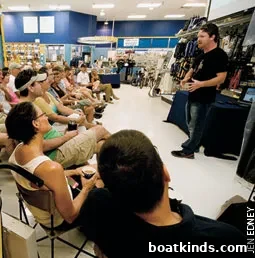
Although he’s best known for solo exploits, Rutherford is calm and effective in public, delivering candid, well‑prepared talks that blend seamanship advice with stories from harsh seas. He’s not slick; he comes across as genuine, prepared and engaging. He reminds audiences that no one is fearless — “you have to control fear or it will control you” — and he uses dry humor alongside hard‑won lessons in tiny‑boat survival.
Audience members respond. After a presentation at West Marine in Annapolis, Mark van Emmerik called Rutherford “a great conversationalist” and praised his practical advice on outfitting and seamanship. Rutherford now supplements his sailing with public speaking, meeting diverse crowds from schoolchildren to corporate groups, and using each appearance to educate, inspire and build momentum for future projects.
His seamanship grew from a string of earlier adventures. He rode a bicycle through Laos, Cambodia and Vietnam, crossed the Atlantic twice in a Pearson 323, and navigated 200 miles up the poorly charted Gambia River. Those experiences — improvisation in unfamiliar places and feeling his way through fog and ice — helped prepare him for the Arctic’s poorly charted northern waters.
Rutherford’s path to sailing was not straightforward. Raised in Ohio, he bought his first boat, a 1969 Coronado 25, online for $2,000, then lost it in Florida during the 2004 hurricane season. Self‑taught and persistent, he learned through mistakes: he ran aground, ripped sails, and rebuilt himself through hard experience.
His life before sailing was tumultuous. He grew up in a religious group called Truth Fellowship; when his parents left the group and later separated, he became angry and rebellious, dropping out in eighth grade. By 16 he had been jailed and rehabbed multiple times. A pattern of repeated incarceration finally prompted self‑reflection — a turning point that led him to pursue education and a different life.
Rutherford earned the chance to reset at Eagle Rock School in Estes Park, Colorado, an alternative residential high school where he completed his education at age 20 on a full grant. Over time he reconciled with his family; after his first solo Atlantic crossing in 2008 he even called his mother from a phone booth in England for weather updates as he prepared to navigate an uncertain coastguard situation.
Keeping the momentum
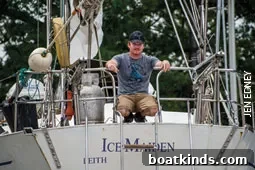
Rutherford uses each success to build the next. After the circumnavigation he founded the Ocean Research Project, a nonprofit focused on science and education that sprang from ideas he formed while crossing Arctic waters. He hopes to re‑create Shackleton’s James Caird voyage and is pursuing use of a 54‑foot steel sloop, Ice Maiden, to gather scientific data and film documentaries in remote regions.
His planned projects include trips to the Arctic to monitor permafrost drilling impacts, investigations of the Great Pacific Garbage Patch, surveys of Micronesia’s threatened reefs, and Antarctic research. Financial and logistical details are still in development; Rutherford envisions partnerships that trade documentary rights for access to the vessel, allowing him to continue fieldwork over the next several years.
Whether Rutherford will top his Annapolis‑to‑Annapolis feat or shift into a new role as expedition leader remains to be seen. Success will require him to move from lone adventurer to a leader who can manage teams and human dynamics while nurturing momentum. He recognizes the fine line between confidence and hubris: “Granted, I kicked down the door, so here I am,” he says with a laugh. “But I have to keep my momentum. If I just sit around, drink beers and bullshit, it will all be gone.”
Despite long odds, his track record suggests he’s capable of overcoming obstacles. Supporters admire how he defeated earlier demons and then the sea. “I think he’s a little crazy,” observed Sandra Peel after one of his talks. “But he’s exciting to listen to because he shows you can succeed without everything being perfect.”
Dieter Loibner is sailing editor for Soundings.
October 2012 issue