
A TowBoatU.S. operator went from rescuer to the subject of a multi-agency search after his own towboat capsized in the St. Augustine Inlet off Florida’s northeast coast.
It had been more than three hours since the sea rolled Norm Manley’s towboat and threw him into the inlet. The 60-year-old TowBoatU.S. operator had left the dock at 5 a.m. on Nov. 29 in a 24-foot Wellcraft to assist a three-person crew on a 48-foot sailboat that had run aground. What began as an evaluation quickly turned into an urgent rescue attempt, and Manley ultimately became the one who needed saving.
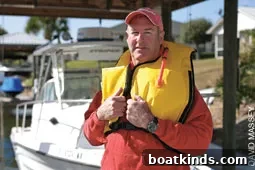
Manley, who has worked as a towboat operator with the St. Augustine TowBoatU.S. franchise for three years, says conditions deteriorated as he began towing the sailboat out of the inlet. He describes a sudden roll: “I don’t know what happened. … A rolling wave or something came underneath me, and before I knew it the boat just went over on the port side.” His 250-hp Yamaha-powered vessel capsized and sank about a minute after he started pulling the sailboat toward the channel.
Thrown into the water with his life vest auto-inflating, Manley grabbed the VHF microphone and called mayday as the boat went under, but the mic was ripped from his hand and his distress call was never heard. It was the sailors on the grounded boat who alerted the Coast Guard and local search-and-rescue agencies when they noticed the tow line but could not find the towboat or its operator, Coast Guard Cmdr. Patrick Schreiber later confirmed.
Manley kicked away from the sinking craft to avoid getting tangled in lines and began drifting out of the inlet. At 6 a.m. it was still dark, and spotlights from the sailboat failed to reveal his position. The sea state worsened, and conditions became increasingly dangerous.
Worsening conditions
As he drifted, Manley tried to stay calm and conserve energy. The water temperature was about 67 degrees, and despite wearing an inflatable PFD that provided roughly 35 pounds of buoyancy, he began to feel the effects of cold and exposure. “The first stage was, OK, I have to be calm and be patient, and someone will rescue me,” he says. “The second stage was, Oh no, I’m out of the inlet in the seas… And the third stage was, I don’t think I have enough time left – they’re not going to find me in time.”
Over the course of hours he battled 6- to 8-foot seas and 15- to 20-knot winds. Rescue teams from St. Johns County Fire and Rescue and the county sheriff’s office arrived around 6:30 a.m. and deployed an 18-foot rigid-inflatable boat (RIB) with a rescue swimmer, two personal watercraft, and a 12-foot Arancia 3.8 inflatable rescue boat. A sheriff’s office boat and helicopter, a Coast Guard helicopter and a 47-foot motor lifeboat also joined the search.
Visibility and surf made the search difficult. “The surf was real heavy,” says Jeremy Robshaw, the rescue swimmer aboard the RIB. Teams had limited information about Manley’s exact location and whether he was wearing a life vest, complicating the effort to locate someone in rough ocean conditions.
Manley began shivering and retching from cold and exhaustion. He vomited repeatedly and struggled to maintain orientation as currents carried him farther offshore. He drifted roughly a mile east out of the inlet, then about a mile south, ending up roughly a mile off Anastasia Island. At that point his mental focus started to fade and he had trouble picking out the direction of land.
Despite seeing flashing search lights, a helicopter and passing sportfishing boats, he remained unseen. “I was hoping they didn’t run me over,” he says. Thoughts of his wife Peggy and their family weighed heavily on him as he drifted and weakened.
Towboat resurfaces
Searchers in the sheriff’s helicopter located Manley’s towboat first: the bow was briefly visible above the surf, having apparently resurfaced and drifted in the same direction as Manley. The helicopter relayed the sighting to on-water rescuers, and two bystanders on a Honda personal watercraft—Tommy Orr and Jessica Earl—rushed toward the wreckage.
Earl and Orr found Manley about 100 yards from the submerged Wellcraft. He was alive but disoriented and barely able to recall events. Earl helped him onto a rescue sled attached to the PWC, and Orr headed directly to shore where emergency medical personnel were waiting.
Manley remembers first seeing the helicopter and then the PWC. “I thought it was a mirage,” he says. He relaxed only after being brought to the emergency room, overwhelmed by relief. At the hospital his body temperature registered 85 degrees; medical staff told him he had about 30 minutes of life left when they began treatment.
Cmdr. Schreiber credited the successful recovery to strong coordination among the Coast Guard and local agencies. “This was a successful rescue because of the partnerships we have with the local agencies,” he says.
The 1986 Wellcraft walk-around rose long enough to be seen and then disappeared again. TowBoatU.S. franchise owner Capt. Scott Stebleton said the boat had recently been refitted and was equipped with new towing lights, wiring, bilge pumps, batteries and a new lower unit. “It was a hell of a boat,” he said. Stebleton defended Manley’s decision to act without waiting for backup, calling him “a hell of a boat captain.”
Manley plans to continue working for TowBoatU.S., but he will avoid St. Augustine Inlet and focus on fair-weather operations out of Palm Coast, which lacks an ocean inlet. “I’m going to become more of a fair-weather captain,” he says. For Manley, the work was partly about enjoyment and being on the water rather than the pay.
This article originally appeared in the March 2011 issue.