
Docking a Single-Outboard Boat: Practical Techniques and Tips
Even though many boats today come with electronic helms, joysticks, bow thrusters, and automatic docking systems, a large number of vessels remain simple and mechanically driven. Walk any marina or boat show and you’ll find many modest boats powered by a single outboard. Some new boats omit advanced systems to keep costs down, and many used boats were built before those technologies were common. For both newcomers and experienced skippers, it’s useful to revisit the fundamentals of docking a single-engine boat.
Before you reach the dock, assess conditions and prepare your boat. Check wind direction, current strength and tide, and make sure lines and fenders are ready. If you’re in a tidal waterway with currents running parallel to the shoreline, it’s usually best to approach and tie up bow into the current. For example, on my 27-foot center console with a 300-horsepower outboard, I keep the boat in a slip on a tidal river. When the tide is incoming I approach the fuel dock on the port side; on an outgoing tide I approach on the starboard side. Planning your approach according to the direction of the current simplifies the maneuver and reduces stress.
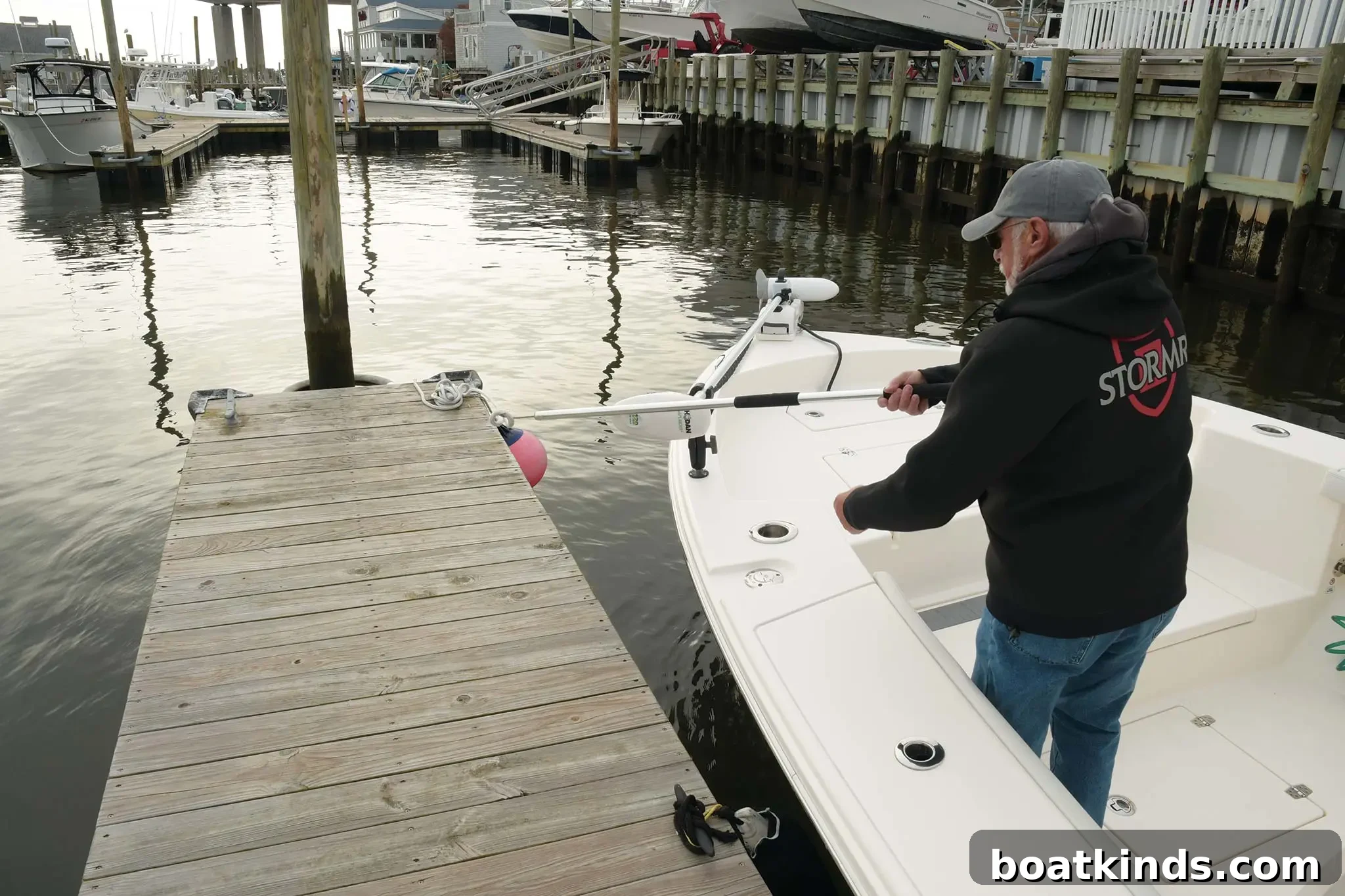
If the tide or current is pushing you away from the dock, prepare by attaching bow and stern lines on the side you’ll be tying up and hang fenders where the hull will meet the dock. Use the throttle and shift to feel how much power you need to hold position or move slowly against the current. With a single outboard, control is often achieved by repeatedly shifting in and out of gear at idle or low throttle—this “bumping” technique moves the boat in small increments and helps manage momentum. Always approach as slowly as possible; fine control beats force.
Wind plays a major role in how you approach. When wind and current are toward the dock, come in at a shallow angle—roughly 20 degrees. As you close, turn to parallel and let the wind or current push you gently into the dock. Use short bursts in gear to make small corrections, then secure bow and stern lines.
If wind or current is pushing away from the dock, approach more sharply—40 degrees or more—and stop when the bow is nearly touching the dock by reversing briefly. Secure the bow line first. Then use forward gear at idle while steering hard away from the dock to pivot the stern in, and secure the stern line once the boat is snug.
With negligible wind and current, docking is straightforward: approach slowly at a shallow angle, have a crew member step ashore to secure the bow line, then swing the stern in using a boat hook or line and tie it off. This method relies on minimal engine work and careful handline handling.
Casting off also depends on conditions. In calm conditions, simply release bow and stern lines, check that the channel is clear, and leave at a shallow angle. Pushing off manually from midships before shifting into gear can make departure easier.
When wind or current is strong toward the dock, you can use the bow line to help depart. Cast off the stern line first, reposition the bow line as a temporary spring, and keep a fender near the bow. Briefly apply forward gear while steering toward the dock to swing the stern clear, increase speed slowly until the stern clears, then release the remaining line, shift into reverse and back away until you have room to go forward and turn out.
If wind or current pushes away from the dock, take advantage of it: cast off both bow and stern lines and allow the boat to drift clear under control, then shift into forward when you have adequate separation.
Entering a Slip with a Single Engine
Backing into a narrow slip can be nerve‑wracking, especially with boats docked on both sides of a fairway. When entering the fairway, favor the up‑current side and proceed at idle. As you near the slip on the starboard side, reduce speed further by using neutral and position the boat perpendicular to the mouth of the slip. Begin the turn using the wheel and momentum—turn earlier if the wind is aft, later if it’s on the bow—so wind assists the alignment.
Think of the slip approach like a three‑point turn: use the wheel along with forward, reverse and neutral to inch the boat into the berth. Once positioned, back in slowly staying close to the finger pier where bumpers or fenders are located. Attach a spring line first to stop the stern from drifting and to prevent a collision with the main dock, then secure stern lines and lastly the bow line.
One last tip: Never approach faster than you are willing to hit the dock. Go slow, use neutral freely, and control movement by bumping the engine in and out of gear. With practice, these techniques become intuitive and docking a single‑outboard boat gets much easier and safer.
February 2025