Sail Scene
New York’s Capozzi comes up short in Osprey Cup
The 2008 Rolex Osprey Cup, one of only two ISAF Grade 1 women’s match racing events in the United States, was contested October 22–25 at the St. Petersburg Yacht Club in Florida. Italy’s Giulia Conti captured the title, defeating Debbie Capozzi of Bayport, New York, in the final. The event was sailed in Sonar-class keelboats, with four-person crews and a first-to-win-three final match format.
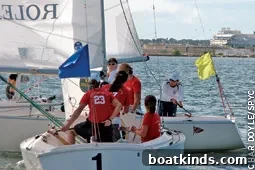
Conti sailed with Alessandra Marenzi, Alessandra Angelini and Giovanna Micol and the regatta schedule included a total of 78 matches on Tampa Bay. Conti, who had previously won the Rolex Osprey Cup in 2005 and finished runner-up in 2007, posted seven wins during the round robin despite limited time focused specifically on match-racing.
“I came here because I wanted to enjoy the environment, despite zero training,” Conti said. “So my expectations were far from the victory, but my heart and my mind were far from giving up. I have to confess also that inside me I was feeling that I needed a good performance after missing a medal in China in spite of my expectations there.” Conti and crew member Giovanna Micol also compete together in the Olympic 470 class.
The semifinal round produced notable upsets. Conti eliminated one of the pre-regatta favorites, 16th-ranked Brit Lucy MacGregor, the 2008 European champion. In the other semifinal, Capozzi advanced by defeating Claire Leroy of France, the reigning ISAF Women’s Match Racing world champion and the world’s No. 1 at the time.
Debbie Capozzi, who represented the United States at the 2008 Olympics in the Yngling class, acknowledged a steep personal learning curve during the event. “I have not steered much the past couple of years so my learning curve was high,” she said. Capozzi credited her talented crew — Genny Mulloch, Molly O’Bryan and Derby Anderson — for handling the many tasks that allowed her to concentrate on steering and tactics.
In the petite final to determine third and fourth place, Claire Leroy defeated Lucy MacGregor 3-1. Among other U.S. competitors, Katy Lovell of New Orleans finished sixth; JoAnn Fisher of Annapolis, Maryland, placed eighth; Rachael Silverstein of St. Petersburg finished ninth; and Sandy Hayes of Scituate, Massachusetts, took tenth.
Dinghy sailors handle big boats in college regatta
The Intercollegiate Offshore Regatta returned to Larchmont Yacht Club on Columbus Day weekend with increased participation and very nearly a full fleet of borrowed boats. This year’s event grew from 235 to 318 college sailors and expanded its borrowed-boat fleet from 31 to 36. Twenty-nine different colleges and universities were represented, prompting longtime host Larchmont Yacht Club to formally join forces with the event organizer, the Storm Trysail Club, to manage what has become the largest college big-boat regatta in the country.
Owners of the borrowed boats served as on-board coaches, giving collegiate crews practical instruction and supervision while providing students with hands-on experience in larger keelboat racing. For many dinghy sailors, the regatta offers a valuable change of perspective and an opportunity to develop broader seamanship and leadership skills.
“The opportunity for college sailors to experience a different perspective on the sport is invaluable,” said Jesse Fielding of the University of Rhode Island sailing team. “The responsibility of looking after a boat, a crew and an owner are skills that lifelong sailors need to have.” Fielding was one of two University of Rhode Island team members who participated in the 2008 TransPac Race as part of Roy Disney’s Morning Light campaign; he and teammate Robbie Kane sailed aboard Richard du Moulin’s Express 37, Lora Ann, alongside other URI sailors.
Boat owner Richard du Moulin praised the University of Rhode Island crew for strong leadership and notable downwind technique. “I gave them some tips on how to sail upwind faster, but I sat back and took lessons watching them sail my asymmetrical rig downwind,” he said. “The Morning Light experience gave these kids incredible downwind steering technique, which is why we won four out of five races.”
Fleet divisions included four one-design classes and a PHRF division. The PHRF class was the largest, with 12 boats rated between 72 and 87 — eight of them rating 72 — followed by an 11-boat J/105 class. Class winners were: U.S. Coast Guard Academy in the J/44 division; Georgetown University in the J/122 division; Massachusetts Maritime Academy in the J/109 division; University of Rhode Island in the PHRF division; and Cornell University in the J/105 division.
The overall event winner, determined by best winning percentage across five races, was Massachusetts Maritime Academy sailing Rick Lyall’s J/109 Storm. The school became the inaugural recipient of the Paul Hoffmann Trophy, a new perpetual award donated by the family of Paul Hoffmann, Jr. in memory of his father, a past commodore of the Storm Trysail Club and longtime Larchmont Yacht Club member.
See the world
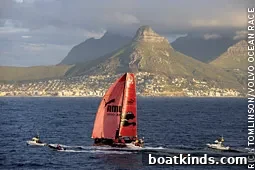
In ocean-racing news, Puma Ocean Racing, skippered by Newport, Rhode Island sailor Ken Read, finished second in the first leg of the Volvo Ocean Race after a demanding 6,500-mile duel with leg winners Ericsson 4. Puma crossed the finish line in Cape Town, South Africa, and earned valuable points for the leg, moving the team within a single point of the overall race lead. The 2008–09 running of the Volvo Ocean Race is a long offshore marathon covering about 37,000 nautical miles and visiting multiple ports worldwide over nine months, including a scheduled stop in Boston.