
LYMAN-MORSE
Lyman-Morse is a Maine boatbuilder that has embraced diversification while maintaining a strong boatbuilding core. Since Drew Lyman succeeded his father Cabot as president in 2013, he and his wife Mackenzie have expanded the company’s capabilities beyond traditional boatbuilding to make the business more resilient. Despite those additions, Lyman-Morse continues to produce high-quality custom and semi-custom boats from its sheds on the coast.
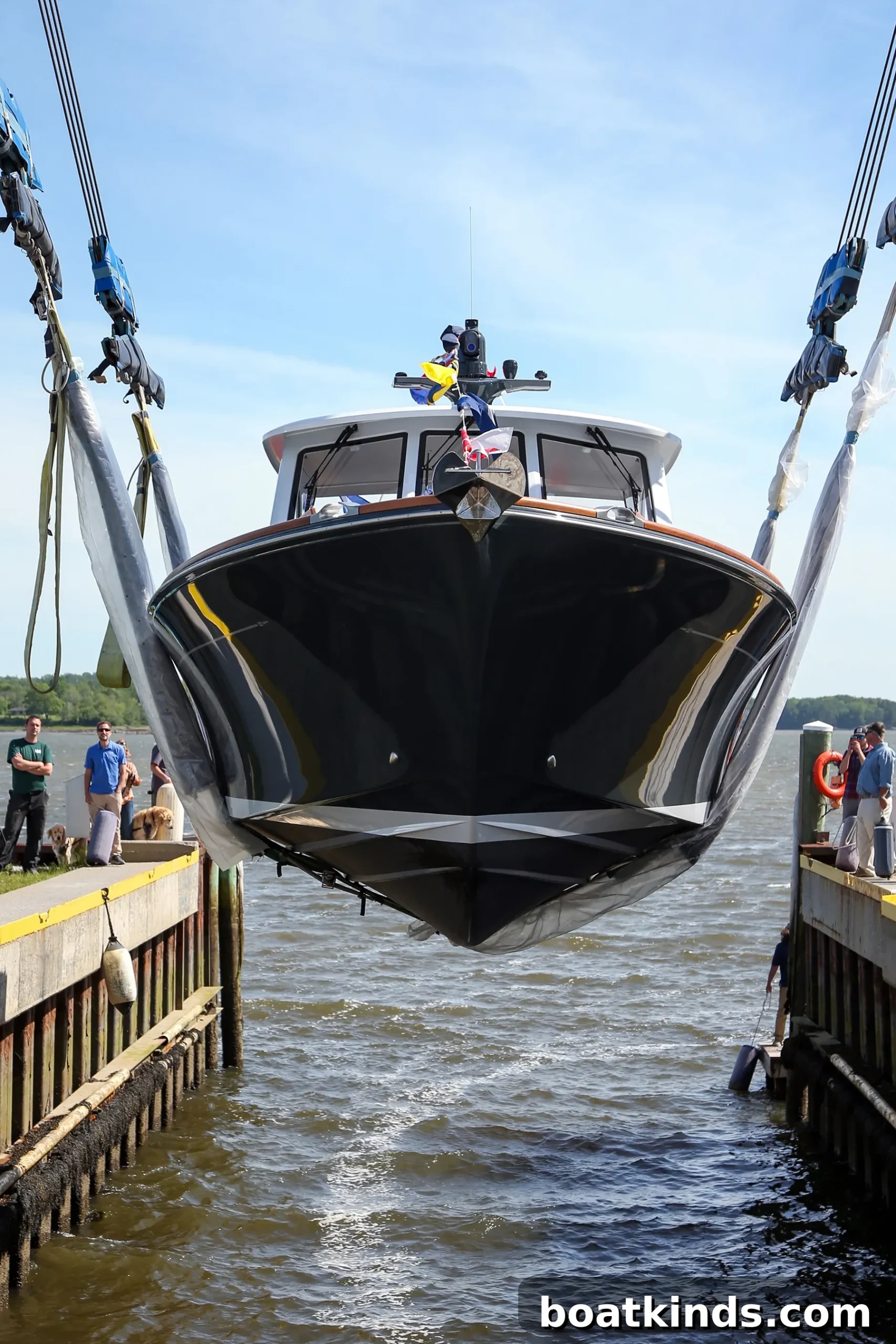
In early June the yard launched and sea-trialed the first Hood 35, an express version of the new C.W. Hood design. This vessel will be the first recreational boat equipped with military-grade controls for the Hamilton HJX29 water jets, using Hamilton’s intuitive “boat mouse” control. Shaped like a small boat, the device lets the operator move the vessel by directing the mouse to the desired position. With twin 480-hp Yanmar engines, the Hood 35 exceeded 40 knots during its initial sea trial.
The owner, a technology executive, requested a New England aesthetic combined with the latest onboard systems. The 35’s cold-molded wood-composite hull blends Douglas fir and Western red cedar, and the boat integrates drone controls, remote video cameras and autonomous-capable systems. A FLIR camera with motion tracking can identify and follow objects in the boat’s path, even birds. The console draws inspiration from automotive tech design, and the berth slides fore and aft on a finger-jointed panel developed with input from the owner. Hull No. 2, a flybridge variant, is already under construction and destined for a client in Florida.
At the same time, Lyman-Morse is building an Express version of the Hunt-designed Monhegan 42, a hull the yard has produced before, and has another collaborative project with Hunt scheduled for announcement in September. The yard also recently completed two semi-custom LM46 sailboats; Hull No. 2 launched in April with a racing keel and advanced sail inventory and immediately set the fastest elapsed time in May’s 140-nautical-mile Sam Wetherill Trophy Overnight Race, an early preparation event for the Bermuda Race.
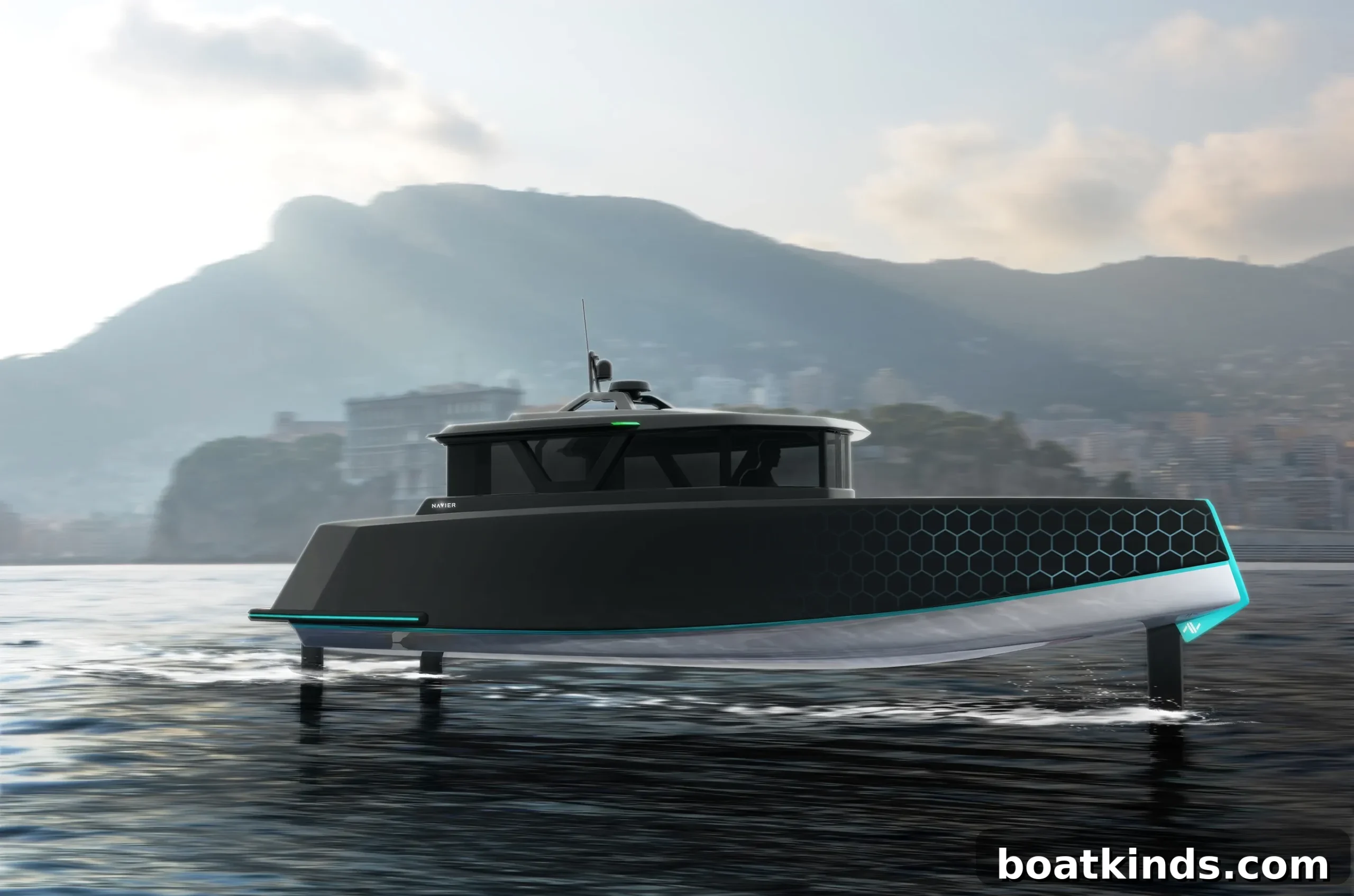
Perhaps most notable amid the rise of electric propulsion, Lyman-Morse was contracted by Silicon Valley start-up Navier to build the first two Navier 27 foiling electric boats. In May the composite Hull No. 1 received its paint finish while Hull No. 2 was in the mold. Navier supplies the foils and electric drive units; Lyman-Morse handles the structural build and systems integration. The team is aiming to complete Hull No. 1 in time for the Fort Lauderdale International Boat Show. With sailboats, traditional powerboats and cutting-edge electric foilers underway, Lyman-Morse’s portfolio is broadly diversified across modern boatbuilding disciplines.
FRONT STREET SHIPYARD
Belfast’s Front Street Shipyard followed a busy launch season last year—including a pilotboat-to-mailboat conversion and a new 30-foot Holland lobster boat powered by a 300-hp Yamaha outboard—by starting three new-build projects this season. The yard continues to support both commercial and recreational boatbuilding with a mix of custom and production work.
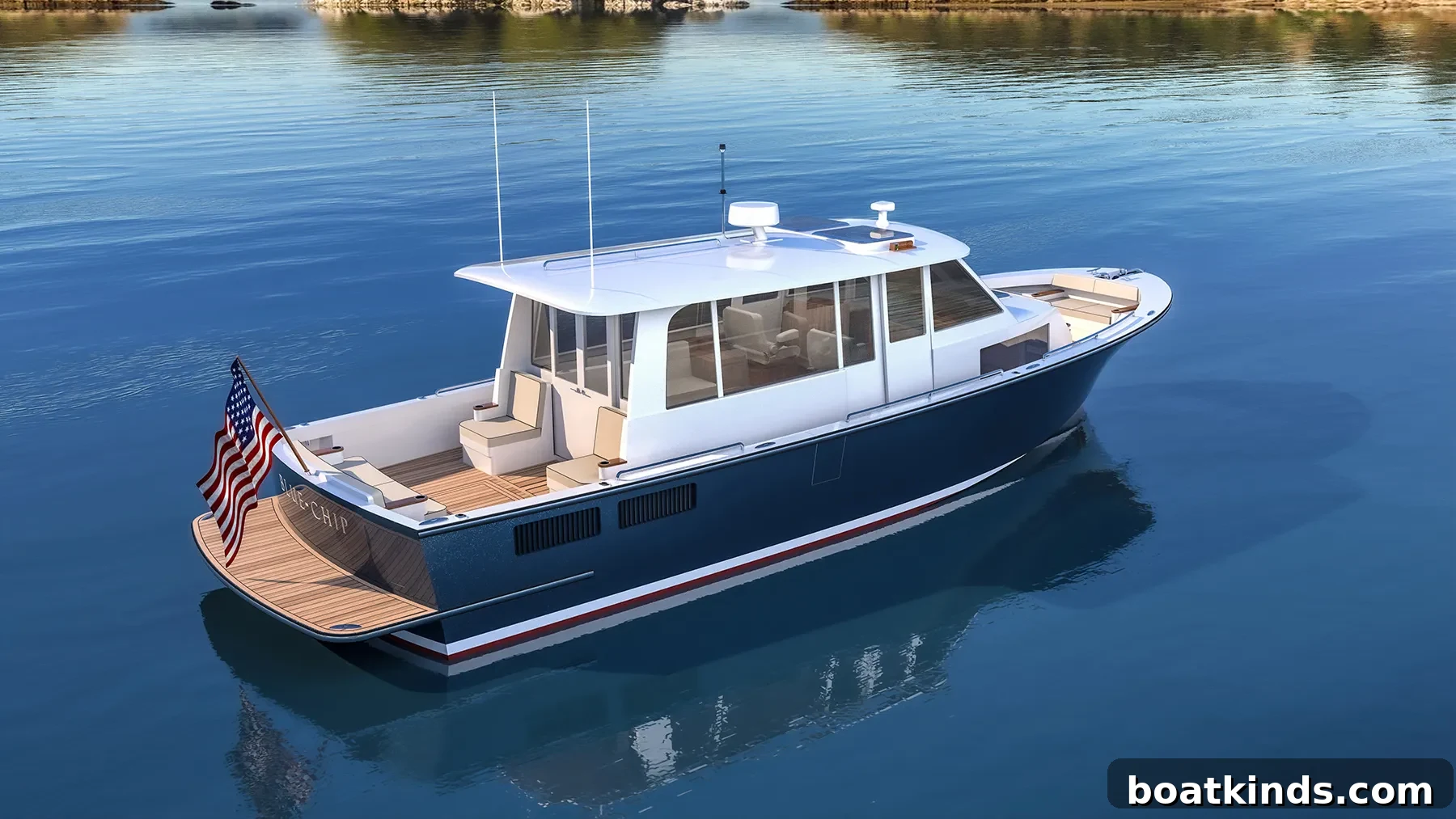
In Building 5 a Ray Hunt–designed 41-foot dayboat with a deep-V composite hull and understated, conservative styling is nearing completion. The owner plans to use this “modern classic” for entertaining and occasional sportfishing in New England. The open cockpit prioritizes socializing with generous seating, a hidden fish box and recessed rod holders. Below deck the cabin includes a berth and a head with an enclosed shower for occasional overnight stays; interior finishes feature an oiled teak sole and varnished cherry cabinetry that contrasts with white bulkheads.
The hull topsides and deck employ cored fiberglass for lighter weight and strong performance. Measuring 41 feet, 6 inches LOA with a 13-foot, 6-inch beam, the boat will be powered by twin Volvo Penta D6-IPS 650 drives, and is expected to cruise at 32 knots with a top end near 38 knots. Alongside the Hunt dayboat, two Mussel Ridge hulls are progressing: a 46-foot commercial fishing boat and a 42-foot recreational version scheduled for launch in 2023.
At Front Street’s Bucksport facility, hulls and decks are being laid up for other builders, including SW Boatworks’ 42- and 44-foot models and the popular Crowley 36 lobster boats. The shipyard also brought an inland solar array online recently; on sunny days it generates roughly 2,000 kilowatt-hours, supplying about 40–45 percent of the yard’s electrical needs and reducing operational costs while supporting sustainable shipyard operations.
BROOKLIN BOATYARD
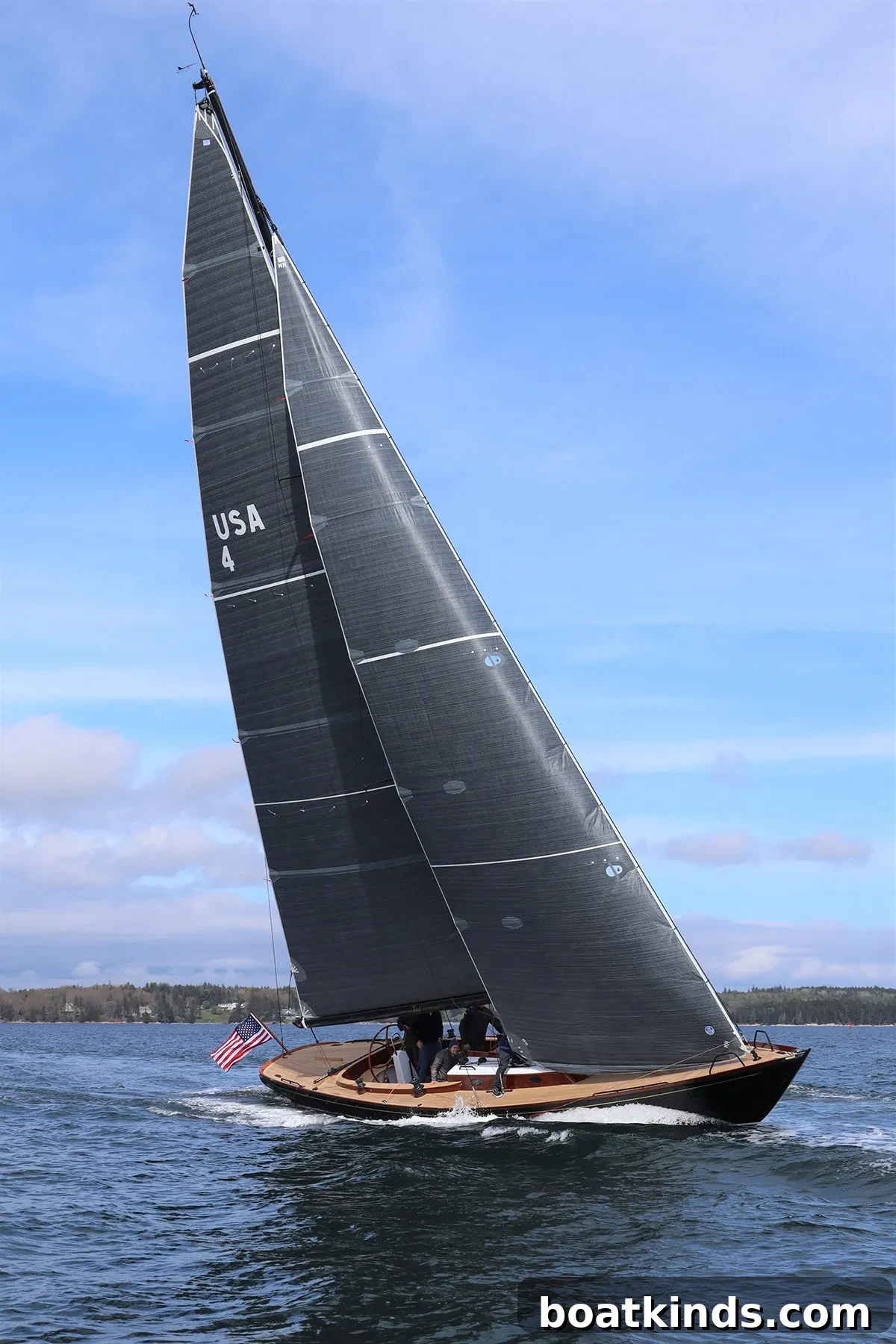
Brooklin Boat Yard (BBY) continues to produce elegant sailboats and refined powerboats rooted in traditional aesthetics and modern construction. This spring BBY launched the first Eggemoggin 47 Plus racing daysailer. The original Eggemoggin 47, penned by former BBY in-house designer Bob Stephens, debuted in 2001; subsequent modified versions were introduced in 2012 and 2013. The new 47 Plus, named Tink and designed by BBY’s current in-house designer Will Sturdy, represents a more significant evolution of the concept.
Sturdy, who often sails the earlier-generation 47s, increased the 47 Plus’s righting moment by roughly 30 percent with a broader beam, revised rig and updated foil configuration. The hull uses carbon fiber and wood for a lightweight, low-displacement structure; the standing rigging and spar are carbon, and the boat carries an 8-foot-6-inch fin keel with a long-spade rudder. A LiFePO4 (Lithium Iron Phosphate) battery system powers electric sailing auxiliaries, including motorized travelers and winches, reflecting the growing role of electrification in performance sailboats.
“It started as an evolution,” Sturdy says of the 47 lineage. “The boats share an aesthetic, but the 47 Plus has a distinct, more performance-oriented character.”
BBY’s next new sailboat is in final design: a 43-foot day racer by the respected Spanish firm Botin Partners. The Spirit-of-Tradition sloop is moving toward materials assembly after a completed cockpit mock-up. Meanwhile the yard remains active in powerboat construction: last year BBY delivered the BBY 32 Express Cruiser, a 34-foot, 2-inch LOA Downeast-style boat with twin outboards. A second BBY 32—configured as a center-console with a single 300-hp outboard—is under construction and available for sale. Both BBY 32s use a super-ultralight hard-chine cold-molded hull sheathed in sapele plywood.
On the drawing board are a classic-style lobster boat and a striking 36-foot Express Cruiser with flybridge powered by twin outboards—projects that reflect BBY’s ability to bridge traditional forms and modern systems in both sail and power markets.
HODGDON SHIPBUILDING
Hodgdon’s history stretches back to 1816, when Caleb and Tyler Hodgdon expanded their sawmill into boatbuilding by founding Hodgdon Brothers in East Boothbay, Maine. Over generations the family produced schooners, naval patrol craft and yachts designed by some of the era’s leading naval architects.
Tim Hodgdon, the company’s fifth-generation president, guided the firm toward the superyacht market in the early 1980s. Hodgdon Yachts built notable sailing vessels such as the 124-foot sloop Antonisa, the 154-foot ketch Scheherazade and the 100-foot Comanche. Comanche was built for speed and set remarkable records, including covering 620 nautical miles in 24 hours and winning the 2015 Sydney to Hobart Race.
Since Comanche’s 2014 launch, Hodgdon has emphasized Hodgdon Yacht Services in Southport—supporting roughly 250 boats a year and hosting dealerships for Yamaha, Suzuki and Highfield inflatables—its Boothbay waterfront facility, and production work in Damariscotta. The company also produces luxury tenders, ranging from 6.5 to 12 meters, including the Michael Peters–designed Beachlander series that can nose ashore and lower a beaching bow for easy access. Recent Beachlander models include a 10.5-meter and a 10.8-meter launch; another tender is scheduled for delivery to the Netherlands.
Because many tender clients are superyacht owners and military customers who value discretion, Hodgdon has largely operated away from the spotlight since Comanche’s launch. That changed this spring when Audrey Hodgdon, the sixth generation active in the business, announced that Hodgdon will build the all-electric Vita Lion for UK-based Vita Yachts.
The Lion will be Vita’s flagship: a sleek 34-foot-5-inch plan by Milan studio BorromeodeSilva. Designed to reach more than 35 knots and cruise at roughly 24 knots, the boat will use Vita’s V-4 propulsion system with proprietary throttle and touchscreen controls and high-speed charging capable of achieving up to 90 percent state-of-charge in under an hour. Configured for comfort and social use, the Lion accommodates up to eight guests in a versatile cockpit that can convert for dining; forward is an enclosed cabin with a day berth, head and storage, plus an integrated sound system. Vita planned sea trials in Southern France this summer.
SABRE YACHTS
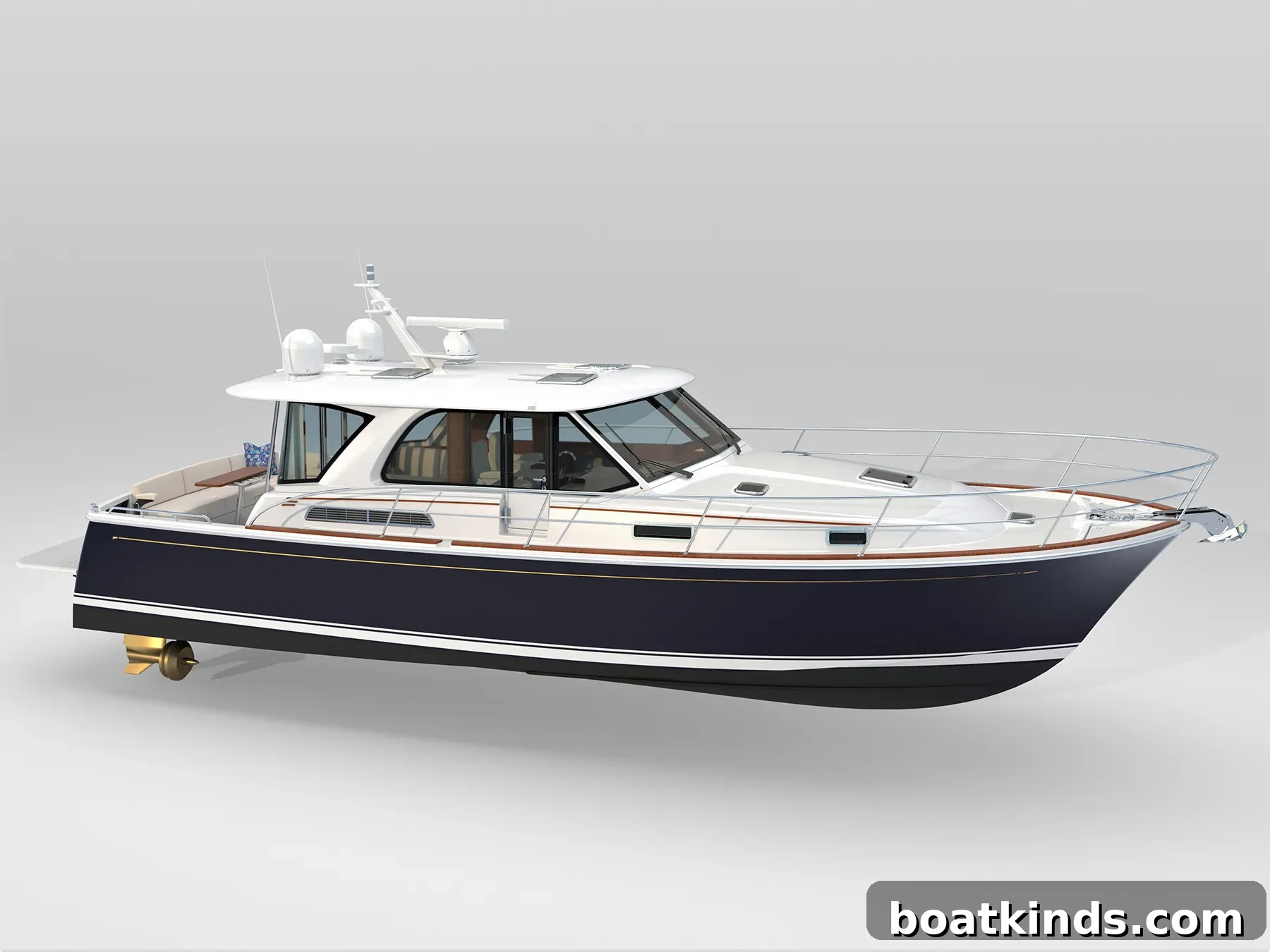
Sabre Yachts has long focused on the mid-40-foot market, beginning with the Sabre 42 in 1987 and subsequently producing 15 models in the 40–45-foot range. The new Sabre 43 Salon Express replaces the retired Sabre 42 Salon Express as the company’s latest Downeast-inspired design with contemporary updates.
Although a clean-sheet design, the Sabre 43 remains true to the brand’s Downeast heritage while adopting modern lines: a revised mast profile, large fixed glazing, a helm door and gentle deck rails that refresh the silhouette but still read as Sabre. The 43 will be the first fully networked Sabre under 58 feet, enabling owners to monitor and control key functions and circuits via helm MFDs or an iPad mini. Systems include lighting control, telematics for GPS monitoring, geofencing, trip logging and NMEA 2000–based alarms accessible remotely through Sentinel Telematics.
The interior layout features a salon with two long seating banks over six feet, a half-up galley and a below-deck “Hybrid Lounge” that can serve as a guest berth, private retreat or home office. The master stateroom includes an island berth and American cherry storage. A versatile utility space beneath the salon sole can accommodate a washer-dryer pair, wine cooler or additional storage, depending on owner preferences.
Propulsion comes from twin Volvo Penta IPS-500s with D6 380-hp engines, complemented by Volvo-Penta automatic Interceptor trim tabs for a smoother ride. Twin Stidd helm seats and joystick controls integrated into the armrest aim to make long passages comfortable and docking straightforward. The Sabre 43 Salon Express was slated to debut at the 2022 Newport International Boat Show.
This article was originally published in the August 2022 issue.